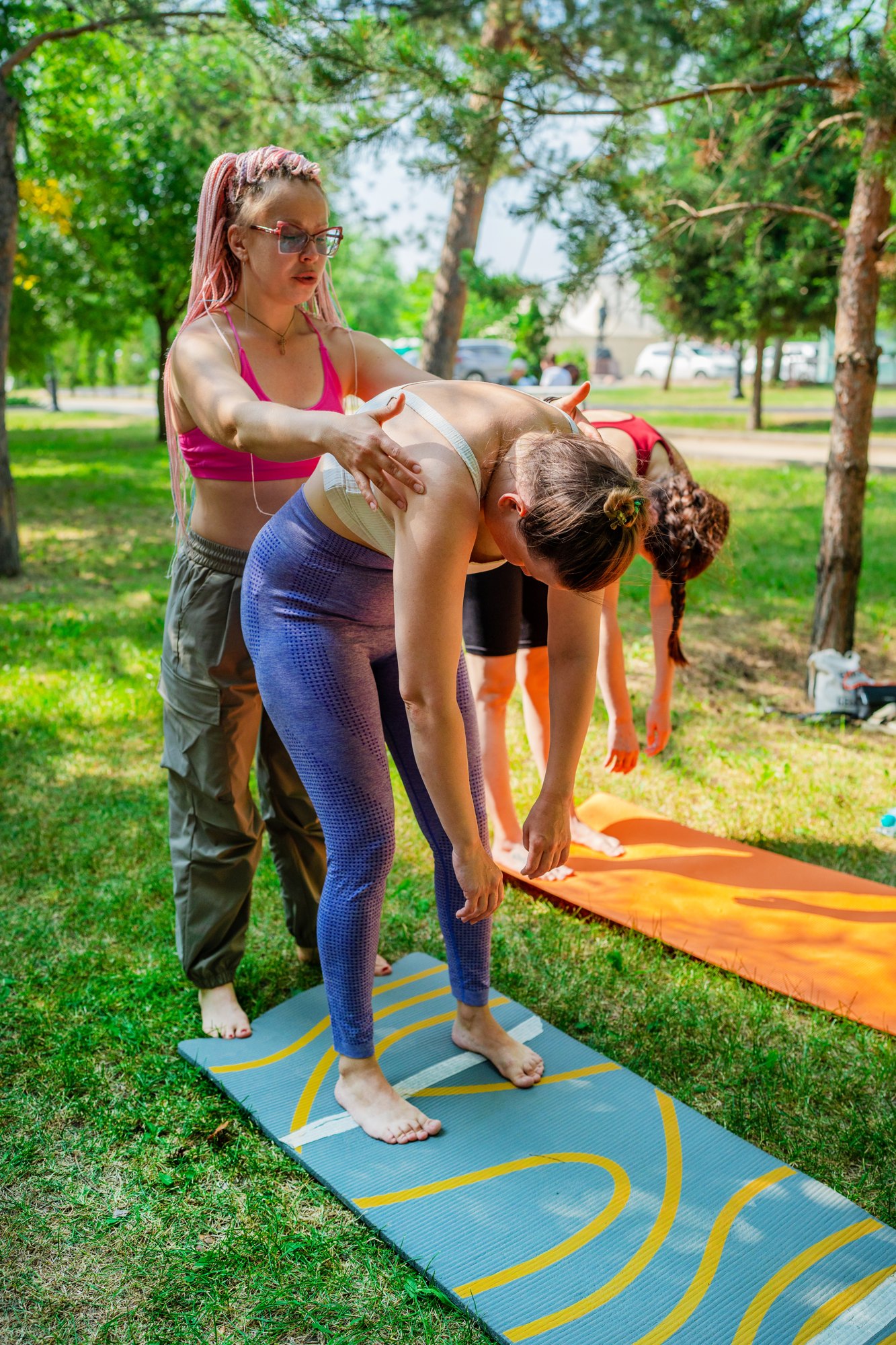
In short: yoga teacher training (often shortened to YTT) is a structured course that teaches you how to practise more deeply and how to teach others safely. Most people start with a 200-hour program, then may add 300 hours of advanced study. A school’s certificate, registration with an association such as Yoga Alliance, and any legal rules where you teach are three different things, and no single credential is required or sufficient everywhere.

Thinking about yoga teacher training? Maybe you want to teach, or maybe you simply want to understand your own practice from the inside. Both are good reasons, and plenty of people who finish a training never teach a public class. This hub explains the paths (200, 300 and 500 hours), the formats (in person, online, hybrid, intensive or spread out), what the letters after a teacher’s name really mean, how to choose a school and what training usually costs. Every guide here is researched from the organizations that set the standards, and we say clearly where a rule is a school’s own policy, an association’s standard or a law.
Start here: three steps
- Check your why and your practice. Most schools expect a steady personal practice before you enroll. If you are still finding your style, compare the main types of yoga first; the style you love will shape the training you choose.
- Learn what a 200-hour course covers. Read our guide to 200-hour yoga teacher training: the curriculum, intensive vs part-time formats, costs and the questions to ask any school.
- Understand credentials before you pay. Our explainer on Yoga Alliance, certificates and the law separates a school’s certificate from registry membership and from legal requirements, so you know exactly what you are buying.
Training paths: 200, 300 and 500 hours
The hour numbers you see everywhere come from the standards of Yoga Alliance, a US-based membership association for yoga teachers and schools that launched its registry in 1999. They are not a law, but they have become the common language of yoga teacher training around the world.
- 200 hours: the foundation. Yoga Alliance describes it as the foundational training covering techniques, anatomy, philosophy and professional skills, and notes that most new teachers begin here. See our 200-hour guide.
- 300 hours: advanced study. A second training taken after a 200-hour course, focused on refining teaching, sequencing and specialist topics. Our guide to 300-hour yoga teacher training covers prerequisites and what changes.
- 500 hours: two routes to the same total. Yoga Alliance lists two ways to reach the 500-hour level: complete one 500-hour program at a single school, or complete a 200-hour program and then a separate 300-hour program.
- Specialist trainings. Yoga Alliance also registers prenatal and children’s yoga trainings. Teaching pregnant students calls for specific knowledge; our prenatal yoga guide explains why.

Formats: in person, online and hybrid
You can train in a studio near home over several months of weekends, in a three- or four-week intensive at a retreat center, fully online or in a mix of both. Yoga Alliance’s current standards let its registered schools teach entirely in person, entirely through distance learning or in a blend, as long as at least 15% of program hours are delivered live (teacher and students together in real time). Read online yoga teacher training for what works well on screen and what to check before you enroll.
Training abroad turns the course into a journey, and many people combine it with a longer stay. Popular places include Bali, India and Costa Rica; see teacher training in Bali, teacher training in India and teacher training in Costa Rica, and our destination guides for yoga in India and yoga in Bali for the travel side.
Credentials explained in one minute
Four different things often get blurred together in course marketing:
| What it is | Who gives it | What it tells you |
|---|---|---|
| Certificate of completion | The school that trained you | You finished that school’s program and met its assessment |
| Registration (for example RYT 200 or RYS 200) | A membership association such as Yoga Alliance | The program or teacher meets that association’s published standards; Yoga Alliance calls its registry voluntary |
| “Accredited” or “certified by…” | Whoever the school names | Ask by whom and check the claim in that body’s public directory |
| Legal requirements | Governments, employers and insurers | Vary by country, state and workplace; no single yoga credential is required everywhere |
The full explanation, including what RYT and RYS stand for and how continuing education works, is in yoga teacher credentials explained. For quick definitions, see the glossary entry RYT and RYS.

How to choose a school
- Lead trainers: who actually teaches most of the hours, how long they have taught and in which tradition.
- Curriculum: a written breakdown of hours by subject, including anatomy, philosophy (for example the yamas and the wider yoga philosophy), breathing practices such as pranayama, and supervised teaching practice.
- Assessment: how the school decides you are ready to graduate. Yoga Alliance’s standards say schools should not graduate trainees simply because they attended.
- Group size and contact time: how many trainees per trainer and how many hours are live.
- Ethics and safety: a written code of conduct, consent around hands-on adjustments and a clear complaints route.
- The fine print: refund and cancellation terms, what accommodation and meals include, and any extra fees.
If you are not sure you are ready to teach, a yoga retreat or a few months of regular classes can be a gentler next step. Our guide on how to become a yoga teacher covers the whole path, from practice to first classes and realistic income.
What yoga teacher training costs
Schools set their own prices. Yoga Alliance gives a typical range of about USD 1,500 to more than USD 5,000 for its registered schools, depending on length, location and format. Residential trainings abroad usually add accommodation, meals and flights; online courses usually cost less but may not include the in-person feedback you want. If you plan to register with Yoga Alliance afterward, budget for its own fees too: as of October 2026 it lists a one-time USD 50 application fee and USD 65 a year for teacher membership.
Find a program
Our teacher training directory lists programs only after we have checked them with the school, and shows each school’s credential claims next to the public record we checked them against. We never publish a program, a price or a date we have not confirmed. Read how we work in our editorial standards.
Frequently asked questions
Do I need a certification to teach yoga?
It depends on where and for whom you teach. Yoga Alliance describes its registry as voluntary, and it is a private association, not a government licensing body. Many studios, gyms and insurers do ask for a 200-hour training or a registry credential, so check with the places you hope to teach and any local rules.
What is the difference between RYT 200 and a 200-hour certificate?
The certificate comes from the school that trained you and shows you completed its program. RYT 200 is a registration with Yoga Alliance that you apply for after training at one of its Registered Yoga Schools; it carries annual membership fees and continuing education requirements.
How long does a 200-hour yoga teacher training take?
Intensives commonly run about three to four weeks full time. Part-time programs spread the same hours over several months of evenings and weekends. Online and hybrid formats vary.
Can I do yoga teacher training online?
Yes. Yoga Alliance's current standards let its registered schools teach in person, fully online or in a mix, as long as at least 15% of program hours are taught live. Check how much live feedback on your own teaching a program includes.
How much does yoga teacher training cost?
Yoga Alliance gives a typical range of about USD 1,500 to more than USD 5,000 for its registered schools. Residential programs abroad usually add accommodation, meals and travel.
Sources
- Explore Training Options, Yoga Alliance (accessed October 6, 2026)
- Meet Yoga Alliance (history), Yoga Alliance (accessed October 6, 2026)
- Standards for RYS Credentials, Yoga Alliance (accessed October 6, 2026)
- Yoga Alliance, Wikipedia (accessed October 6, 2026)
Facts checked on October 6, 2026