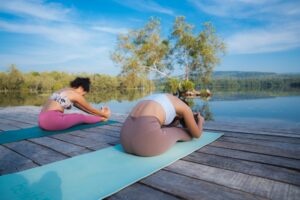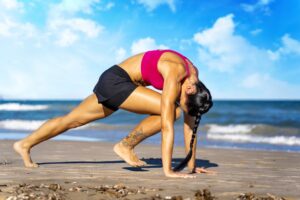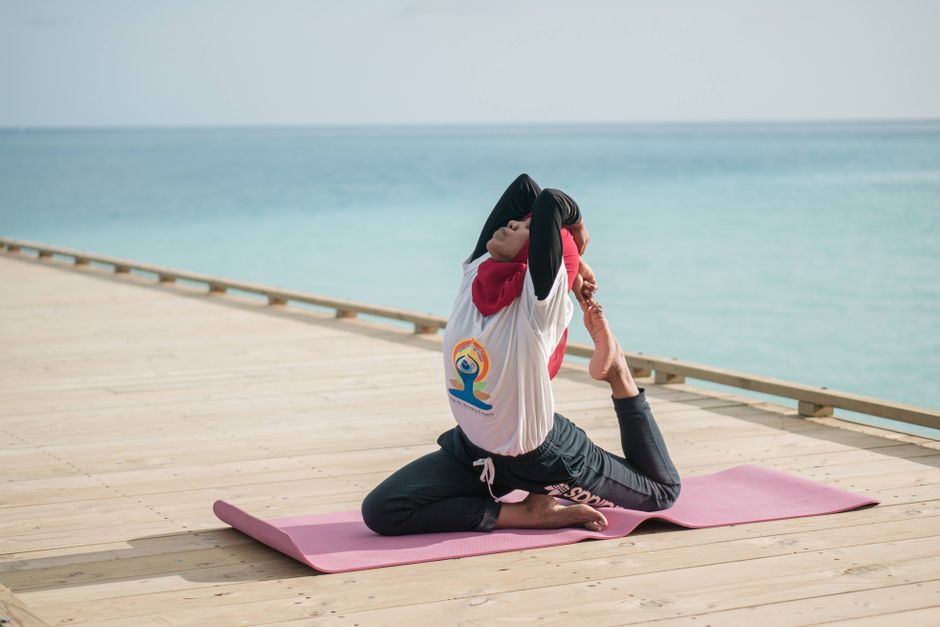
In short: pigeon pose is a floor hip opener in which the front leg folds across the mat and the back leg stretches straight behind you. It works the outer hip of the front leg and the front of the hip on the back leg. Go slowly, support the front hip with a blanket or block, and come out if you feel anything in the knee.
Pigeon pose turns up in almost every flowing class and in many slow ones, and it divides people: some find it the most satisfying stretch of the session, others find it awkward or uncomfortable. Hips differ a lot from body to body, and the pose works best when you shape it to your hips instead of copying the picture. Below, we explain the reasoning behind the steps, what the name means and where pigeon fits in a practice.
Making pigeon pose work for your hips
Pigeon asks two different things of the two legs. The front thigh rotates outward at the hip, which stretches the muscles at the back and side of the hip; the back leg extends, which lengthens the hip flexors at the front. Most trouble comes from the front leg. If the hip cannot rotate far enough, the knee twists instead, or the hip hangs in the air and the weight drops onto the knee. Two adjustments solve most of this: bring the front heel closer to your groin rather than forcing the shin parallel to the front of the mat, and fill the gap under the front hip with a folded blanket or a block. Our guide to yoga blocks explains the sizes, and a yoga bolster under the chest makes the folded version restful enough to hold for longer.
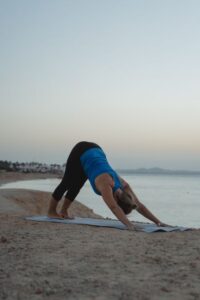
Many people come into pigeon from downward-facing dog, but you can start from hands and knees, which gives more time to place the front leg. If the floor version is not comfortable yet, the reclined figure-four stretch gives a similar outer-hip stretch with no weight on the knee, and a chair version, with one ankle resting on the opposite knee, works at a desk or when getting to the floor is hard (see chair yoga). Stay for about five slow breaths when you are learning. In slower classes you may hold for a minute or more; let the sensation be steady and bearable, never sharp, and keep the breath slow and low, as described in our guide to diaphragmatic breathing.
What the Sanskrit name means
The name breaks down into eka (one), pāda (foot), rāja (king), kapota (pigeon or dove) and āsana (a seat or posture; see our glossary entry on what asana means). The full King Pigeon is a deep backbend in which the back foot is drawn toward the head. The shape most classes call “pigeon” is a simpler variation of it, which Yoga Journal describes as the common version of One-Legged King Pigeon. A different and much deeper kneeling backbend is also called Kapotāsana, or pigeon, in some lineages, so if a teacher says “pigeon” in an advanced class, it is worth checking which one they mean.
Pigeon is a modern posture. It is not among the 15 postures described in the Hatha Yoga Pradipika, the 15th-century manual of Hatha yoga, and it spread with the 20th-century styles that grew out of Mysore, India. You will meet it today in vinyasa classes, where it is held for a few breaths, and in yin yoga, where a similar shape called swan is held for minutes.
Why the knee matters
Strong sensation in the buttock, outer hip or the front of the back hip is expected. Pain in the front knee is not: if you feel it, come out and use reclined figure four instead. Yoga Journal advises that people with knee or sacroiliac discomfort are best off avoiding pigeon, and warns that folding forward without careful alignment can put a lot of stress on the knee and sacrum. The US National Center for Complementary and Integrative Health notes that the knee and lower leg are among the most commonly injured areas in yoga, so this is a pose to approach patiently.
If you have a knee, hip or lower back condition, have had recent surgery or are pregnant, check with your doctor before practicing, and tell your teacher. Our guide to prenatal yoga covers adapting a practice during pregnancy. This page is general information, not individual advice.
Preparation, counterposes and what comes next
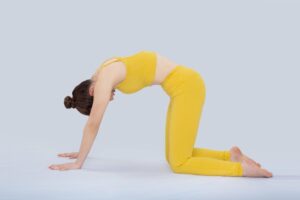
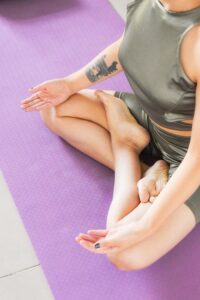
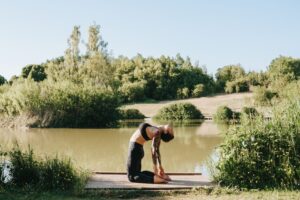
Warm up the hips and spine first: a few rounds of cat-cow, downward dog and reclined figure four are enough. Afterward, a few breaths in downward dog or lying flat in corpse pose lets the hips settle. If you enjoy the upright version, camel pose is a natural next backbend to explore, and lotus pose asks for even more outward rotation at the hip, so treat pigeon as preparation for it, not the other way round.
Pigeon appears in our yoga for flexibility plan, and you can browse more hip openers in the yoga pose directory. The Yoga Sutras describe posture as steady and easy; in Charles Johnston’s 1912 translation, “Right poise must be firm and without strain.” That is a good test for pigeon. Read more in our guide to the Yoga Sutras, or, if you would like a teacher to look at your pigeon in person, consider a retreat for beginners.