In short: box breathing is a simple counted pattern: breathe in for four, hold for four, breathe out for four, hold for four, and repeat. It is a modern technique, closely related to the equal-ratio breathing some yoga teachers use, rather than a classical pranayama. Keep the holds short and easy, and skip them altogether if holding your breath makes you uncomfortable.

Box breathing takes its name from the four equal sides of a square. You trace the box with your breath: in, hold, out, hold, each side the same length. Because it needs nothing but a quiet minute and a way to count, it has become a popular stress-management exercise, recommended by Cleveland Clinic and used in military training. This guide explains how to do it step by step, how to choose your counts, where the technique really comes from, what the research does and does not show, and who should leave out the breath holds.
What box breathing is
Box breathing is a four-part breathing pattern in which every phase lasts the same number of counts. Cleveland Clinic describes it as four counts in, four counts holding, four counts out and four counts holding after the exhale, and lists the other names you may hear for it: 4×4 breathing, 4-4-4-4 breathing, equal breathing, four-square breathing and square breathing. Researchers at Stanford describe it the same way, as equal inhalations, breath retentions and exhalations, and note that it is also called “tactical breathing.”
Two things make it different from simply “taking a deep breath.” First, you count, which gives the mind something steady to hold on to. Second, the pattern naturally slows you down: if each count lasts about a second, one full round takes around 16 seconds, which works out to roughly four breaths a minute.
How to do box breathing, step by step
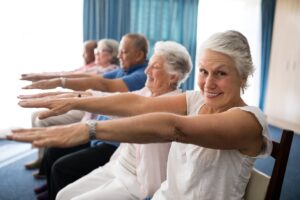
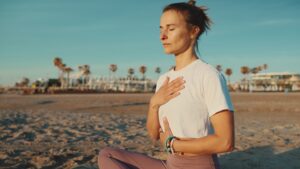
Sit in a chair with both feet on the floor, or sit on a cushion with your back comfortably upright. You can also lie down. Let your shoulders drop and rest your hands in your lap. Breathe through your nose if that is comfortable.
- Empty out. Breathe out slowly and gently, letting the air leave without forcing it.
- Breathe in for four. Count silently to four as you breathe in through your nose. Let the belly and lower ribs widen first; there is no need to fill up to the top.
- Hold for four. Pause with the air in. Keep the throat soft, as if you are simply waiting, not clamping shut.
- Breathe out for four. Release the breath smoothly over four counts.
- Hold for four. Pause with the lungs comfortably empty, again without strain.
- Repeat. Cleveland Clinic suggests three to four rounds to start, once or twice a day. When you finish, let your breathing return to its own rhythm for a few breaths before you get up.
If counting feels mechanical, picture each side of a square as you go: up the left side as you inhale, across the top as you hold, down the right side as you exhale, and along the bottom as you hold.
Choosing your counts
Four is a starting point, not a rule. The right count is one you can keep for several rounds without gasping, rushing the next inhale or feeling your heart speed up.
| Count per side | One round takes about | Good for |
|---|---|---|
| 3 | 12 seconds | First tries, or anyone who finds four too long |
| 4 | 16 seconds | The standard version, as Cleveland Clinic teaches it |
| 5 | 20 seconds | People who find four easy after some practice |
| 6 or more | 24 seconds or longer | Experienced practitioners only; keep the holds relaxed |
A useful test: if the inhale after a hold comes in as a grab rather than a smooth breath, the count is too long. Shorten it. Cleveland Clinic’s integrative medicine specialist makes the same point, advising beginners not to go too slowly or too quickly and to keep the breath gentle and free of strain.
You can also keep the box shape but shorten only the holds, for example four in, two hold, four out, two hold. Some people find that version a comfortable bridge, and it is the safer choice if holding your breath is new to you.
Where box breathing comes from
Box breathing is best understood as a modern technique. Its name and its reputation come from recent stress-management settings rather than from yoga texts: Stanford researchers note that it has been used by members of the military for stress regulation and performance, and Cleveland Clinic says it is employed by US Navy SEALs. We could not find a reliable source for who first coined the name “box breathing,” so we do not repeat the stories you may read online.
Yoga does have a long history of controlled breathing. In the Yoga Sutras attributed to Patanjali, pranayama (prāṇāyāma, breath control) is the fourth of the eight limbs of yoga, defined as the regulation of incoming and outgoing breath and of its pauses, which become drawn out and subtle “in accordance to place, time and number,” in Edwin Bryant’s rendering. Medieval hatha texts go further. The Hatha Yoga Pradipika, in Pancham Sinh’s early twentieth-century translation, names eight kinds of breath retention (kumbhaka), including Ujjayi, Bhramari and Bhastrika, and gives detailed counts and schedules for them.
So equal counting and breath retention both appear in yoga tradition, and Cleveland Clinic points out that box breathing is also known as sama vritti pranayama, a name some yoga teachers use for equal-ratio breathing. But the classical texts do not describe a four-sided “box,” and the purposes they give for retention are spiritual and traditional ones, quite different from the stress-management goals box breathing is taught for today. It is fair to call box breathing a modern cousin of pranayama rather than an ancient practice under a new name.
What the research says, with its limits
There is reasonable evidence that slow, controlled breathing in general can shift the body toward calm, and only small, early evidence about box breathing in particular.
- Slow breathing in general. A 2018 systematic review of 15 studies in healthy people found that breathing slower than 10 breaths a minute was linked to higher heart rate variability, changes in brain activity and reports of more relaxation and less anxiety. The authors note how few studies met their criteria.
- Breathwork and stress. A 2023 meta-analysis of 12 randomized trials (785 adults) found breathwork was linked to lower self-reported stress than control conditions, with a small-to-medium effect. Most of the trials were judged at moderate risk of bias, and the authors explicitly warned against hype outrunning the evidence.
- Box breathing itself. In a 2023 Stanford study, 108 adults (mostly undergraduates, recruited remotely) did five minutes a day of one of three breathing exercises or mindfulness meditation for a month. All groups reported better mood and less anxiety. Box breathing did not stand out: the exhale-focused “cyclic sighing” group showed the largest improvement in mood. Only 19 box breathers were included in some of the physiological analyses, and the authors describe the study as exploratory.
- Blood pressure. The US National Center for Complementary and Integrative Health (NCCIH) summarizes a 2019 review in which slow breathing exercises led to a modest drop in blood pressure, while noting that the studies had short follow-up and a high risk of bias. If you have high blood pressure, keep following the plan your doctor gave you.
In plain terms: box breathing is a reasonable, low-cost way to slow down and focus, and many people find it calming. It is not a treatment for anxiety or any other condition, and the evidence does not show it works better than other slow-breathing methods.
Who should skip the holds
The pauses are what make box breathing different from ordinary slow breathing, and they are also the part to treat with care. Short, relaxed pauses are well within normal breathing for most healthy adults. Long or forced holds are not something to push.
As a general precaution, leave the holds out (just breathe in for four and out for four) and check with your doctor before practicing breath retention if any of these apply:
- You are pregnant. See our guide to prenatal yoga for gentle options.
- You have a heart condition, high blood pressure that is not well controlled, or a lung condition such as COPD or asthma.
- You have a history of panic attacks, or noticing your breath tends to make you anxious.
- You feel dizzy, lightheaded, tingly or short of breath while practicing. Stop, breathe normally and do not resume the holds that day.
Never practice breath holding in or near water, while driving or in any situation where feeling lightheaded could put you at risk. A 2013 review of published case reports on yoga-related injuries advised beginners to avoid forceful breathing practices and people with medical conditions to work with their doctor and teacher; box breathing is gentle compared with those practices, but the same common sense applies.
Common mistakes
- Counting too long too soon. Longer is not better. A smooth count of three beats a strained count of six.
- Clamping the throat during holds. Pause by simply stopping the breath, with the jaw and throat soft, rather than locking the throat or bearing down.
- Over-breathing. Huge inhales can leave you lightheaded. Breathe in a normal-sized breath, just more slowly.
- Lifting the shoulders. If the shoulders rise to your ears on each inhale, place a hand on your belly and let the breath start low. Our diaphragmatic breathing guide shows how.
- Using it only in a crisis. Like any skill, it is easier to use in a hard moment if you have practiced it in calm ones.
How box breathing fits into a yoga practice
Box breathing works well as a short settling exercise before or after asana practice, or as a bridge into sitting quietly. Many teachers prefer to start students with relaxed, natural breathing and belly breathing before adding counts and holds, then move on to classical techniques such as Ujjayi breathing or alternate nostril breathing.
Because counting gives the mind a single point of focus, box breathing also makes a natural doorway into meditation. If you would like to keep going, our beginner’s guide to meditating picks up where the last round of breathing leaves off. You can also end a session lying in Corpse Pose (Savasana) with a few rounds of four-in, four-out breathing and no holds.
Related practices
- All breathing exercises, sorted from gentle to those that need a teacher
- Diaphragmatic breathing: the foundation for every counted breath
- Pranayama foundations: the classical yoga practices and their traditions
- Bhramari, the humming bee breath: another gentle practice with a long exhale
- Mindfulness meditation: attending to the breath without controlling it
Practicing breathing and meditation with others can help. A meditation retreat gives you daily guided sessions with a teacher who can watch your breathing and adjust it.
This guide is general information, not medical advice. If you have a health condition or are pregnant, check with your doctor before starting breathing exercises with breath holds.
Frequently asked questions
What is the 4-4-4-4 breathing technique?
It is another name for box breathing: breathe in for a count of four, hold for four, breathe out for four and hold for four, then repeat. Cleveland Clinic also lists the names equal breathing, square breathing and four-square breathing.
How long should I do box breathing?
Start with three to four rounds, about a minute, once or twice a day, as Cleveland Clinic suggests. Studies of breathwork have used around five minutes a day. Stop sooner if you feel dizzy or uncomfortable.
Is box breathing a form of pranayama?
Not in the classical sense. Yoga texts describe breath control and breath retention, and some teachers call equal-ratio breathing sama vritti, but the four-sided box with its modern name and stress-management purpose is a recent technique. It is best seen as a modern cousin of pranayama.
Can I do box breathing without the holds?
Yes. Breathing in for four and out for four, with no pauses, keeps the slow, counted rhythm without breath retention. This is the better choice if you are pregnant, have a heart or lung condition, or feel lightheaded with the holds.
Is box breathing better than other breathing exercises?
There is no good evidence that it is. In a small 2023 Stanford study comparing several five-minute daily practices, all groups improved in mood and anxiety, and an exhale-focused technique called cyclic sighing showed the biggest mood improvement. Choose the slow-breathing method you will actually practice.
Sources
- How Box Breathing Can Help You Destress, Cleveland Clinic (accessed October 6, 2026)
- Brief structured respiration practices enhance mood and reduce physiological arousal (Balban et al., Cell Reports Medicine, 2023), Cell Reports Medicine / PubMed (accessed October 6, 2026)
- Effect of breathwork on stress and mental health: a meta-analysis of randomised-controlled trials (Fincham et al., 2023), Scientific Reports / PubMed (accessed October 6, 2026)
- How breath-control can change your life: a systematic review on psycho-physiological correlates of slow breathing (Zaccaro et al., 2018), Frontiers in Human Neuroscience / PubMed (accessed October 6, 2026)
- Relaxation Techniques: What You Need To Know, National Center for Complementary and Integrative Health (NIH) (accessed October 6, 2026)
- Yoga (Yoga Sutras of Patanjali), by Edwin Bryant, Internet Encyclopedia of Philosophy (accessed October 6, 2026)
- The Hatha Yoga Pradipika of Svatmarama, translated by Pancham Sinh, Internet Archive (accessed October 6, 2026)
- Adverse events associated with yoga: a systematic review of published case reports and case series (Cramer et al., 2013), PLoS One / PubMed (accessed October 6, 2026)
Facts checked on October 6, 2026