This article contains affiliate links: if you buy through them we may earn a commission, at no extra cost to you. Read our affiliate disclosure.
In short: yin yoga is a slow, quiet style in which you hold mostly seated and lying floor poses for several minutes each, with your muscles as relaxed as you can make them. It is a modern method, popularized in the United States by teacher Paul Grilley and named by his student Sarah Powers. Yin teachers say the long holds work the deeper “yin” tissues around the hips, pelvis and lower spine rather than the muscles. Expect stillness, props and plenty of time to notice your breath.
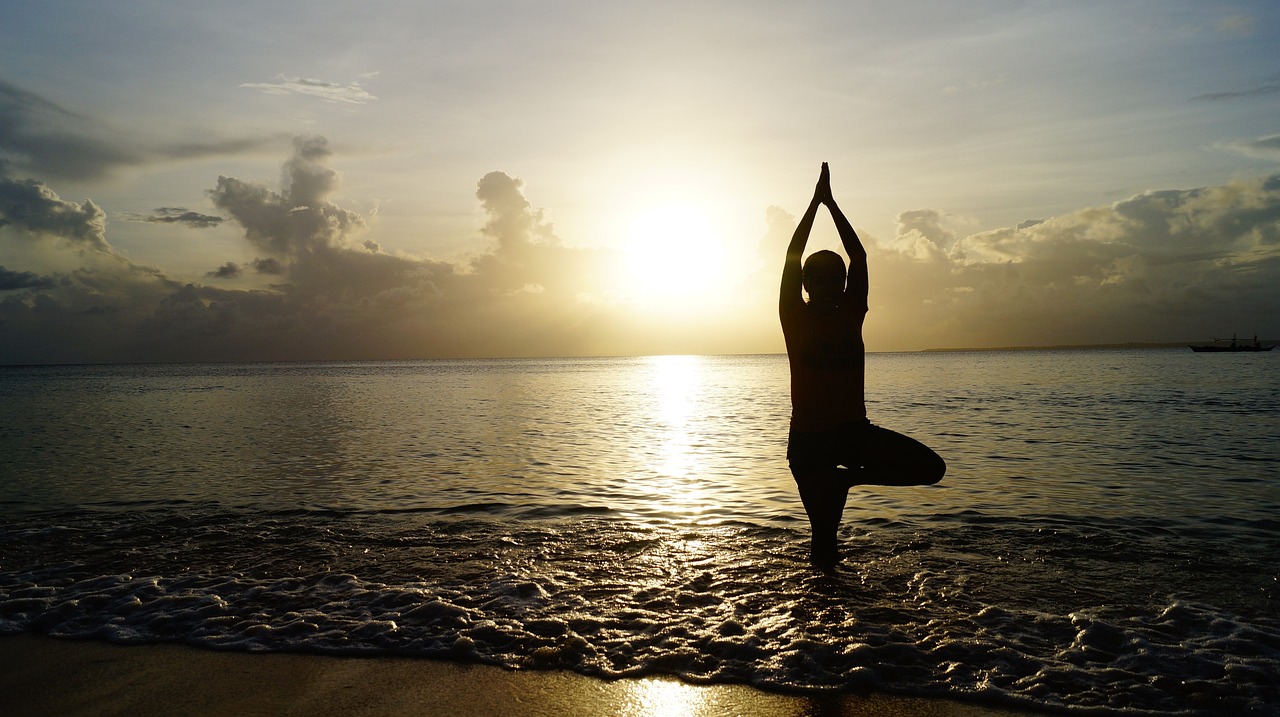
If most of the yoga you have tried involves flowing from pose to pose, yin yoga can feel almost like the opposite. You might do only a dozen poses in a long class, staying still in each one for three to five minutes. That stillness is the practice. This guide explains what yin yoga is, where the method came from, what a class looks like, which poses and props it uses, who it suits and how it differs from restorative yoga.
What is yin yoga?
Yin yoga is a style of mostly passive floor poses held for long periods. In YinSights, the free online book on the method published by teacher Bernie Clark at YinYoga.com, it is described as a practice that “targets the connective tissues,” such as ligaments and the tissues around the joints, rather than the muscles that more active, “yang” styles emphasize. Clark notes that poses may be held anywhere from one to twenty minutes, and that the practice usually focuses on the area between the knees and the navel: the hips, pelvis and lower back.
The names yin and yang come from Chinese philosophy, where they describe complementary qualities such as stillness and movement, cool and warm. In yin yoga they are used as a teaching image: yin practice is slow, cool and still; yang practice is active, warm and moving. Many students do both.
It helps to separate three things:
- The method: long, relaxed holds of floor poses. That is what you will meet in any yin class.
- The teaching model: the idea that long holds stress connective tissue in a healthy way. It is how yin teachers explain the practice; there is little research testing it directly.
- The energy model: many yin teachers also describe poses in terms of the meridians of Chinese medicine and the subtle-body teachings of yoga. These are traditional and teaching frameworks, not established anatomy. Our guide to chakras explains how to read subtle-body ideas in their context.
Origins: a modern method with older roots
Yin yoga as a named style is recent. According to YinSights, Paul Grilley, who began studying yoga in 1979, did most to popularize it but did not invent it. He combined three lines of study and dedicated his own book on the method to three teachers:
- Paulie Zink, a martial artist who introduced Grilley to Daoist (Taoist) yoga, with its long-held floor postures;
- Dr. Gary Parker, with whom he studied anatomy;
- Dr. Hiroshi Motoyama, a Japanese researcher of yoga and meridian theory, whom Grilley met in 1990 and who shaped his understanding of how postures relate to the body’s energy channels as described in that tradition.
One of Grilley’s students, Sarah Powers, began combining his long-held postures with meditation, and according to YinSights it was Powers who coined the name “Yin Yoga” that is used today.
Practitioners also point to older precedents. The Hatha yoga texts describe seated postures held for long periods to prepare for breathing practice and meditation; YinSights notes that the Haṭhapradīpikā lists only sixteen postures, about half of them seated. That is a link in spirit, not a direct line: the yin class format itself is a modern creation. For the wider story, see our history of yoga.
The three principles of a yin practice
Sarah Powers offers three simple principles, as quoted in YinSights:
- Come into the pose to an appropriate depth. Go to the first point where you feel a clear but bearable sensation, not your maximum.
- Resolve to remain still. Let the muscles soften; avoid fidgeting or pushing deeper by force.
- Hold the pose for time. Stay for several minutes, breathing steadily.
Coming out matters too. Move slowly, because joints and tissues can feel stiff after a long hold, and take a short rest or a gentle movement between poses.
What happens in a typical class
YinSights gives a useful worked example: in a 90-minute class with five-minute holds, a one-minute rest between poses, five minutes of meditation at the start and five minutes of savasana at the end, there is time for only about thirteen poses. Many studio classes are 60 or 75 minutes and use fewer.
A class might look like this:
- Settling in with a few minutes of quiet sitting or lying, noticing the breath.
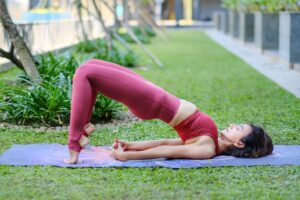
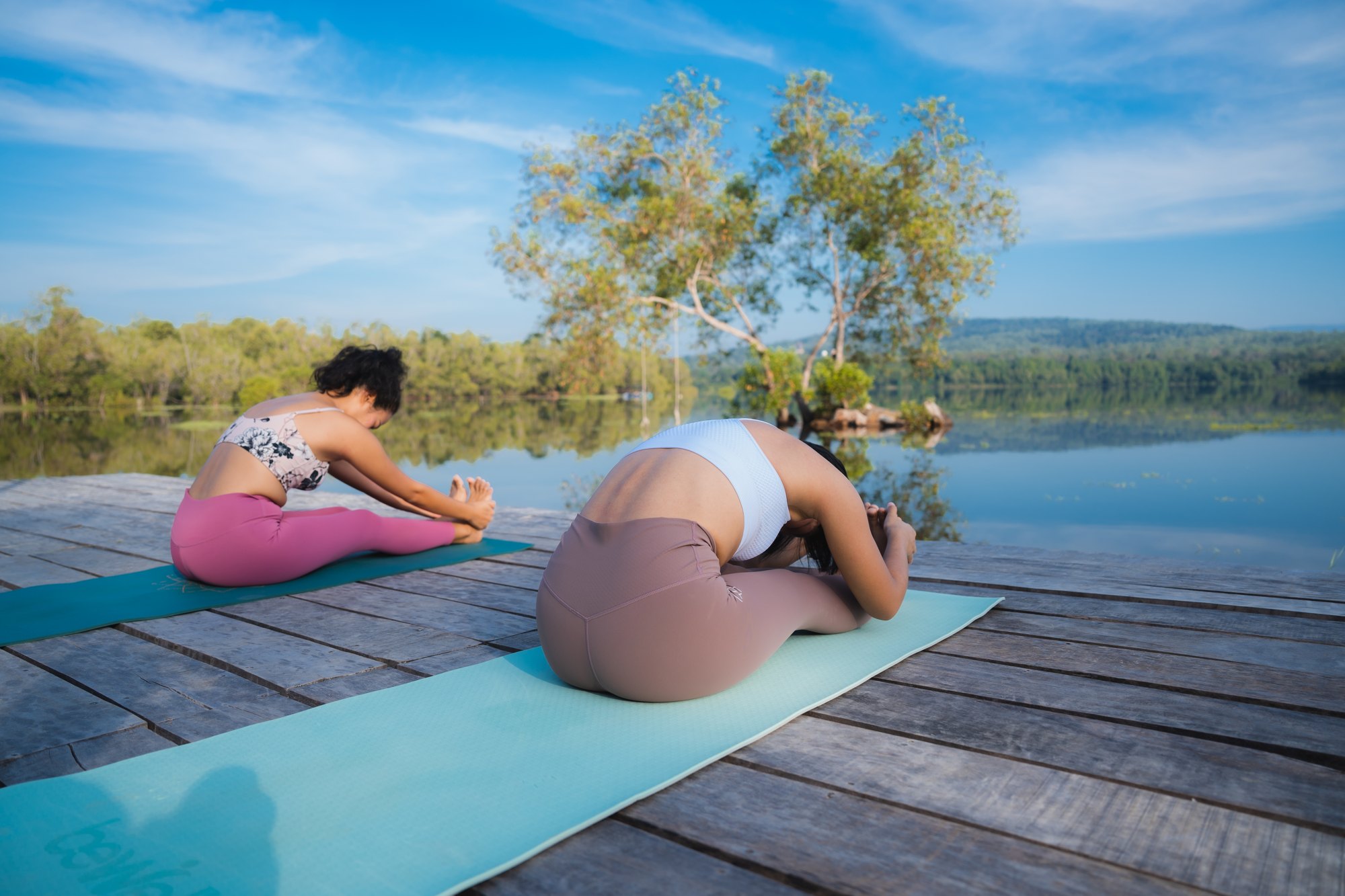
- A sequence of long holds, for example a hip pose such as Swan (a yin version of pigeon pose), a forward fold such as Butterfly or Caterpillar, a gentle backbend such as Sphinx, and a supported bridge with a block under the pelvis.
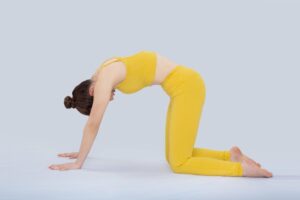
- Short rebounds between poses: lying still for a minute or moving gently, for instance through a few rounds of cat-cow, to notice the after-effects.
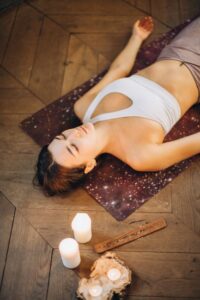
- A long final rest in savasana, the corpse pose.
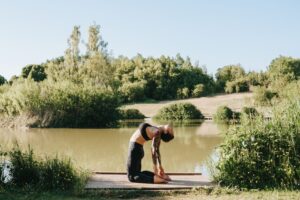
Yin poses often have their own names. YinSights lists over two dozen, including Butterfly, Dragon, Frog, Saddle, Shoelace, Sphinx and Seal, and Swan. Some are close relatives of familiar poses, and some (such as Bridge, Camel and Child’s Pose) keep their usual names. A deeper kneeling backbend like camel pose is held only briefly and gently in yin classes, if at all.
Intensity and level
We class yin yoga as gentle: there is no fast movement and little muscular effort. That does not mean easy. Holding a hip opener for five minutes asks for patience, and the sensations can be strong. Yin suits all levels, including complete beginners, as long as you choose your depth carefully.
Breathing and meditation in yin
Because you are still for long periods, yin is a natural place to practice breath awareness. Slow diaphragmatic breathing helps many people stay relaxed in a long hold, and some teachers add calm techniques such as alternate nostril breathing at the start or end. Sarah Powers’s version of yin pairs the poses with mindfulness; if that interests you, our guide to mindfulness meditation is a good next step. In the classical eight limbs of yoga, steady posture comes before breath control and meditation, which is one way yin teachers explain why the style feels so meditative.
Props: bolster, blocks and blankets
Props make yin comfortable enough to stay in a pose without strain. A firm bolster under the chest or knees, two blocks under the thighs in Butterfly or under the pelvis in Bridge, and a folded blanket under the knees or sitting bones are the usual kit. If you practice at home, a bolster and two blocks cover most needs; our guides to yoga bolsters and yoga blocks compare the options. Two well-made props that suit yin, from our research (not hands-on testing):
Hugger Mugger Standard Yoga Bolster
- About 25 x 11 x 6 in, 5 lb (listing)
- Foam core wrapped in cotton batting (maker)
- About $114, seen October 2026
Cork Yoga Blocks, 2-Pack
- 9 x 6 x 4 in each (listing)
- Natural cork, rounded edges
- About $27, seen October 2026
Who yin suits, and who should take care
Yin can suit beginners, people who want a calm counterweight to running, cycling or strong yoga, and anyone who wants a slower, more meditative practice. It is often paired with active styles such as vinyasa.
Some care is needed:
- Very flexible (hypermobile) people should stay well short of their end range; long passive holds can push joints further than is wise.
- Knees: YinSights lists knee problems, especially of the inner meniscus, as a reason to watch pressure in poses such as Swan; bring the front foot in or choose a reclined alternative.
- Health conditions: YinSights advises anyone who is pregnant or has a joint injury, recent surgery, epilepsy, diabetes or heart disease (especially high blood pressure) to discuss their practice with a health professional first. Our prenatal yoga guide covers pregnancy.
- Numbness or tingling in a hold means come out and adjust. Strong stretching sensation is expected; sharp, burning or electric pain is not.
Yin vs restorative yoga
The two are often confused because both are slow and use props. The difference is the aim. In yin, you go to a mild edge of sensation and stay there; the props help you relax into a stretch. In restorative yoga, props support the body so fully that there is little or no stretch at all; the aim is rest. A yin class can feel challenging; a restorative class should feel easy.
| Yin yoga | Restorative yoga | Hatha (modern class) | |
|---|---|---|---|
| Pace | Very slow, still | Very slow, still | Slow to moderate |
| Holds | Several minutes, mild stretch | Several minutes, fully supported | Usually shorter, active |
| Effort | Passive, but sensations can be strong | Minimal | Moderate |
| Props | Bolster, blocks, blanket | Many props | Some |
If you want a gentle class with standing poses and a little more movement, a modern hatha class is the middle ground.
Yin yoga on retreat
Yin is a favorite on retreats, often scheduled in the late afternoon or evening after a morning flow class. If you want a slow, restful trip, our guides to wellness retreats and how to choose a yoga retreat explain what to ask about the class timetable, and our destinations section covers places where yin is commonly taught alongside other styles.