In short: Ayurveda is India’s traditional system of medicine, whose name is usually translated as “the science of life.” It rests on classical Sanskrit texts and on ideas such as the five elements and the three doshas, and it shares philosophical roots with yoga. As a tradition it is rich and still widely practiced; as medicine, the scientific evidence is limited, and some Ayurvedic products sold online have been found to contain lead, mercury or arsenic, so talk with your doctor before using them.
If you have ever been offered an oil massage at a yoga retreat, seen a menu labelled “vata-balancing,” or taken a quiz about your “dosha,” you have met Ayurveda. This guide explains where it comes from, what its core ideas are, how it relates to yoga, and what U.S. health agencies say about its safety and evidence. It describes Ayurveda as a tradition, in its own terms, and keeps that separate from what research has and has not shown. It is general information, not medical advice.
What is Ayurveda?
Ayurveda (āyurveda in scholarly transliteration) is a traditional medical system from the Indian subcontinent. The University of Minnesota’s Center for Spirituality and Healing explains that the name comes from the Sanskrit for “the science of life,” and the U.S. National Center for Complementary and Integrative Health (NCCIH) describes it as one of the world’s oldest medical systems and one of India’s traditional health care systems today.
According to NCCIH, Ayurvedic treatment combines products (mostly from plants, but sometimes animal, metal or mineral ingredients), diet, exercise and lifestyle. Practitioners see health as a balance between body, mind and surroundings, and they put a lot of weight on daily and seasonal routines meant to prevent illness, not only treat it.
Ayurveda is not a single fixed method. It is practiced at home as family custom, by trained Ayurvedic physicians in India, at hotel spas, and at retreat centers that combine it with yoga. The World Health Organization lists Ayurveda, along with yoga, among the traditional medicine systems of its South-East Asia region, and in 2022 it set up its Global Traditional Medicine Centre in Jamnagar, India.
Where Ayurveda comes from: history and texts
Ayurveda grew out of oral teaching that was later written down in Sanskrit. Practitioners trace its knowledge back to the Vedas, India’s oldest religious texts, and tradition gives it a divine origin, passed from the god Brahma to sages and then to their students. Those accounts belong to the tradition’s own story of itself; historians date the surviving medical texts much later than the earliest Vedas.
Most of what Ayurveda teaches today comes from three classical works, known together as the “great triad” (Brhattrayi):
- Charaka Samhita: the major compendium of internal medicine, theory and practice, attributed to the physician Charaka, who edited earlier teaching compiled by Agnivesha.
- Sushruta Samhita: the classic text on surgery, attributed to Sushruta.
- Ashtanga Hridaya: a later synthesis attributed to Vagbhata, still used as a main textbook in Ayurvedic training.
Dates for these texts are debated, and our sources do not agree. The University of Minnesota’s overview places the Charaka Samhita around 800 BCE and the Ashtanga Hridaya around 400 CE, while a 2017 review in the Journal of Traditional and Complementary Medicine traces Ayurveda’s history to the 2nd century BCE. What is clear is that these are layered texts, compiled and revised over a long period, and that they are still studied by Ayurvedic practitioners today. Later works, such as the Madhava Nidana (on diagnosis) and the Bhava Prakasha (on medicinal plants and food), added to the tradition.
The same review notes that Ayurveda’s theory draws on schools of Indian philosophy, including Nyaya and Vaisheshika (logic and categories of reality) and Samkhya (the enumeration of the elements that make up the world). That last link matters for yoga, as we explain below. For the wider story of how yoga’s own texts developed, see our history of yoga.

Core ideas: elements, doshas and constitution
These are concepts within the tradition. They are not anatomical structures that medical science has identified, and they are best read as Ayurveda’s own way of describing the body and its changes.
The five elements
Ayurvedic texts describe everything, living or not, as made from five elements (pancha mahabhuta): space, air, fire, water and earth. Each element is associated with qualities such as lightness, heat, fluidity or stability.
The three doshas
The elements combine into three doshas, often translated as “humors” or functional principles:
| Dosha | Elements in the tradition | Functions it is said to govern |
|---|---|---|
| Vata | Air and space | Movement, circulation, elimination |
| Pitta | Fire | Digestion, metabolism, body heat |
| Kapha | Water and earth | Structure, lubrication, stability |
In Ayurvedic teaching, health means the doshas are in balance, and illness follows when one becomes excessive or deficient through diet, season, habits, stress or environment. Our guide to the three doshas goes through each one and explains why online “dosha quizzes” are a starting point for curiosity, not a diagnosis.
Prakriti: your constitution
The tradition holds that each person is born with a particular mix of the doshas, called prakriti (also spelled prakruti), which stays the same through life, while the day-to-day state shifts with food, weather and activity. The University of Minnesota’s overview notes that, in the tradition, determining a person’s constitution is the job of a trained practitioner, through a long examination of the body, pulse, tongue, habits and history.
Agni, digestion and routine
Ayurveda gives a central place to agni, the “digestive fire,” and to routine: dinacharya (the daily routine) and ritucharya (the seasonal routine). Much of what visitors meet at a retreat, such as warm, simple meals, regular sleep and gentle oil massage, comes from this emphasis on routine.
How Ayurveda relates to yoga
Yoga and Ayurveda are separate traditions with their own texts, but they grew up in the same intellectual world. The Internet Encyclopedia of Philosophy notes that Samkhya ideas appear across Indian literature, including medical treatises (āyurveda) and the basic texts of the Yoga school, and that several modern scholars read much of Patanjali’s yoga philosophy as a version of Samkhya. The gunas, the three qualities of nature in Samkhya, and the idea of prana, the breath or life force, appear in both conversations.
In practice, the overlap you will notice is mostly modern and practical:
- Many retreat centers offer yoga classes alongside Ayurvedic meals, massage and consultations.
- Some teachers suggest adjusting a practice to the season or to a person’s constitution, for example a calmer, grounding practice for someone described as vata-dominant. That is a teaching within the tradition, not a tested prescription.
- Both traditions value routine, moderate eating and attention to the breath, which is one reason they are often taught together.
You do not need to follow Ayurveda to practice yoga, and the reverse is also true. If you want the yoga side of the picture, start with what yoga is and the Yoga Sutras.
What a consultation and treatments involve
According to the University of Minnesota’s overview, a visit to an Ayurvedic practitioner usually starts with a long conversation about diet, work, exercise, sleep, relationships and mood, followed by observation of the body, touch (including pulse reading) and questions about symptoms. Recommendations may include:
- Diet and routine: foods and meal times matched to the person and the season.
- Herbal preparations: plant-based formulas, sometimes with mineral or metal ingredients (see the safety section below).
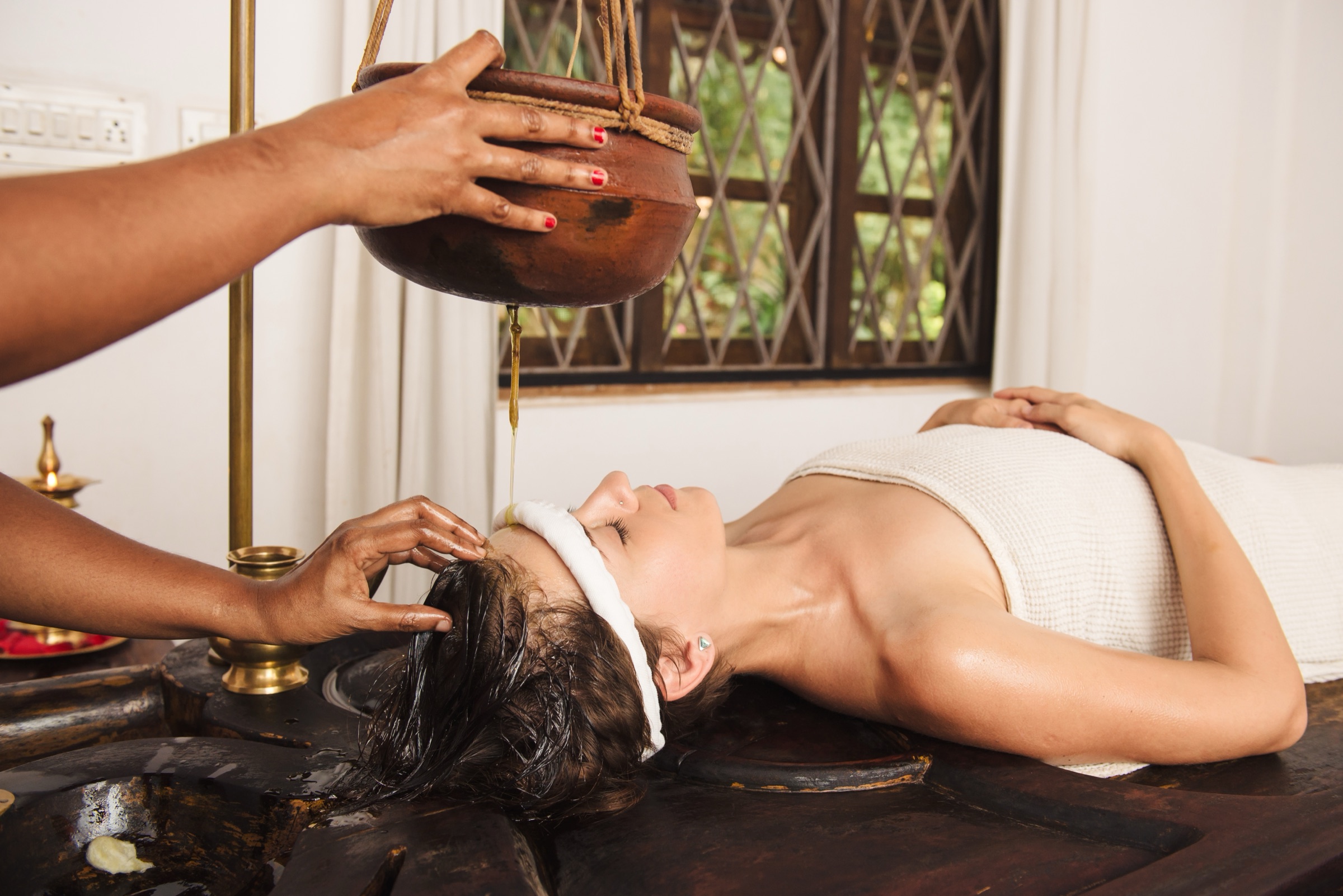
- Massage and oil treatments: such as warm oil massage.
- Panchakarma: a multi-step cleansing program from the classical texts. Its full form includes procedures such as induced vomiting, laxatives, enemas and nasal treatments. The University of Minnesota describes it as invasive and says it requires supervision by a trained practitioner who watches for contraindications and side effects. Many spa versions offer only the gentler parts, such as massage and steam.
We do not describe these treatments as removing “toxins” or as curing anything. When a retreat promises that, ask what exactly is offered and on what evidence; our guide to judging wellness retreat claims explains how.
What the evidence says
NCCIH’s summary is that only a few well-designed clinical trials and systematic reviews suggest Ayurvedic approaches are effective, and that there is little scientific evidence on Ayurveda’s value for most health issues. It notes some small or limited studies:
- A 2013 trial in 440 people with knee osteoarthritis found two Ayurvedic plant formulations gave pain relief and function improvements similar to glucosamine and to the drug celecoxib.
- A small 2011 pilot study of 43 people found conventional and Ayurvedic treatments for rheumatoid arthritis similarly effective.
- Small trials of herbal formulas for type 2 diabetes have been reported, but reviewers say study designs are not strong enough for firm conclusions.
Ayurvedic practitioners point out a real difficulty: Ayurveda individualizes treatment, so the same diagnosis may get different formulas in different people, which makes standard controlled trials hard to design. The World Health Organization’s position is that traditional medicine should be integrated “based on the latest scientific evidence,” with safety and efficacy established through rigorous research even when a practice has been used for a long time.
Put simply: Ayurveda’s teachings on routine, rest, simple food and movement sit comfortably with ordinary health advice, but its specific remedies have not been shown to treat disease, and they should not replace medical care.
Regulation and safety notes
Metals in some Ayurvedic products
This is the most important safety point. NCCIH warns that some Ayurvedic preparations may contain lead, mercury or arsenic at levels that can be toxic, and that the U.S. Food and Drug Administration has warned that metals in some products make them potentially harmful.
- In a 2008 study in JAMA, researchers bought Ayurvedic medicines online and analyzed 193 of them: about one in five (20.7%) contained detectable lead, mercury or arsenic. The rate was similar for products made in the United States and in India. Products made with rasa shastra, the traditional practice of combining herbs with metals, minerals and gems, were more than twice as likely to contain metals (40.6% vs 17.1%). Three-quarters of the metal-containing products claimed to follow Good Manufacturing Practices.
- NCCIH also cites a 2015 survey in which 40% of people using Ayurvedic preparations had elevated blood lead levels, and a 2015 CDC report of lead poisoning linked to Ayurvedic preparations bought online.
How products are regulated in the United States
In the U.S., herbal Ayurvedic products are usually sold as dietary supplements. The FDA explains that under the Dietary Supplement Health and Education Act of 1994 it does not approve dietary supplements before they are marketed, and it does not test them before they are sold. Manufacturers are responsible for safety. A product sold as a supplement that claims to treat, prevent or cure a disease is, legally, a drug, which is why supplement labels carry the disclaimer that the product “is not intended to diagnose, treat, cure, or prevent any disease.”
Practitioners
NCCIH notes there is no significant regulation of Ayurvedic practice or education in the United States and that no state requires Ayurvedic practitioners to be licensed. Training and titles vary widely, so ask any practitioner where and how long they trained, and whether they work alongside medical doctors.
Practical safety checklist
- Talk with your doctor before taking any Ayurvedic product, especially if you have a health condition, take medicines, or are pregnant or breastfeeding. NCCIH specifically warns that some products could be harmful during pregnancy and nursing.
- Do not use Ayurveda to put off seeing a doctor about a medical problem.
- Tell all your health care providers about any complementary approaches you use.
- Be wary of products bought online, of rasa shastra (metal- or mineral-based) preparations, and of any claim to “detoxify” or cure.
- At a retreat, ask whether treatments are supervised by a qualified practitioner, what each treatment involves, and who to contact if you feel unwell. Avoid intensive cleansing programs unless your own doctor agrees.
Ayurveda on a yoga trip
Many travelers meet Ayurveda first at a retreat. In India, the state of Kerala’s tourism department promotes Ayurveda and publishes a list of accredited Ayurveda centers, and many yoga retreats elsewhere borrow Ayurvedic meals and massages. Our country guides to yoga in India and yoga in Sri Lanka cover the practical side of a trip, and how to choose a yoga retreat gives you the questions to ask before booking. For a broader look at food, sleep and rest around yoga, return to the Wellbeing hub.
Approached as a living cultural tradition, with curiosity and some caution about products and claims, Ayurveda can add real depth to a yoga trip: a different way of thinking about routine, seasons and food, rooted in centuries of Indian thought.
Frequently asked questions
What does Ayurveda mean?
Ayurveda is usually translated from Sanskrit as "the science of life" or "knowledge of life." It is the name of India's traditional system of medicine, built on classical texts such as the Charaka Samhita and the Sushruta Samhita.
Is Ayurveda the same as yoga?
No. They are separate traditions with their own texts and aims, though they share philosophical roots (both draw on Samkhya ideas) and are often taught together at retreats. You can practice yoga without following Ayurveda, and the reverse.
Are Ayurvedic supplements safe?
Not always. NCCIH warns that some Ayurvedic preparations may contain toxic levels of lead, mercury or arsenic, and a 2008 JAMA study found detectable metals in about one in five Ayurvedic medicines bought online. In the U.S. the FDA does not approve or test supplements before they are sold. Talk with your doctor before taking any of them.
Does science support Ayurveda?
Only in a limited way. NCCIH says few well-designed trials suggest Ayurvedic approaches work, with some small studies on osteoarthritis and type 2 diabetes, and little evidence for other health issues. Its advice on routine, rest, simple food and movement fits ordinary health guidance, but its remedies should not replace medical care.
Do Ayurvedic practitioners need a license in the United States?
No state requires a license, and NCCIH notes there is no significant regulation of Ayurvedic practice or education in the U.S. Ask any practitioner about their training and whether they work with medical doctors.
Is panchakarma a detox?
Panchakarma is a traditional multi-step cleansing program; the tradition describes it as removing ama. That is a traditional belief, not a proven medical effect. Its full form includes invasive procedures that need supervision by a trained practitioner, so check with your doctor first.
Sources
- Ayurvedic Medicine: In Depth, National Center for Complementary and Integrative Health (NIH) (accessed October 6, 2026)
- Lead, mercury, and arsenic in US- and Indian-manufactured Ayurvedic medicines sold via the Internet (Saper et al., JAMA 2008;300(8):915-923; PubMed 18728265), JAMA (accessed October 6, 2026)
- Questions and Answers on Dietary Supplements, U.S. Food and Drug Administration (accessed October 6, 2026)
- Where does Ayurveda come from?, University of Minnesota, Earl E. Bakken Center for Spirituality & Healing (accessed October 6, 2026)
- What is the philosophy of Ayurvedic medicine?, University of Minnesota, Earl E. Bakken Center for Spirituality & Healing (accessed October 6, 2026)
- What happens in a visit to an Ayurvedic practitioner?, University of Minnesota, Earl E. Bakken Center for Spirituality & Healing (accessed October 6, 2026)
- A glimpse of Ayurveda: the forgotten history and principles of Indian traditional medicine (Jaiswal and Williams, J Tradit Complement Med 2017), Journal of Traditional and Complementary Medicine (PubMed Central) (accessed October 6, 2026)
- Sāṅkhya, Internet Encyclopedia of Philosophy (accessed October 6, 2026)
- Traditional medicine: questions and answers, World Health Organization (accessed October 6, 2026)
- Ayurveda (incl. Accredited Ayurveda Centers), Kerala Tourism, Government of Kerala (accessed October 6, 2026)
- WHO Global Traditional Medicine Centre, World Health Organization (accessed October 6, 2026)
Facts checked on October 6, 2026