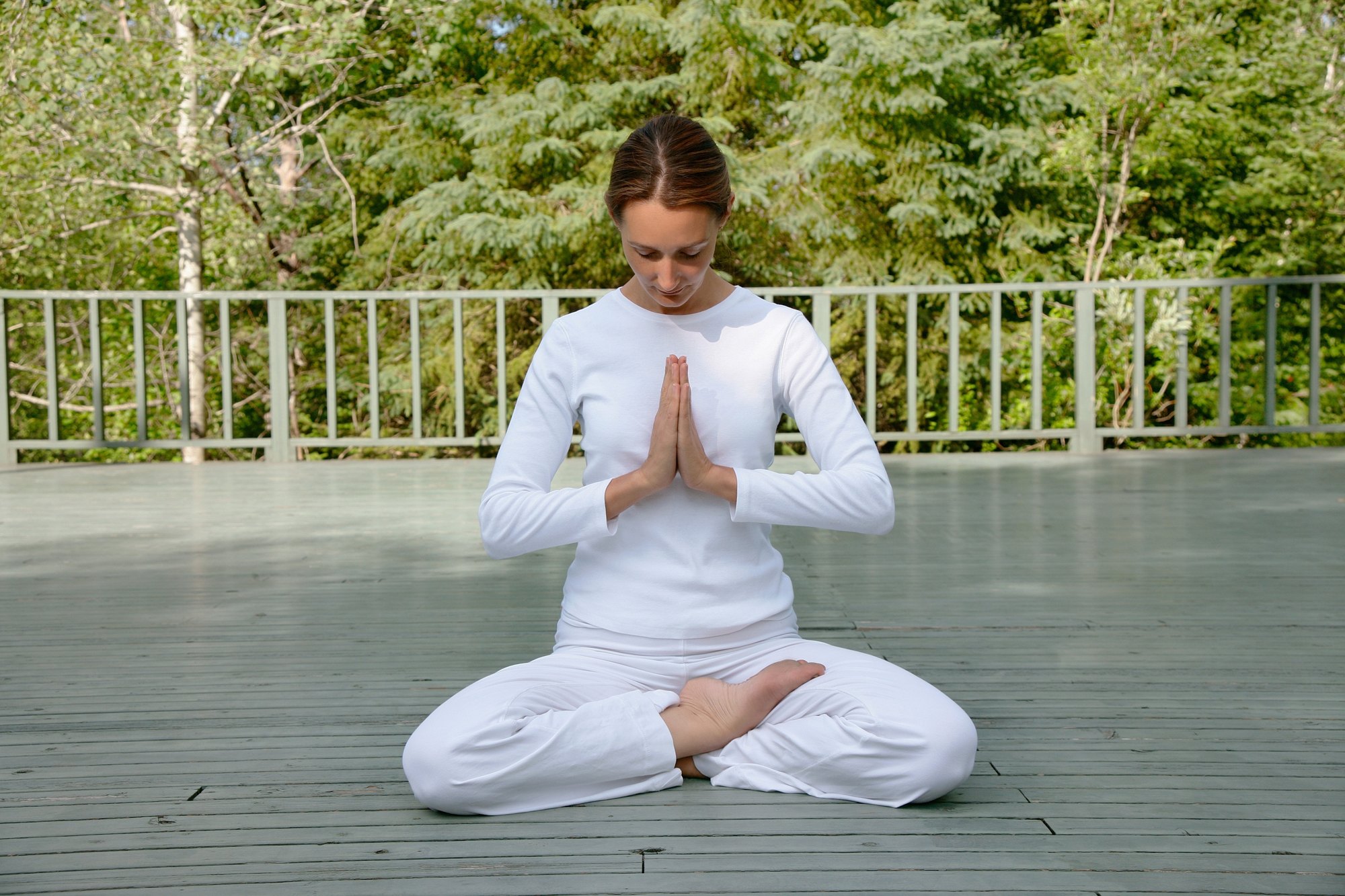
In short: “Kundalini” names two different things. In some Tantric and Hatha yoga traditions, kuṇḍalinī is an energy believed to lie coiled at the base of the spine, which practice is meant to awaken. “Kundalini Yoga” as most studios teach it today is a modern method brought to the United States in 1968 by Yogi Bhajan: classes built from set sequences called kriyas that combine movement, strong breathing, mantra and meditation. Some of its breathing techniques are forceful, so beginners should learn from a qualified teacher.

Kundalini classes look and sound different from most yoga: repeated movements done quickly, breath practices like “breath of fire,” chanting, and long meditations, sometimes with eyes closed for most of the class. This guide separates the old idea of kuṇḍalinī from the modern method that carries its name, explains what happens in a class, covers who should be careful, and gives the facts students should know about the method’s founder before choosing a teacher.
The traditional concept: what is kuṇḍalinī?
Kuṇḍalinī (कुण्डलिनी) is a Sanskrit word related to kuṇḍala, a ring or the coil of a rope; the Monier-Williams dictionary gives “circular, annulate” for kuṇḍalin and lists kuṇḍalinī as a name of a Śakti, a form of the goddess. Encyclopaedia Britannica describes kuṇḍalinī, in some Tantric (esoteric) forms of yoga, as the cosmic energy believed to lie within everyone, pictured as a coiled serpent at the base of the spine. Through postures, gestures and breathing exercises, the practitioner is taught to raise it along the spine through six centers, or chakras, to a seventh at the top of the head, an experience the tradition describes as union with the eternal self.
The idea is central to the Hatha yoga texts. The Haṭhapradīpikā, in Pancham Sinh’s 1914 translation, opens its chapter on seals with the image that as the king of serpents supports the earth, so the Kuṇḍalinī supports all yoga practices, and it lists synonyms including Bhujangī, “she-serpent,” and Śakti. Our guide to chakras explains the subtle-body model in its traditional context.
These are teachings within a religious and spiritual tradition. They describe an inner experience as practitioners and texts understand it; they are not anatomy, and there is no scientific evidence for a physical energy at the base of the spine.
The modern method: Kundalini Yoga as taught by Yogi Bhajan
The style you will find on most studio timetables comes from Yogi Bhajan, born Harbhajan Singh Puri in 1929 in what is now Pakistan, who came to the United States by way of Canada in 1968. He founded 3HO (the “Healthy, Happy, Holy Organization”) as a nonprofit in 1969, and Religion News Service describes him as a spiritual leader and entrepreneur who promoted his own brand of Sikhism alongside the yoga. The Kundalini Research Institute (KRI) runs the method’s teacher training, known as the Aquarian Teacher program.
3HO calls Kundalini Yoga “the Yoga of Awareness” and describes it as combining postures, breath, meditation, mantra and music. So the modern method draws on the old idea of awakening energy, but its specific kriyas, meditations and class format are its own, systematized in the late twentieth century. That is why we list it as a modern method in our style directory, alongside its traditional roots.
What happens in a Kundalini class
3HO lists the core elements of a class as posture (asana), kriya, breathwork (pranayam), mudra (hand gestures), mantra, eye focus (drishti), bandhas (energy locks) and meditation. In practice, a class often runs like this:
- Tuning in: chanting the mantra “Ong Namo Guru Dev Namo” to open the class.
- Warm-up: simple spinal movements, such as a seated spinal flex that resembles cat-cow.
- Kriya: a set sequence of exercises with a stated aim, practiced in a set order and timing. Kriyā is Sanskrit for “action.” Exercises are often repeated rhythmically for one to several minutes.
- Relaxation: lying on your back in corpse pose.
- Meditation: seated, often with a mantra, a mudra and a specific breath; easy cross-legged seat is the norm, and lotus pose is never required.
- Closing: 3HO practice ends with the song “Long Time Sun Shine.”
You don’t need any special clothing; wear something comfortable you can sit in for a while.

Breath: breath of fire and other techniques
Breathing is central to Kundalini practice. Its signature technique, breath of fire, is described by 3HO as a rapid, rhythmic, continuous breath generated from the navel point and diaphragm, equal on the inhale and the exhale, at about two to three breaths per second. 3HO stresses that it is not hyperventilation and not bellows breath. It is also a different technique from Kapalabhati, the cleansing practice of the Hatha texts, though both are fast and forceful.
3HO’s own guidance says to refrain from breath of fire during pregnancy, during the first days of menstruation depending on flow, when experiencing dizziness, panic or uncontrolled high blood pressure, and when recovering from surgery or serious illness; if you feel lightheaded, dizzy or nauseous, return to slow breathing. Those cautions match the general rule on our breathing exercises hub: forceful breathing should be learned from a qualified teacher, and anyone with heart or blood pressure problems, epilepsy, a history of panic attacks, or who is pregnant should check with a doctor first. Gentler techniques such as alternate nostril breathing and long, slow deep breathing are good places to start. Our guide to pranayama explains the wider family of practices.
Mantra and mudra
Chanting is part of almost every class, beginning with the opening mantra “Ong Namo Guru Dev Namo.” 3HO describes shabad, practice with sacred sound through mantra or chanting, as a tool to focus the mind; mantras are sung or spoken in unison, sometimes for long stretches. Hand positions, such as touching thumb and index finger, are held during meditation. Our guide to mudras explains these gestures in their traditional context. If chanting in a religious language does not sit well with you, you can listen or breathe quietly instead; a good teacher will not mind.
Intensity and level
We class Kundalini as moderate. The postures are mostly simple, but fast repetitions, arm holds for minutes at a time and vigorous breathing can be demanding. Beginners are welcome in most classes; go at your own pace and rest whenever you need to.
Benefits: what the research says
Kundalini yoga has been tested in some clinical research. In a 2021 randomized trial published in JAMA Psychiatry, 226 adults with generalized anxiety disorder took twelve weekly group sessions of Kundalini yoga, cognitive behavioral therapy (CBT) or stress education. Kundalini yoga worked better than stress education, but it was not shown to be as effective as CBT, and the authors concluded that CBT should remain the first-line treatment. In other words: a promising complement for some people, not a replacement for proven care. If you live with anxiety or another health condition, talk to your doctor about where yoga fits.

Cautions
- Forceful breathing: see the cautions above; never push through dizziness or tingling.
- Long arm holds and fast spinal movements: ease off if you have shoulder, neck or back problems.
- Intense experiences: some people report strong emotions or unusual sensations in long meditation and breathing practices. Stop, breathe normally and talk to the teacher; if you have a history of psychosis, trauma or severe anxiety, check with a mental health professional first.
- Pregnancy: 3HO publishes specific practices for pregnancy and advises avoiding breath of fire; see also our prenatal yoga guide and talk to your doctor or midwife.
Choosing a teacher: what to know about the founder
Students deserve the facts. In 2020, An Olive Branch, a consultancy that helps spiritual communities respond to ethical misconduct, published a report commissioned by the Siri Singh Sahib Corporation, the umbrella organization that includes 3HO. Religion News Service reported that the report concluded it was “more likely than not” that Yogi Bhajan, who died in 2004, used his position to sexually abuse women and female minors, including rape, sexual battery and sexual harassment. Religion News Service also reported that rumors of misconduct had followed him since his arrival in the United States.
Religion News Service called it the first documented, well-sourced third-party account of the alleged misconduct. When you choose a class, it is reasonable to ask how the teacher approaches this history, whether they were trained by KRI or elsewhere, and whether the studio has a clear code of conduct and a way to raise concerns. The ethical teachings at the heart of yoga, the yamas, begin with non-harming, and that applies to teachers as much as students.
Kundalini compared with other styles
| Kundalini | Hatha (modern class) | Vinyasa | |
|---|---|---|---|
| Structure | Set kriyas, meditation, chanting | Held poses, breathing, relaxation | Flowing sequences |
| Breath | Often vigorous, technique-specific | Mostly gentle | Steady, often Ujjayi |
| Spiritual content | Explicit (mantra, Sikh-influenced teachings) | Varies | Varies, usually light |
See our guides to hatha, vinyasa and yin yoga, or browse all types of yoga.
Kundalini on retreat
Kundalini retreats and festivals often include long group meditations and chanting. Before booking, read the program carefully, ask who trained the teachers and how breathing practices are adapted for beginners, and check our guides on how to choose a yoga retreat and meditation.