This article contains affiliate links: if you buy through them we may earn a commission, at no extra cost to you. Read our affiliate disclosure.
In short: chair yoga is an adaptation, not a separate style or tradition: ordinary yoga poses, breathing and relaxation done sitting on a chair or standing with a chair for support. It lets people practice who can’t or prefer not to get down to the floor, including many older adults, people with limited mobility and office workers. One of its best-known teachers, Lakshmi Voelker, developed her chair yoga method in 1982. Research is still limited, but a randomized trial in older adults with knee and hip osteoarthritis found lasting improvements in how much pain interfered with daily life.

Chair yoga is one of the most searched types of yoga, and it is easy to see why: all you need is a sturdy chair and a little space. This guide explains what chair yoga is (and isn’t), who it suits, which poses it uses, what the research shows, and how to practice safely at home or in a class.
What is chair yoga?
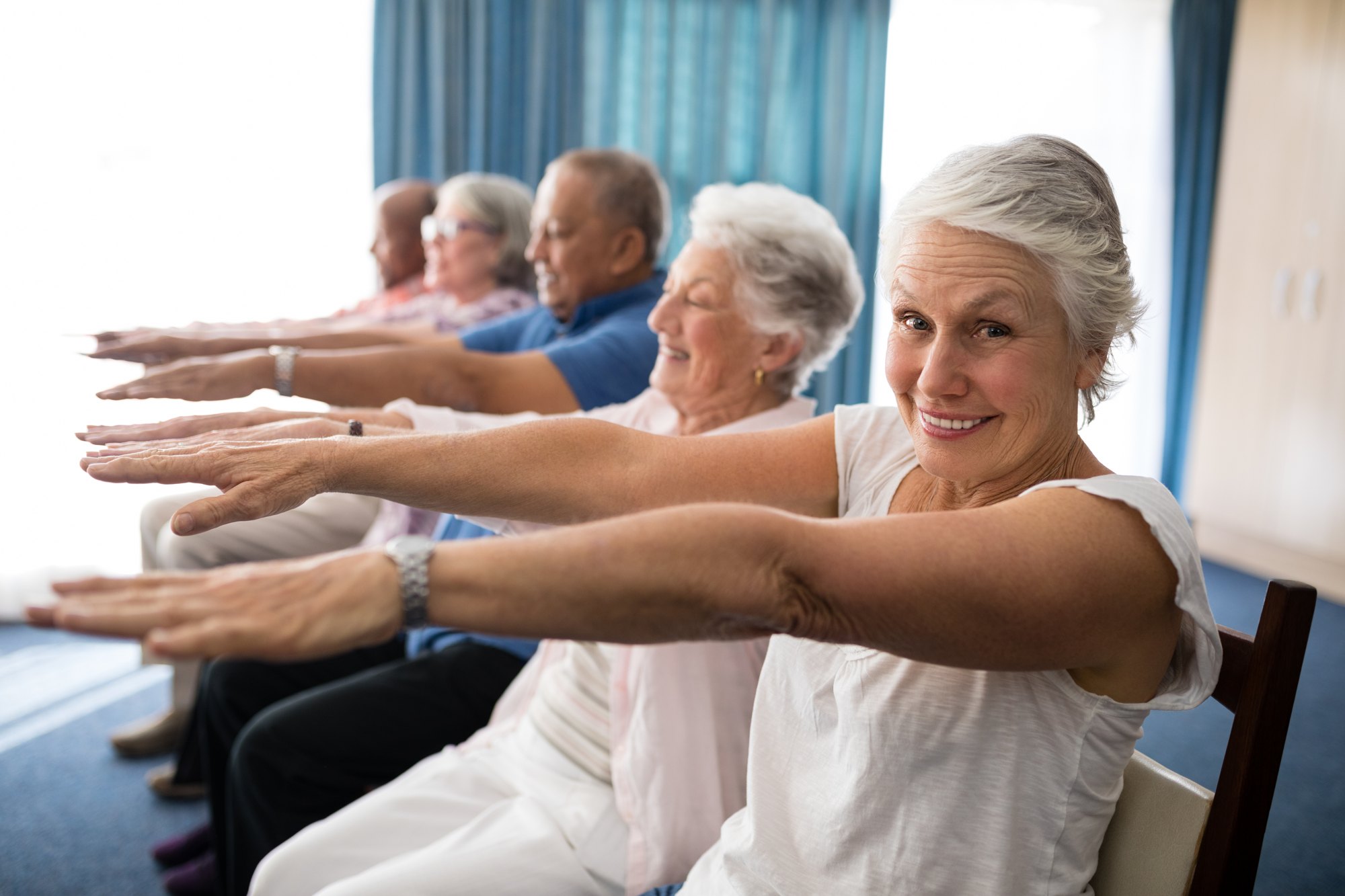
In chair yoga, a chair takes the place of the floor, or sits beside you as a support. There are two broad kinds of practice:
- Seated: the whole class takes place sitting on the chair: breathing, neck and shoulder movements, seated twists, side bends, gentle backbends, leg lifts, and a seated version of the final relaxation.
- Chair-supported: some poses are done standing, holding the back of the chair for balance, or with hands on the seat in place of the floor.
That is why we list chair yoga as an adaptation in our style directory: it changes how you practice familiar poses rather than introducing a new method with its own philosophy or lineage. The poses come from the same Hatha-derived repertoire as a modern hatha class. Props have long been used to make poses accessible; Yoga Journal describes the use of props as one of the defining features of Iyengar yoga. Our Iyengar yoga guide explains that approach.
Origins
People have adapted yoga with chairs for decades, so no single person “invented” it. One of the best-known methods is Lakshmi Voelker Chair Yoga. According to Voelker’s own account, she created it in 1982 when a student in her thirties had an arthritis flare and could no longer get down on the floor to practice. Voelker went on to run chair yoga teacher certifications. Other teachers and programs, including the “Sit ‘N’ Fit” chair yoga program used in the research below, have developed their own sequences.
Who chair yoga suits
- Older adults, especially those who find getting up and down from the floor difficult. See our guide to yoga for older adults.
- People with limited mobility, balance concerns or joint pain, with their doctor’s go-ahead.
- People recovering from illness or surgery, once cleared by their care team.
- Office workers who want to move and stretch at their desk.
- Travelers on long flights or train journeys, for gentle seated movement.
- Anyone, as a short daily practice. Chair yoga is not only for people who can’t do floor yoga.
Key poses in chair yoga
Most familiar poses have a chair version. Here are some you will meet in almost any class:
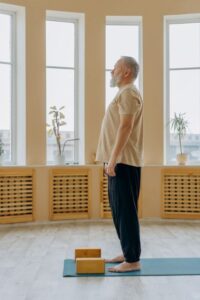
- Seated mountain: sit tall toward the front of the seat, feet flat, knees over ankles, the chair version of mountain pose. It is the starting point for most seated poses.
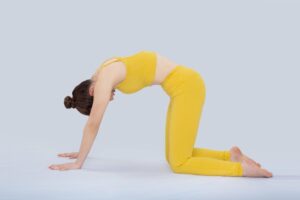
- Seated cat-cow: hands on the knees, round the spine on an exhale and lift the chest on an inhale, the seated version of cat-cow.
- Seated twist: turn gently from the ribs, one hand on the opposite knee, the other on the chair back.
- Seated side bend: one arm reaching up and over, the other hand on the seat.
- Chair pigeon (figure four): cross one ankle over the opposite knee and sit tall; lean forward slightly for more stretch. Our pigeon pose guide includes this option.
- Chair-supported tree: stand beside the chair, holding the back, and rest one foot on the opposite ankle or calf, a supported tree pose.
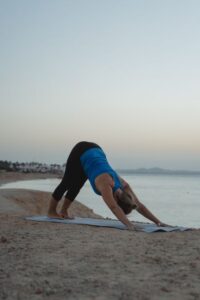
- Chair dog: hands on the chair seat or back, walk back until arms and spine form a long line, a gentler version of downward-facing dog.
- Seated relaxation: sit back, feet flat, hands resting, eyes closed for a few minutes.
What happens in a typical class
Community and studio chair yoga classes usually last 30 to 60 minutes. A class might begin with a few minutes of breathing, move through neck, shoulder and wrist warm-ups, then seated twists, side bends and leg movements, a few supported standing poses for those who want them, and finish with seated relaxation. Teachers usually offer more than one version of each pose, so you can choose the one that suits you that day.
For a ready-made routine, our practice plans section has short sequences by time and level, and our morning yoga plan includes poses that are easy to adapt to a chair.
What the research shows
Chair yoga research is growing but still small. In a 2017 randomized controlled trial published in the Journal of the American Geriatrics Society, 131 older adults with osteoarthritis of the knees or hips who could not take part in standing exercise were assigned to twice-weekly, 45-minute Sit ‘N’ Fit Chair Yoga sessions or a health education program for eight weeks. The chair yoga group had a greater reduction in how much pain interfered with daily life, and that effect lasted three months after the program ended. Improvements in pain scores, walking speed and fatigue were seen during the program but did not last afterward, and chair yoga had no effect on balance in that study.
More broadly, the U.S. National Center for Complementary and Integrative Health notes that several studies support a beneficial effect of yoga on balance in older adults living in the community. Taken together, the evidence suggests chair yoga can be a helpful, gentle form of exercise; it is not a cure for arthritis or any other condition, and it should complement the care your doctor recommends.
Choosing a chair and setting up
- A sturdy chair without wheels or arms, with a flat seat. A folding chair is fine if it is stable.
- Place it on a non-slip surface, or put the back legs against a wall so it can’t slide. A yoga mat under the chair helps.
- Feet flat on the floor, knees roughly level with the hips. If your feet don’t reach, put a yoga block or a firm cushion under them.
- Use a strap if you can’t comfortably reach your feet or knees in seated stretches.
Two simple props that make chair yoga more comfortable, from our research (not hands-on testing):
Gaiam Yoga Strap with D-Ring
- About 1.5 in x 6 ft (listing)
- Polyester blend, metal D-ring buckle
- About $10, seen October 2026
Cork Yoga Blocks, 2-Pack
- 9 x 6 x 4 in each (listing)
- Natural cork, rounded edges
- About $27, seen October 2026
Our guide to yoga blocks explains other options.
Breathing in chair yoga
Sitting upright in a chair is a comfortable position for breathing practice. Simple diaphragmatic breathing is the place to start. Box breathing and alternate nostril breathing also work well seated; if you have heart or blood pressure problems, skip any breath holds. Forceful techniques are not part of most chair classes.
Philosophy: yoga is not about the floor
It can help to remember that in the classical texts, posture was never about acrobatics. Patañjali’s Yoga Sutras, as usually translated, ask only that a posture be steady and comfortable, and the posture is one of eight limbs of yoga alongside ethics, breath, attention and meditation. Sitting tall in a chair, breathing slowly and paying attention is a complete yoga practice in that sense. The first ethical principle in the yamas, non-harming, is a useful guide too: choose the version of each pose that is kind to your body today, even if it changes from day to day.
Safety
- Check with your doctor first if you have a heart or lung condition, high blood pressure, osteoporosis, recent surgery or joint replacement, or are pregnant. The U.S. National Center for Complementary and Integrative Health advises older adults, pregnant people and people with health conditions to talk with their health care providers and the yoga instructor about their needs.
- Move within a comfortable range. Stretching sensation is fine; sharp pain, numbness or dizziness mean stop.
- Stand up slowly, especially after forward bends or relaxation, and keep a hand on the chair.
- With osteoporosis, ask your doctor or physical therapist which twists and forward bends are right for you.
Chair yoga compared with other gentle styles
| Chair yoga | Hatha (modern class) | Restorative | |
|---|---|---|---|
| Kind | Adaptation | Traditional roots, modern class | Modern method |
| Where | Seated on or supported by a chair | Mostly on the mat | Lying or sitting on props |
| Floor transitions | None needed | Several | A few, slow |
| Effort | Gentle | Gentle to moderate | Minimal |
See also our guides to restorative and yin yoga, or compare everything on types of yoga.
Chair yoga while traveling and on retreat
A few seated movements and slow breaths are an easy way to feel better on a long flight or drive. On retreat, ask whether classes can be adapted for a chair; many teachers are happy to help if you tell them in advance. Our guide on how to choose a yoga retreat lists the questions to ask about accessibility and class levels.