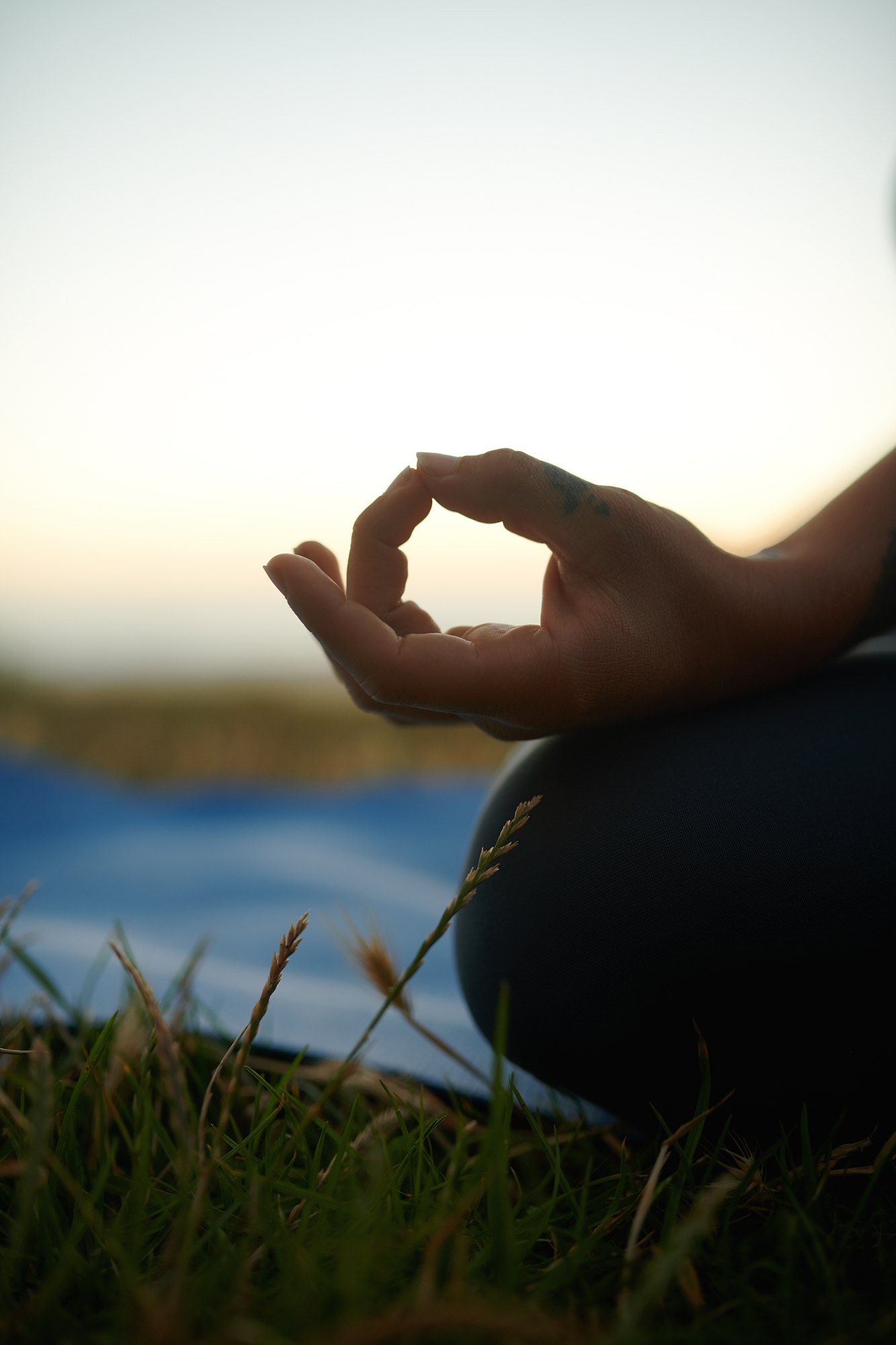
In short: a mudra is a “seal” or gesture: most often a position of the hands and fingers used in meditation, ritual, sacred art and Indian classical dance. In yoga classes you will mostly meet a few hand mudras, such as palms together at the chest or thumb and index finger touching. In older Hatha yoga texts, though, “mudra” also names advanced whole-body practices. What mudras are said to do comes from tradition; specific health effects have not been shown by research.

Hands pressed together at the start of class, fingers resting in a circle on the knees during meditation, the palm-up hands of a seated Buddha statue: all of these are mudras. This guide explains what the word means, the different traditions that use mudras, the handful of common mudras you are likely to meet in yoga and meditation, how to use them in your own practice, and how to read the many claims made about them. It belongs to our yoga philosophy section.
What is a mudra?
The Sanskrit mudrā (मुद्रा) first meant a seal, the kind pressed into wax, and by extension a stamp, mark or sign. The Monier-Williams dictionary also gives its religious meaning: particular positions or intertwinings of the fingers used in worship and held to carry symbolic meaning and power. So a mudra is a gesture that “seals” or marks something: an attitude, a moment in a story, or, in the yoga traditions, the flow of breath and attention.
Mudras in different traditions
Mudras are shared across several South Asian traditions, and each uses them differently. Knowing which tradition a mudra comes from helps you understand what it means.
- Hindu worship and temple art. Hand gestures appear in ritual and in sculpture of deities, and the greeting gesture of joined palms is carved at the entrances of historic temples.
- Buddhist art and meditation. In Buddhist images the gesture of the hands tells you which moment in the Buddha’s life is shown, such as meditation, teaching or touching the earth to witness his awakening. These conventions spread across Asia and took local forms.
- Indian classical dance and theater. The Nāṭyaśāstra, the classical treatise on performance, lists 24 single-hand and 13 two-hand gestures, used in dance styles such as Bharatanatyam to tell stories.
- Hatha yoga. In the Hatha texts, mudras are mostly not hand gestures at all but internal “seals”: contractions and positions of the body used with breath control. We explain these below.
Common hand mudras in yoga and meditation
These are the mudras you are most likely to see in classes and on meditation cushions. Names vary between schools, so don’t be surprised if a teacher uses a different one.
Añjali mudrā (अञ्जलि मुद्रा): joined palms
How: press the palms together evenly in front of the chest, fingers pointing up, thumbs lightly touching the breastbone. Meaning: añjali means the two hands held side by side, and Monier-Williams glosses it as reverence and salutation. It is the gesture that often accompanies the spoken greeting namaste, and in classes it often opens or closes practice. The standing pose with hands in this mudra is sometimes called praṇāmāsana; it is also the start of many versions of the sun salutation.
Jñāna or chin mudrā: thumb and index finger
How: touch the tip of the index finger to the tip of the thumb to make a circle, keep the other three fingers relaxed and fairly straight, and rest the backs of the hands on the knees or thighs. Meaning: jñāna means knowledge or wisdom, and practitioners associate the gesture with steady, attentive awareness. Schools disagree on the names: some call it jnana mudra with the palms up and chin mudra with the palms down, others the reverse. It is the classic hand position for seated meditation and for pranayama.
Dhyāna mudrā: the meditation gesture
How: rest both hands in the lap, palms up, the right hand on top of the left, and let the tips of the thumbs touch lightly to form an oval. Meaning: dhyāna means meditation. This is the gesture of many seated Buddha images and is also called samādhi mudrā. Many people find it the most restful option for longer sittings; our guide on how to meditate covers the rest of the posture.
| Mudra | Hand position | Where you will meet it | A good choice for |
|---|---|---|---|
| Añjali | Palms pressed together at the chest | Greetings, the start and end of class, sun salutations | A moment of arrival or thanks |
| Jñāna / chin | Thumb and index fingertips touching, hands on the knees | Seated meditation and breath practice | Pranayama and shorter sittings |
| Dhyāna | Hands in the lap, right over left, thumbs touching | Buddhist images and meditation | Longer, quiet sittings |
Abhaya and bhūmisparśa mudrā: two you will see in art
Abhaya, “fearlessness,” is the right hand raised at shoulder height, palm facing out, a gesture of protection and reassurance. Bhūmisparśa, “earth-touching,” shows the seated Buddha’s right hand reaching down to touch the ground, calling the earth to witness his awakening. These are mostly iconographic gestures; you will meet them in temples and museums more than in yoga classes.
The other kind of mudra: seals in Hatha yoga
Open the 15th-century Haṭha Yoga Pradīpikā and you will find a whole chapter on mudras that has little to do with the hands. In Pancham Sinh’s translation (1914–1915), chapter 3 lists ten: mahā mudrā, mahā bandha, mahā vedha, khecarī, uḍḍiyāna bandha, mūla bandha, jālandhara bandha, viparīta karaṇī, vajrolī and śakti cālana. The text says these ten “annihilate old age and death,” which is a traditional claim about spiritual attainment, not a medical one.
These practices combine postures, internal locks of the throat, abdomen and pelvic floor, breath retention and, in some cases, techniques the texts themselves describe as secret. In the Hatha model they are meant to direct prana and awaken the energy called kundalini, which our guide to the chakras explains. Several involve forceful breath retention or unusual physical techniques. They were taught one to one by a teacher, and they still need a qualified teacher today. If you are pregnant or have high blood pressure, heart disease, glaucoma, a hernia or recent surgery, check with your doctor before any practice that involves holding the breath or strong abdominal locks.
Using hand mudras in your practice
Hand mudras are simple, free and safe for almost everyone. Here is a gentle way to begin:
- Settle your seat first. Sit on a cushion or chair with the spine upright and the shoulders soft. A mudra can’t make up for an uncomfortable posture; our lotus pose guide includes easier seated alternatives.
- Choose one mudra. Joined palms for a moment of arrival, jnana mudra for breath work, dhyana mudra for longer sitting.
- Keep it light. Touch the fingers without pressing; tension in the hands spreads to the arms and shoulders.
- Pair it with the breath. Try a few rounds of slow diaphragmatic breathing or a calm practice such as alternate nostril breathing, which uses its own hand position to close each nostril.
- Notice, don’t chase. Pay attention to how the gesture affects your focus. If it becomes a distraction, let the hands simply rest.
If you have arthritis or stiff fingers, any comfortable resting position works; the intention behind the gesture matters more in the traditions than the exact finger shape. Mudras also appear at the end of many meditation and yoga nidra sessions as a way of marking the close of practice.
What mudras are said to do: tradition vs evidence
Books and websites often attach precise effects to individual hand mudras: one for digestion, one for the heart, one for confidence. It is worth separating three things.
- Traditional belief. In Hindu, Buddhist and yogic practice, mudras are understood to carry meaning and, in tantric and Hatha teaching, to seal or direct subtle energy. We report these as teachings of the traditions.
- Modern additions. Long charts that map each finger to an element, organ or condition are mostly modern compilations, and you will find different charts disagreeing with each other.
- Scientific evidence. When we searched PubMed, the US National Library of Medicine database, in October 2026, the word “mudra” appeared in the title or abstract of only about 47 papers, and we found no systematic review showing that a specific hand mudra has a specific health effect. Studies of yoga or meditation programs that include mudras cannot separate the gesture from everything else in the practice.
So enjoy mudras for what they clearly are: a way to settle the hands, focus attention and connect with a long tradition. Don’t use them in place of medical care, and be wary of anyone selling a mudra as a treatment.
Related terms and further reading
Mudras belong with other practices of the subtle body: bandhas (locks), nadis and the chakras. You will also meet them in Kundalini yoga classes, which use many hand mudras, and in Hatha yoga. For the Sanskrit terms on this page, see our yoga glossary.
- Svātmārāma, Haṭha Yoga Pradīpikā, translated by Pancham Sinh (1914–1915), chapter 3 on mudras; public domain and readable on the Internet Archive.
- Monier-Williams, A Sanskrit-English Dictionary (1899), entries mudrā and añjali, free online through the University of Cologne.
Frequently asked questions
What does mudra mean?
Mudra is a Sanskrit word for a seal, stamp or sign. In religious and yogic practice it names a symbolic gesture, usually of the hands and fingers, and in Hatha yoga also certain whole-body seals used with breath control.
What is the most common mudra in yoga?
Anjali mudra, palms pressed together at the chest, which often accompanies the greeting namaste. In meditation, the most common are jnana or chin mudra (thumb and index fingertip touching) and dhyana mudra (hands resting in the lap, thumbs touching).
Do mudras really work?
Within their traditions, mudras are taught to carry meaning and to direct subtle energy. Scientific research has not shown that a particular hand mudra has a particular health effect. They can still be a useful way to settle the hands and focus attention.
What is the difference between jnana mudra and chin mudra?
Both join the tips of the thumb and index finger. Many schools use the name jnana mudra when the palms face up and chin mudra when they face down, but some use the names the other way round. Follow your teacher's usage.
Are Hatha yoga mudras safe for beginners?
The hand mudras are. The Hatha yoga mudras listed in texts like the Hatha Yoga Pradipika, which use strong locks and breath retention, are advanced practices that need a qualified teacher, and people who are pregnant or have heart or blood pressure conditions should check with their doctor first.
Sources
- Monier-Williams Sanskrit-English Dictionary: mudrā, Cologne Digital Sanskrit Dictionaries, University of Cologne (accessed October 6, 2026)
- Monier-Williams Sanskrit-English Dictionary: añjali, Cologne Digital Sanskrit Dictionaries, University of Cologne (accessed October 6, 2026)
- Hatha Yoga Pradipika, translated by Pancham Sinh (chapter 3, the ten mudras), Internet Archive (accessed October 6, 2026)
- Mudra (Buddhist iconography, Natyashastra, Hatha yoga), Wikipedia (accessed October 6, 2026)
- Añjali Mudrā, Wikipedia (accessed October 6, 2026)
- PubMed search: mudra in title or abstract (47 results on 2026-10-06), US National Library of Medicine (accessed October 6, 2026)
Facts checked on October 6, 2026
Styles that emphasise this
Poses and sequences connected to this practice
Related guides
 Chakras: the seven-center model in its traditional contextWhat chakras are in Tantric and Hatha yoga, where the seven-chakra model comes from, each center…
 The Bhagavad Gita and Yoga: what the text teachesWhat the Bhagavad Gita is, its setting in the Mahabharata, its teaching on karma, bhakti and…
 The Yamas: yoga’s five ethical restraints explainedThe five yamas of the Yoga Sutras, ahimsa, satya, asteya, brahmacharya and aparigraha, with their source,…