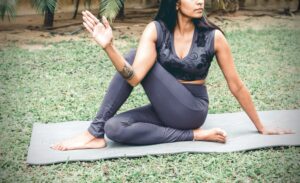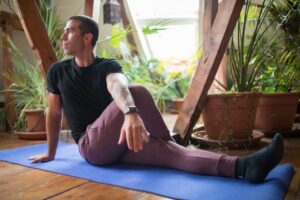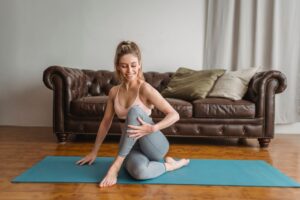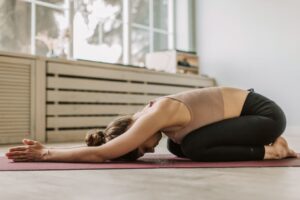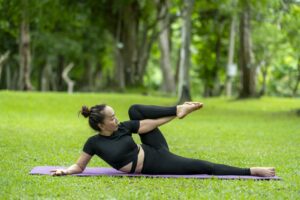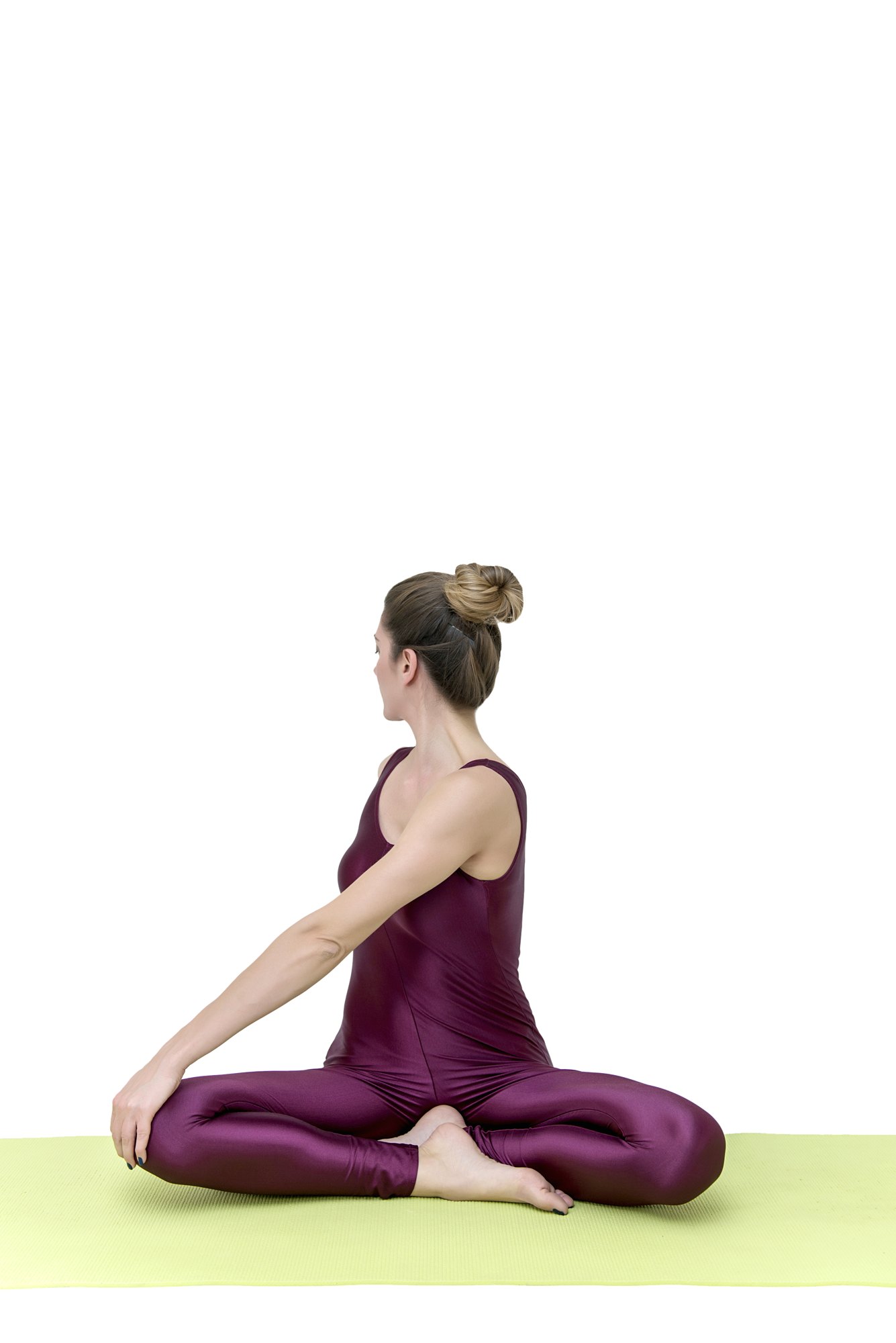
In short: revolved easy seat is the simplest seated twist: you sit cross-legged, lengthen the spine, place one hand on the opposite knee and the other on the floor behind you, and turn gently toward the back hand. It warms up the spine at the start of a class, rests it at the end, and it is the base of most chair twists. Almost everyone can do it.
Because it is so simple, it rarely gets its own name in the classic manuals. It is taught in hatha, vinyasa, gentle and chair yoga classes, often to loosen the back after sitting.
About the name
Revolved easy seat (also revolved easy pose, easy seated twist or simply seated twist) is a modern descriptive name: it is easy pose with a twist. You will often see the Sanskrit-style name Parivrtta Sukhasana in modern classes and apps, built from parivṛtta (revolved) and sukhāsana (easy pose), but we have not found it in the classic manuals or lineage sources, so we treat it as modern usage rather than an established Sanskrit name. Yoga Journal uses both names: it lists Revolved Easy Pose (Parivrtta Sukhasana) among gentle twists for the back, and elsewhere describes sitting cross-legged and gently twisting as an easier variation of Bharadvaja’s twist. Yoga International teaches the same shape as “easy pose twist”, a good first twist when the legs of the deeper twists are hard, and lists “easy seated pose twisting (parivrtta sukhasana)” in a restorative sequence.
Making the twist work
The whole pose depends on sitting tall. If the knees are higher than the hips or the lower back rounds, sit on a folded blanket or cushion so the pelvis tilts slightly forward. Then use the breath: inhale to lift through the crown of the head, exhale to turn. Turn from the belly and ribs first, then the shoulders, and let the head follow last, without straining the neck. The hand on the knee guides the turn; the back hand, close to the hips, helps you stay upright rather than leaning back on it. Stay for a few slow breaths, come back to the centre, change the cross of the legs and turn the other way. Yoga teacher Judith Hanson Lasater’s advice for gentle seated twists, published in Yoga Journal, also applies here: keep the base level and let the pelvis move with the spine rather than locking it.
Precautions in plain words
This is a mild twist, but go gently with disc problems, sacroiliac pain or a recent back injury, and ask your doctor or physiotherapist if you are unsure. If the knees or hips are uncomfortable cross-legged, sit on a higher cushion or use the chair version. In pregnancy keep the turn small and the belly free. This page is general information, not individual advice.
Preparation and what comes next
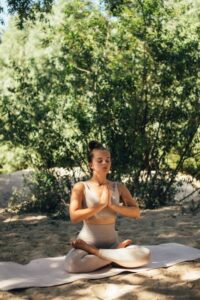
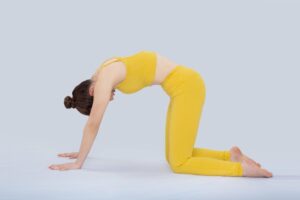
No preparation is needed beyond a comfortable easy pose and perhaps a few rounds of cat-cow. From here, Bharadvaja’s twist, Marichi’s twist and half lord of the fishes are deeper seated twists, and the reclining spinal twist is the lying-down equivalent. It pairs well with a few minutes of meditation or diaphragmatic breathing in the same seat.
When to use it. Revolved easy seat is useful at the start of a practice, a few gentle turns each way to wake up the spine, and at the end, after backbends or forward bends, to even things out. It also fits into a working day: the chair version takes less than a minute and can be done at a desk. Move slowly, keep the breath relaxed, and treat it as a gentle stretch rather than a test of how far you can turn.
You will meet revolved easy seat in hatha, vinyasa and chair yoga classes, and in many gentle and restorative sessions.