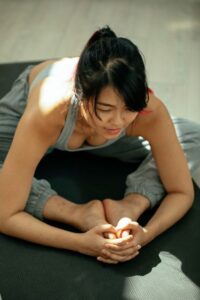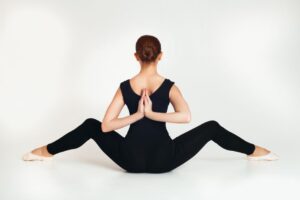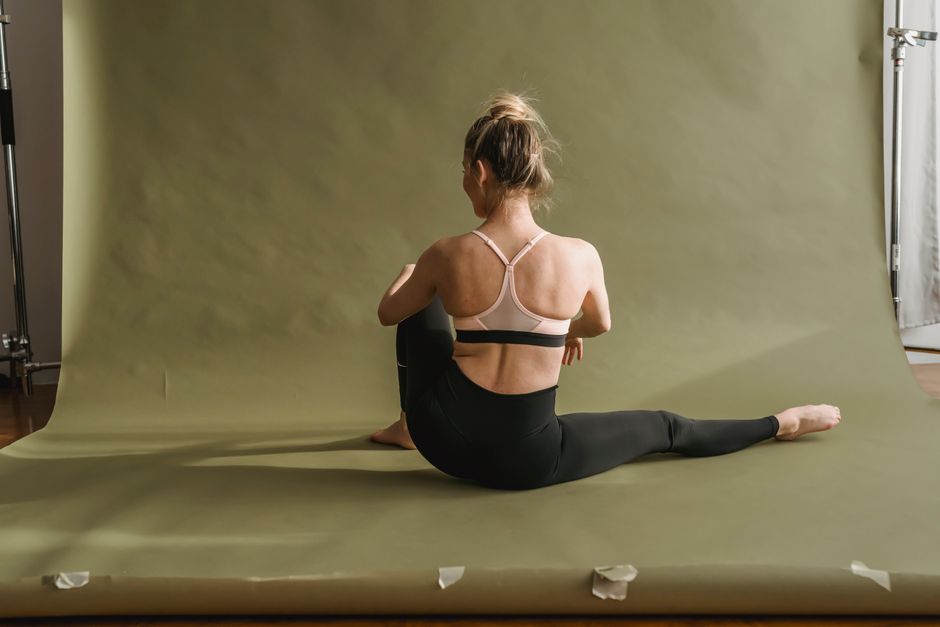
In short: deer is a seated yin position with both knees bent to the same side: the front leg folds in front of you and the back leg folds behind. One hip turns out, the other turns in, which makes deer a useful counterpose after poses that only turn the hips out. You can sit upright or add a soft twist.
Deer appears twice on this site: this yin record and the general deer pose. Below we explain the yin approach, the setup, how long to stay and the cautions.
The name and the related asanas
Deer is an English name with no established Sanskrit. Bernie Clark describes it as a mix of two classical leg positions: the back leg as in hero pose (Vīrāsana) and the front leg as in lotus or bound angle. In yin, the muscles stay relaxed and the pose is held quietly, either briefly between other poses or for a few minutes on its own.
Setting up
Clark starts in butterfly and swings one leg around behind, so the foot comes beside or behind the hip of that side, with the front leg at roughly a right angle. Leah Sugerman (Yoga International) starts with the feet on the floor, mat-width apart, and lets both knees drop to one side. Keep both sitting bones grounded; Clark warns against tipping away from the back leg. If the front knee complains, bring that foot closer to the groin and put a blanket under the knee.
The long hold and twisted deer
Clark finds that most people use deer mainly as a counterpose, held for up to a minute. Sugerman holds it three minutes per side, and Yoga Journal’s deep-release sequence takes twisted deer for three minutes: sit on one hip with both knees bent about 90 degrees, draw the back leg behind until you feel the front of that hip, lengthen the spine and twist over the front thigh, resting on the forearms, blocks or a bolster.
Why deer is easy to get wrong
Deer looks simple, and Bernie Clark notes that most students do not at first understand what the pose is asking for. Two things usually go astray. The feet stay too close to the groin and the hip, so neither hip is really turning. Or the body tilts away from the back leg, and the back hip, the one turning inward, lifts off the floor. Both sitting bones staying down matters more than how far the feet go.
Clark’s way of finding the right spot is to move the back foot away from the hip only until you feel yourself starting to tip away from it, then hold that position with both sitting bones rooted. If you tip easily, bring both feet in toward the center of the body. If you are very flexible, you can gradually move the feet further away from the hips. The front knee aims for roughly a right angle; if that knee is sensitive, keep its foot nearer the groin and slide a folded blanket or a bolster under it.
The twisting version
To add a twist, Clark turns the upper body toward the back foot. You can rest on an elbow, and if the body allows, lower the head toward the floor. This adds a stretch along the side of the body and the thigh of the back leg. Keep the back hip grounded as you turn, so the twist comes from the spine and not from lifting off the floor.
Where deer fits in a practice
Clark places deer after long holds that turn the hips outward with the legs wide, such as shoelace, swan or dragonfly. Used that way, a minute or less on each side is enough. If you hold it longer as a main pose, as Sugerman and Yoga Journal do, come out slowly and give the other side the same time.
Coming out and the rebound
Lean away from the back foot, bring the back leg around to the front and return to butterfly. Clark’s best counterpose for deer is simply the other side, followed by windshield-wiper knees if you like.
Precautions in plain words
Deer is gentle, but the back knee and the inward-turning hip deserve care. With knee problems, keep the front foot close to the groin and support the knee. After a hip replacement, ask your surgeon about turning the back hip inward. In pregnancy, skip the twist or keep it very gentle. This page is general information, not individual advice.
Before, after and where it is taught
Deer often comes after square or shoelace to balance the hips, and after butterfly as a transition. You will meet it in yin yoga classes, which hold mostly floor poses for several minutes with the muscles relaxed, and in some gentle and restorative classes.