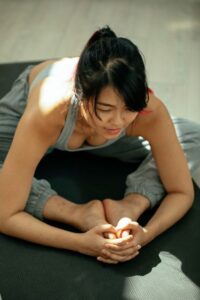
In short: square is a seated yin hip opener. You sit cross-legged, move the feet forward until the shins line up parallel to the front of the mat, and, if the knees allow, stack one shin on top of the other. Then you fold forward and rest there for a few minutes on each side.
Below: how it relates to fire log pose (double pigeon), how to keep the knees safe, the hold and coming out.
The name and the related asana
Square is an English yin name with no Sanskrit of its own. Paul Grilley introduced it in Yoga Journal as the yin variation of easy seat (Sukhāsana), and its stacked form has the same legs as fire log pose (Agnistambhāsana), which many people call double pigeon. In the active pose the spine stays tall and the feet work; in yin square the spine may round, the legs relax and the hold is long.
Setting up with props
Bernie Clark starts cross-legged and moves the feet forward until the shins are parallel to the front edge of the mat, then slides the knees a little closer without pulling the feet back. Janice Quirt (Yoga International) aims for a 90-degree bend in the knees and flexed ankles. Only if the knees are fine does the top ankle go onto the bottom knee. Sit on a cushion if the hips are tight; put a blanket or block under a high knee, or between the top knee and the bottom foot. Grilley warns against letting the top foot sickle, which strains the outer ankle.
The long hold
Fold forward with a rounded back if it is comfortable. Grilley’s advice suits every yin pose: start conservatively in a position you can gradually deepen for three to five minutes, rather than starting aggressively and having to back out. Clark gives three to five minutes per side; Quirt holds four.
Finding the right version for your hips
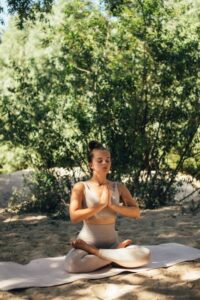
Square can be tricky to get into, and Clark’s key is simple: go where you feel the outer hips, never the knees. Beginners often let the feet slide back toward the groin, which turns square into an ordinary cross-legged seat. Keep the shins forward, parallel to the front edge of the mat. But Clark adds a kind note: if plain cross-legged sitting already works your hips a lot, then that is your version of square. Stay there and enjoy it.
There are three main levels. The first is shins parallel in front of you, one in front of the other, with the knees supported on blankets if they float. The second, for more flexible hips, slides the knees closer together while the feet move further apart. The third stacks the shins: one ankle over the opposite knee, the other ankle under its opposite knee. Clark’s test is clear: if the top knee sits very high in the air, you are not ready for that variation, so bring the top foot back down to the floor in front of the other knee.
Sitting the pelvis right
Clark warns against letting the hips roll backward while seated; you want the pelvis tipping slightly forward so you can fold from the hips. Sitting on a cushion helps with that. It also helps with sciatica: raise the hips until the knees are below them, or skip the pose. Folding forward adds a stretch for the lower back and makes the hip sensation stronger, so fold only as far as the knees stay quiet. If your lower back should not round, stay upright with the back as straight as you can.
After the hold, Clark suggests bouncing the legs out in front and tightening and releasing the knees a few times before the counterposes. Square also makes a good preparation for lotus pose, since both ask for strong outward rotation of the hips.
Coming out and the rebound
Come up slowly, lean back and straighten the legs out in front, then pause. Clark suggests deer, windshield-wiper knees, tabletop or gentle spinal lifts as counterposes. Change the cross for the second side.
Precautions in plain words
The knees decide how far you go. Clark stresses that the sensation should stay in the hips; if a knee hurts, unstack the shins or skip the pose. Raise the hips on a cushion with sciatica, and stay upright if your lower back should not round. This page is general information, not individual advice.
Before, after and where it is taught
Easy pose and reclining figure four prepare the hips; shoelace and swan are the other yin outer-hip shapes. You will meet it in yin yoga classes, which hold mostly floor poses for several minutes with the muscles relaxed, and in some gentle and restorative classes.