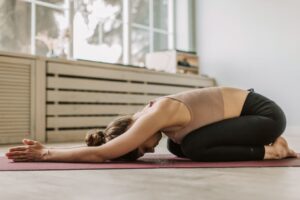
In short: yin frog is a kneeling hip opener. From child’s pose you take the knees wide and rest the chest down, then choose how far forward the hips go: back toward the heels (Tadpole), in line with the knees with the feet together (half frog), or with the shins parallel (full frog). You stay three to five minutes.
This page explains the three stages, how to pad and support the pose, and why it is not the same as the frog pose of Light on Yoga.
The name and the related asanas
Frog is an English yin name with no Sanskrit of its own. Names get confusing here: Bernie Clark names Maṇḍūkāsana or Bhekāsana as its yang equivalents, yet in B.K.S. Iyengar’s Light on Yoga, Bhekasana is a belly-down backbend holding the feet, which has its own page as frog pose. The yin frog is the wide-knee kneeling shape, so its closest active relative on this site is wide-knee frog. In yin the chest rests and the hips settle without effort.
Setting up with props
Pad the knees well. Start in child’s pose, slide the hands forward and separate the knees while still sitting toward the heels; Clark and Janice Quirt (Yoga International) call this Tadpole. Rest the forehead, not the chin, on the floor or a bolster if the neck is stiff, and a bolster under the chest lets the upper body relax. If the shoulders complain, spread the hands wider.
The long hold: Tadpole, half frog, full frog
Quirt holds Tadpole for two minutes, then lifts the hips forward until they are about in line with the knees and lets the pelvis sink: that is half frog, with the feet together. For full frog, turn the feet out and separate the heels until the shins are parallel, ankles flexed. She holds either for three minutes; Clark suggests three to five minutes in total. If the groin feels too intense, let the hips move forward or back.
Why the hip position matters: Clark notes that when the hips are in line with the knees, gravity has its greatest effect on the inner thighs and groin. If you feel a painful pinch, it is fine to slide the hips a little forward, or to keep the toes together and let the hips go back toward Tadpole. His advice for progress is a good yin rule in general: don’t go deeper to advance in this posture, stay longer. One way to do that is to spend the first half of the hold in Tadpole and move to full frog for the second half.
The arms are worth thinking about too. Clark says extending one arm at a time is safer than reaching both arms forward: bend the other arm and rest the head on that forearm, then switch halfway through. If you practice frog soon after a meal, he suggests resting on the elbows so the belly hangs free instead of pressing into the floor. Breathe slowly and let the inner thighs soften with each exhalation; the work is in staying still, not in pushing the knees wider.
Clark describes frog as a deep groin opener, especially for the adductors (the inner-thigh muscles), with a slight backbend in the lower back. That small backbend is the reason people with a sensitive lower back should keep the chest supported and the hips a little back. He also calls it an excellent pose to begin a class, or to use when you are short of time.
Coming out and the rebound
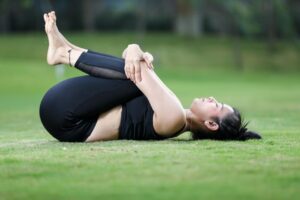
Sit back into child’s pose, or slide forward onto the belly and bring the legs together slowly. Then, as Clark suggests, lie on the back, hug the knees to the chest and rock gently or circle the knees.
Precautions in plain words
Clark lists a bad back, knee discomfort, a stiff neck and tingling hands (with the arms overhead) as reasons to adapt: support the chest, reduce the width, rest the forehead and extend one arm at a time. In pregnancy keep the chest well supported so the belly is free. This page is general information, not individual advice.
Before, after and where it is taught
Child’s pose and butterfly prepare the inner thighs; dragonfly works them seated. You will meet it in yin yoga classes, which hold mostly floor poses for several minutes with the muscles relaxed, and in some gentle and restorative classes.