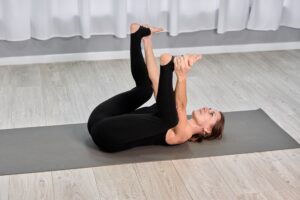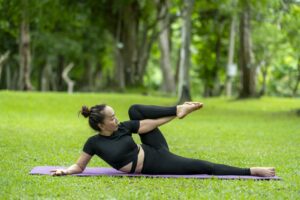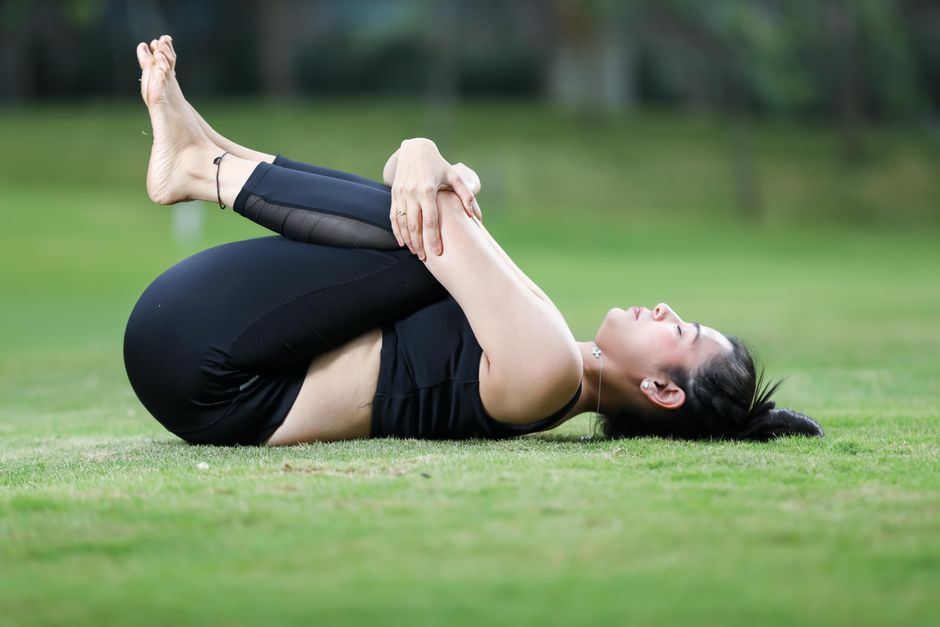
In short: wind-relieving pose is lying on your back and hugging one or both knees in toward the chest. It gently rounds and releases the lower back and presses the thighs against the belly. It is simple, safe for most people and useful at the start or end of a practice and after backbends. Keep the head and shoulders relaxed on the floor and hug the legs, rather than yanking them.
Few poses are as easy to do in bed, on a beach towel or on a hotel-room floor. The shape is the same in every school, but the name is not, so this page explains the names first, then how to do the both-knees and one-knee versions, the precautions and where the pose fits in a practice.
One shape, several names
Pavanamuktāsana joins pavana, wind or air, mukta, released, and āsana, posture (see what asana means); the Bihar School spells it Pawanmuktasana. It is a 20th-century name. In Bikram’s 26-posture hot yoga sequence, “wind-removing pose” (Pavanamuktasana) is the knees-to-chest pose of the floor series: first the right knee, then the left, then both. The Bihar School of Yoga uses the word more broadly. In its manual Asana Pranayama Mudra Bandha, the Pawanmuktasana series is a whole group of simple joint and abdominal exercises, and the knees-to-chest movement inside it is called the leg lock pose, also known as Supta Pawanmuktasana. We cover that series on its own page, the Pawanmuktasana series.
Many modern classes, especially those influenced by T.K.V. Desikachar’s Viniyoga, call the both-knees version Apānāsana, after apāna, the downward-moving breath or energy of yoga physiology. We list Apanasana as a common alternative name, but we have not confirmed it in two primary sources, so the page uses Pavanamuktasana as its main Sanskrit name. In English you will also hear knees-to-chest pose. In yin yoga, hugging the knees and rocking is used as a counterpose rather than a held pose.
How to make it work
Lie on your back, bend both knees and draw them toward the chest. Hold the shins just below the knees, or hold the backs of the thighs if your knees do not like deep bending. Let the lower back and the back of the pelvis rest on the floor; the curve of the lower back gently flattens. Keep the head down and the chin slightly tucked so the back of the neck stays long, as the Bikram dialogue cues. Each exhalation, hug a little closer; each inhalation, let the belly press gently into the thighs. Half a minute to a minute is plenty, and you can rock slowly from side to side to massage the lower back, a counterpose Bernie Clark suggests after yin backbends such as saddle.
The Bihar School’s leg lock pose adds a movement: with the breath held out, the head and chest lift to bring the nose toward the knee, repeated several times. That is a more active abdominal exercise; holding the breath and lifting the head are optional and best skipped with neck problems or high blood pressure.
One-legged wind-relieving pose
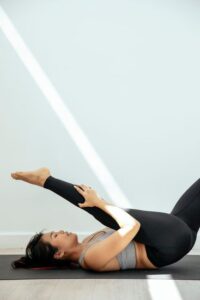
The one-leg version hugs one knee at a time while the other leg stays long on the floor. It is the first stage in the Bikram sequence and in the Bihar leg lock pose, and it is often easier on the lower back. Keep the straight leg active and the back of that thigh heavy; the Bihar School’s teaching on back care emphasises extending the resting leg to stretch the front of its hip. If the straight leg makes the back arch, bend it with the foot flat. You may hear it called half wind-relieving pose; the Sanskrit forms Eka Pāda or Ardha Pavanamuktāsana are descriptive, not names we have confirmed in a primary source. Do both sides, then finish with both knees in.
Precautions in plain words
With a knee problem, hold behind the thighs rather than on the shins so the knees bend less. Hug gently: with a disc problem, check with your doctor or physiotherapist about bending the lower back, and skip lifting the head. After the first trimester of pregnancy, take the knees wide to the sides of the belly, keep it short and follow your health care provider’s advice, as lying flat on the back for long periods is not recommended. Recent abdominal surgery or hernia: ask your doctor first. This page is general information, not individual advice.
Preparation, what comes next and where it is taught
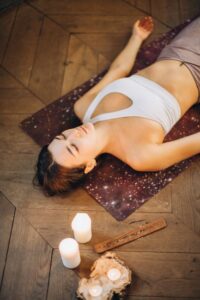
No preparation is needed. Wind-relieving pose is a natural counterpose after backbends such as bridge, wheel or locust, and a gentle way into happy baby, reclining spinal twist and corpse pose. You will meet it in hot yoga (Bikram’s floor series), Bihar School (Satyananda) classes, gentle hatha and restorative sessions. Pair it with slow diaphragmatic breathing.