The Pawanmuktasana series is a set of simple, mostly seated and lying movements taught by the Bihar School of Yoga (Satyananda tradition) as preparation for asana practice. It is set out in Swami Satyananda Saraswati’s manual Asana Pranayama Mudra Bandha, which divides it into three groups: an anti-rheumatic group of joint movements from the toes to the neck, a digestive or abdominal group, and a group called shakti bandha, “energy block” postures. Each group has its own page.
The name
Pawanmukta combines pawan (wind, air) and mukta (released), so the series is often translated as “wind-releasing” or, more loosely, joint-freeing. The same word appears in the name of a single posture, wind-relieving pose (Pavanamuktasana), in which the knees are hugged to the chest; that posture appears inside Part 2 of the series as Supta Pawanmuktasana. The group names (anti-rheumatic, digestive, energy block) are the source’s own labels; we report them as names, not as health claims.
The manual gives its own gloss: pawan means wind or prana, mukta means release, and asana means pose. It also says these practices are called sukshma vyayama in Sanskrit, which it translates as “subtle exercise”. The book describes the series as one of the special contributions of Swami Satyananda’s teaching.
The three groups
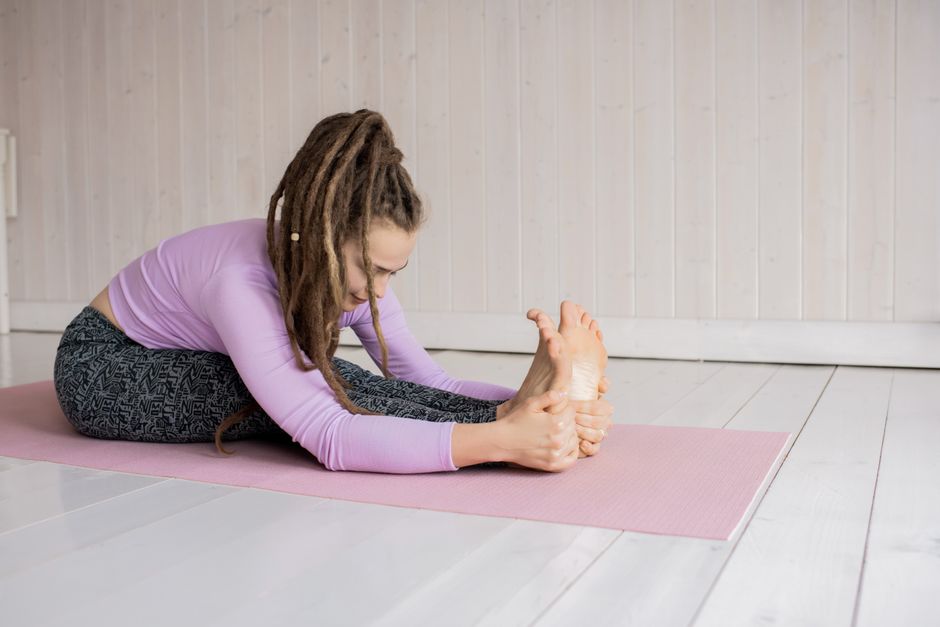
- Part 1, anti-rheumatic group: bending, rotating and clenching movements of the toes, ankles, knees, hips, hands, wrists, elbows, shoulders and neck, done sitting with the legs stretched out.
- Part 2, digestive/abdominal group: leg raises, leg rotation, cycling, the leg-lock (wind-relieving) pose, rocking and rolling, abdominal twists and a lying boat pose.
- Part 3, shakti bandha: pulling the rope, dynamic spinal twist, churning the mill, rowing the boat, chopping wood, the salutation squat, wind-releasing pose, crow walking and the abdominal stretch.
How it is practised
Movements are slow and coordinated with the breath, usually repeated around five to ten times each in the source, with awareness on the moving joint. The manual presents the series as suitable for beginners and for people for whom vigorous exercise is not advisable, and as a foundation before other asanas; a class may use one part or all three. The order of the groups (Part 1, then 2, then 3) and of the exercises within them follows the book.
The book places the series in its beginners group, next to eye exercises, relaxation and sun salutation, and says it may be practiced by anyone, beginner or advanced, young or elderly. It asks you to perform the practices in each group in the order given and to become steady in each group before moving on to the major asanas.
Counting, breath and sides
Most practices in Part 1 are done ten times, and rotations ten times in each direction. Part 1 can be done in three ways, according to the manual: with full attention on the movement while you count each round in your mind; with each movement matched to the breath, which makes it slower; or with attention on the flow of prana. You can start with the first and add the breath once the movements feel familiar. For one-sided movements the book notes that right-handed people usually find them easier with the right side leading, and should then practice with the left side leading too.
Rest is part of the method. In Part 1, after every two or three practices, sit quietly for about a minute with the eyes closed and notice the breath and the parts you have moved; the book says this rest is almost as important as the movements. In Part 2, rest lying down between practices until the breath returns to normal, and do not try every practice at once: add one at a time. End with three to five minutes of corpse pose.
The manual’s general advice is to practice on an empty stomach, three or four hours after food, which is one reason it recommends the early morning. It also lists a few practices from the series as preparation for sitting in meditation, among them ankle rotation, knee crank, half and full butterfly, hip rotation, wind-releasing pose and the abdominal stretch. Using a thin mat or folded blanket helps in the rocking practices of Part 2.
Precautions
Most of Part 1 is gentle and widely accessible. Parts 2 and 3 include leg raises, rocking on the spine, deep squats and abdominal work: with back problems, recent abdominal surgery, high blood pressure, hernia or pregnancy, ask a health professional and leave out the stronger movements. The manual itself says Part 2 should not be practiced with high blood pressure, serious heart conditions, sciatica or a slipped disc, or soon after abdominal surgery, and that it can strain the lower back. Some practices in Parts 2 and 3 ask you to hold the breath for a few seconds; if you have high blood pressure or a heart condition, or if holding feels uncomfortable, keep breathing normally instead. Joint problems such as arthritis need medical care; the series is a movement practice, not a treatment. This page has not yet been reviewed by a qualified teacher.
Easier alternatives
Start with Part 1 only, and use smaller movements. The book allows the hand and arm practices in a cross-legged seat, and the neck movements are done sitting cross-legged. If getting to the floor is hard, the joint movements of Part 1 adapt well to a chair; see our chair yoga sequence for a seated routine.