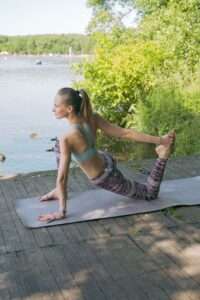
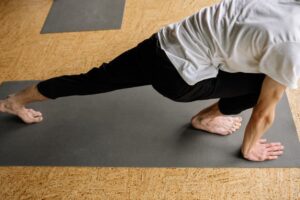
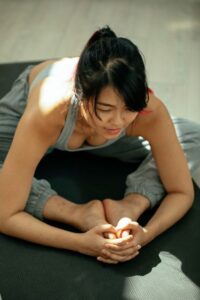
In short: shoelace is a seated yin hip opener. The thighs cross so that one knee stacks on top of the other and the feet come to rest beside the opposite hips, like crossed laces. You sit on a cushion, fold forward if it is comfortable, and stay a few minutes on each side.
Below: how it relates to cow face pose, how to set it up so the knees are safe, the hold and the cautions.
The name and the related asana
Shoelace is an English yin name with no Sanskrit of its own; it shares its legs with cow face pose (Gomukhāsana). Cow face is usually taught upright with an arm bind; the yin version adds a slow, relaxed forward fold and a long hold that targets the outer hips and buttocks.
Setting up with props
Bernie Clark gives three ways in: from hands and knees, placing one knee behind the other and sitting back between the heels; from sitting on the heels; or from a cross-legged seat. In every case slide the feet as far forward as they go so you are not sitting on them. Sit on a bolster or cushion if the hips are tight; Leah Sugerman (Yoga International) raises the seat whenever there is a large gap between the knees. A blanket under the top knee helps, and if the bottom knee complains, keep that leg straight. Yoga Journal calls that the easier option; some teachers name it half shoelace.
Keeping the stretch in the hips, not the knees
Bernie Clark’s teaching notes for shoelace come back again and again to one idea: the weight belongs in the sitting bones. A few details make that happen.
- Start with your more open hip. Place the knee of the more flexible side on top first, so the first side teaches you the shape with less effort.
- Stay heavy at the back. As you fold forward, keep the weight back in the sitting bones. If the weight slides forward, it moves into the knees.
- Keep the hips even. The hip of the top leg tends to pull forward. Let both sides of the pelvis face the front.
- Turn the intensity down when you need to. If the hips or knees feel too much, stay upright or take more weight into the hands and arms. If it is still too hard, simply sit cross-legged and fold forward instead.
The arms are free: rest the hands to the sides or in front of you, or stretch them behind the body. Clark also suggests using the first half of the hold for a side bend or a twist and folding forward for the rest, and points out that the long stillness is a good moment to add a shoulder or wrist stretch.
The long hold
Ground both sitting bones, then fold forward with a rounded back if it suits you, resting the chest on a bolster or the head on the hands or a block. Clark and Yoga Journal suggest three to five minutes per side; Sugerman holds five. Feel the stretch in the outer hip of the top leg and the buttocks, never in the knees.
Coming out and the rebound
Walk the hands back, come up slowly, lean back to release the hips and straighten the legs. Clark and Yoga Journal suggest windshield-wiper knees as a counterpose; Clark also uses deer and tabletop. Then cross the other leg on top.
Clark likes to follow the first side with sleeping swan before you cross the legs the other way, and a seated twist works well afterwards too. Windshield-wiper knees, lying down or sitting, turn the thighs inward, the opposite of the outward rotation of shoelace, which is why they make such a natural counterpose.
Precautions in plain words
Shoelace asks a lot of the hips, and when the hips are tight the knees take the strain. Keep the bottom leg straight or skip the pose if a knee hurts. Clark notes it can aggravate sciatica and is not for backs that should not flex, and that pregnant students should not fold forward after the first trimester. This page is general information, not individual advice.
Before, after and where it is taught
Reclining figure four and square are gentler ways into the same area; swan works it from kneeling. You will meet it in yin yoga classes, which hold mostly floor poses for several minutes with the muscles relaxed, and in some gentle and restorative classes.