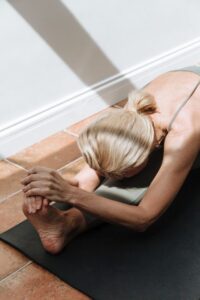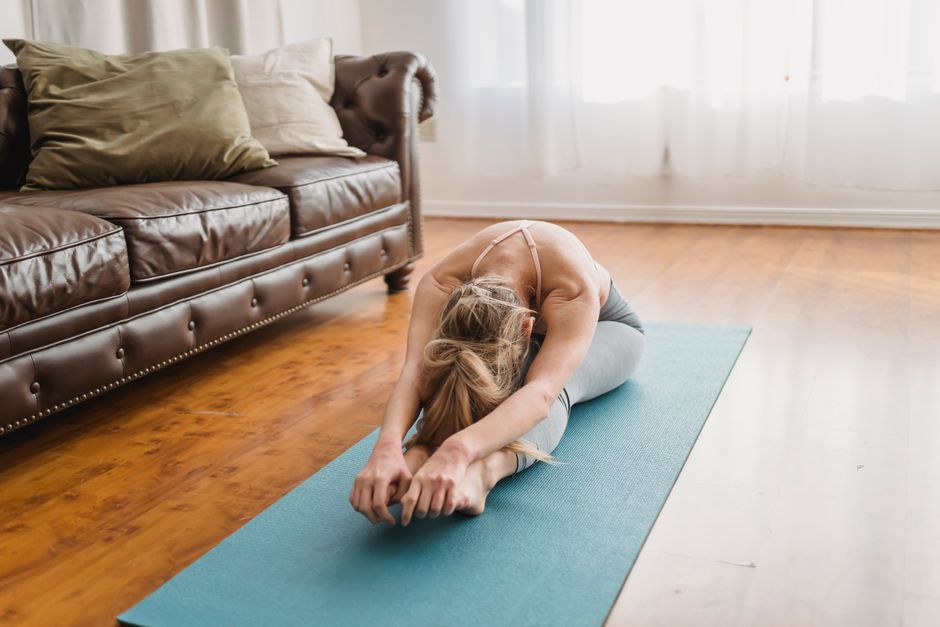
In short: caterpillar is the yin version of a seated forward fold. You sit with the legs out in front, fold forward and let the back round, then rest there with the legs and back relaxed for several minutes. Bent knees and a bolster are welcome.
Below we compare it with seated forward bend, then cover props, the hold, coming out and who should take care.
The name and the related asana
Caterpillar is an English yin name, with no Sanskrit of its own; Paul Grilley calls the same shape simply Forward Bend, the yin variation of Paścimottānāsana. In the active pose you fold from the hips with a long spine and firm legs. Bernie Clark sums up the difference: caterpillar rounds the spine rather than lengthening it. Grilley lets the knees bend and the legs roll out as long as you feel the stretch moving up the back of the body, and he drops the chin toward the chest first.
Setting up with props
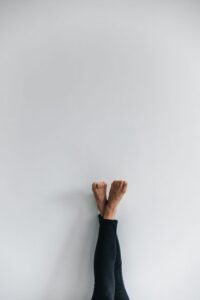
Sit on a cushion or folded blanket. If the hamstrings are tight, bend the knees over a bolster so the legs can relax. A bolster or pillow on the thighs gives the forehead or chest a resting place, which Yoga Journal shows in its 12-pose sequence. With sciatica, or if the pelvis tips backward even on a cushion, Sarah Powers and Bernie Clark suggest lying on the back with the legs up a wall instead.
The most useful check is the top of the pelvis. Bernie Clark asks that the tops of the hips tilt forward; if they roll backward, sit on higher cushions and bend the knees more. The reason is simple: if you cannot fold forward far enough for gravity to draw you down, the muscles keep working and you never relax into the shape. Keep adding height and bending the knees until the fold feels easy to stay in.
Other options from his page: if the weight of the head strains the neck, hold the head in your hands with the elbows resting on the legs or a bolster. If the knees feel strained, keep a slight bend with a blanket underneath them. If you are very flexible and the fold feels like nothing, part the legs just enough for the chest to fit between them. Clark also notes that the legs-up-the-wall version is very nice for people who stand all day.
The long hold
Fold until you meet a clear but tolerable stretch, then let gravity do the work. Clark and Grilley suggest three to five minutes or longer; Yoga Journal’s sequence uses four to five. Let the hands rest on the legs, the floor or the feet without pulling.
The aim is different from the active forward bend. Clark writes that you are not trying to lengthen the spine or stretch the back muscles here, and not trying to bring the head to the feet. Instead, round the spine so the head comes toward the knees. He describes the pose as working the back of the spine, so the sensation is often felt along the back as much as in the legs. Keep the leg muscles soft.
Experiment with the hands: rest the elbows on the thighs or the floor, or hold the toes loosely. There is no need to pull. Breathe quietly and let each exhalation soften you a little further, then stay still. If the stretch fades after a minute or two, you may fold a bit deeper; if it turns sharp or tingly, come up a little.
Coming out and the rebound
Push the floor away and roll up slowly, one vertebra at a time. Clark treats this as a test of patience: slowly means “not fast,” so take several breaths to come up. Lean back on the hands to free the hips, then shake the legs out gently. Rest for a few breaths. Clark suggests sitting upright, a gentle seated backbend, lying on the belly, tabletop or a seated twist as counterposes.
Precautions in plain words
Rounding the lower back under load is not for everyone. With sciatica, use the legs-up-the-wall alternative; with a disc problem, ask your doctor or physiotherapist and skip the fold if in doubt. Support the head if the neck strains. In pregnancy, widen the legs and keep the fold small. This page is general information, not individual advice.
Before, after and where it is taught
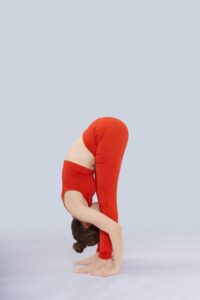
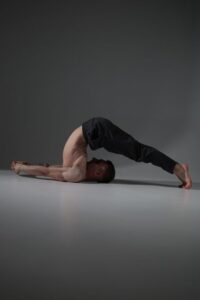
Butterfly warms up the same areas; half butterfly is a one-leg version. Dangling is the standing cousin and snail a much stronger, inverted one; sphinx is a gentle counterpose. You will meet it in yin yoga classes, which hold mostly floor poses for several minutes with the muscles relaxed, and in some gentle and restorative classes.