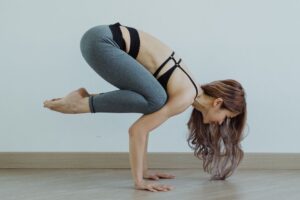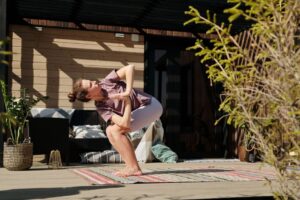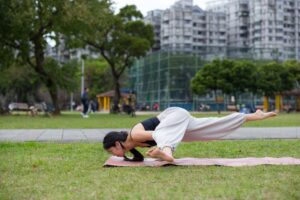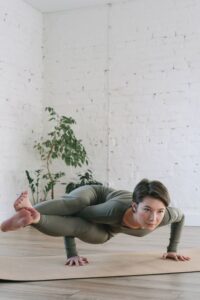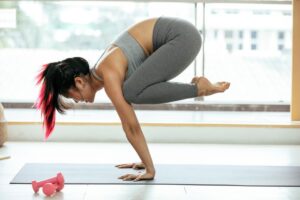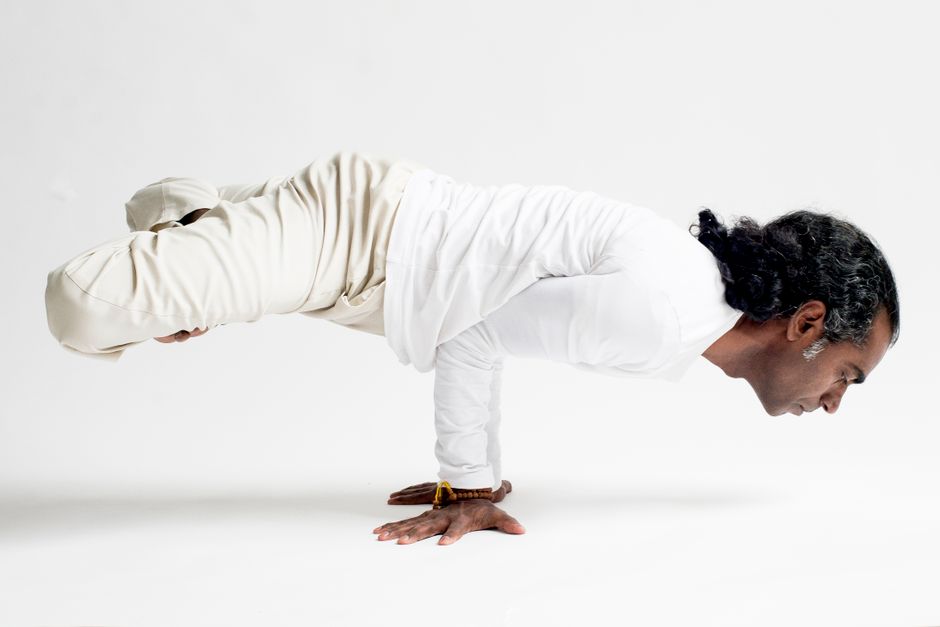
In short: side crow is a twisting arm balance. From a squat with the knees together, you twist, place both hands to one side of the legs, rest the outer thigh on the back of one upper arm and lean forward until the feet lift, with both knees stacked to the side. It is an advanced pose that depends on a deep twist and a strong core more than on arm strength.
Side crow and side crane are the same posture with two English names. Like crow and crane, the names are used loosely: some teachers say side crow when the elbows are bent and side crane when they straighten, others use the two names interchangeably.
The name
Pārśva means side or flank, and bakāsana is crane pose, so Pārśva Bakāsana is the side crane. The Iyengar Yoga (UK) teaching syllabus lists it at plate 412 of B.K.S. Iyengar’s Light on Yoga, right after Bakāsana. Yoga Journal titles the pose Side Crow or Side Crane (Parsva Bakasana) and also uses Parsva Kakasana in its teaching notes, which follows the crow and crane naming of the straight-on pose. Yoga International teaches the same shape as side crane or crow.
Making the pose work
The key is the twist. Yoga Journal puts it plainly: twist enough to place the outer edge of one upper arm far around the outside of the opposite thigh. The deeper the twist, the higher the thigh sits on the arm and the shorter the lever you have to lift. Bend the elbows toward 90 degrees, as in chaturanga, keep them hugging in, and lean forward so the head travels toward the floor while the feet rise behind you. A block or bolster under the forehead gives a safe point of contact while you find the balance.
Yoga International describes a helpful learning stage: rest the hip on the back arm as well as the thigh on the front arm, then gradually shift all of the legs onto the front arm as you get stronger, taking care that the back shoulder does not drop. Spread the fingers and press through the whole hand to spare the wrists. Yoga Journal suggests holding for three to five breaths.
Precautions in plain words
Side crow loads the wrists, elbows and shoulders unevenly and twists the spine. Yoga Journal notes that people with elbow or shoulder injuries, or lower back problems, may want to avoid it. Do not practise it with wrist pain, and in pregnancy skip deep closed twists and arm balances unless your health care provider and an experienced prenatal teacher agree. Warm up the spine with twists first. This page is general information, not individual advice.
Preparation and what comes next
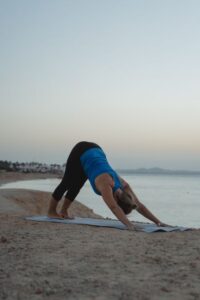
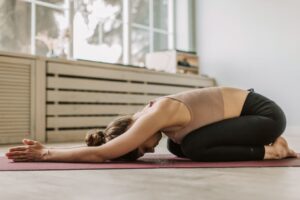
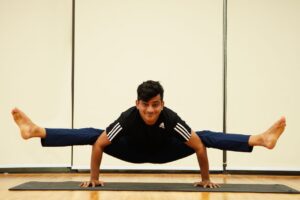
Prepare with chaturanga, crow, revolved chair and seated twists such as Marichi’s twist; Yoga Journal adds standing forward bend and downward dog. From side crow, the legs can scissor open into Sage Koundinya’s pose I, or straighten together to the side, which Yoga Journal offers as a harder variation. Eight-angle pose uses a similar twist with straight legs. Afterwards, untwist in child’s pose or downward dog.
A simple way to practise it. Build side crow over several sessions rather than in one go. Start each time with a few twists from a squat, hands on the floor to one side, without lifting anything. Next, set a block in front of you, lean until the forehead rests on it and let the feet float for a breath or two. When that is steady, lift the head off the block. Finally, try lifting the back hip off the back arm so the legs rest only on the front arm. Always practise both sides, starting with the side that feels harder, and stop while the wrists still feel fresh.
Side crow appears in Iyengar classes and is a favourite peak pose in vinyasa and power yoga.