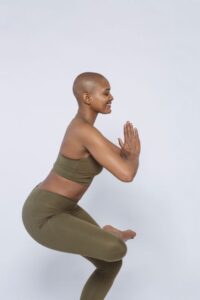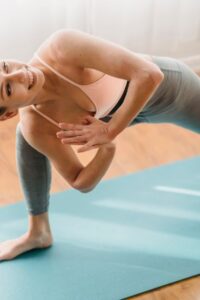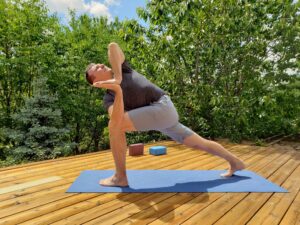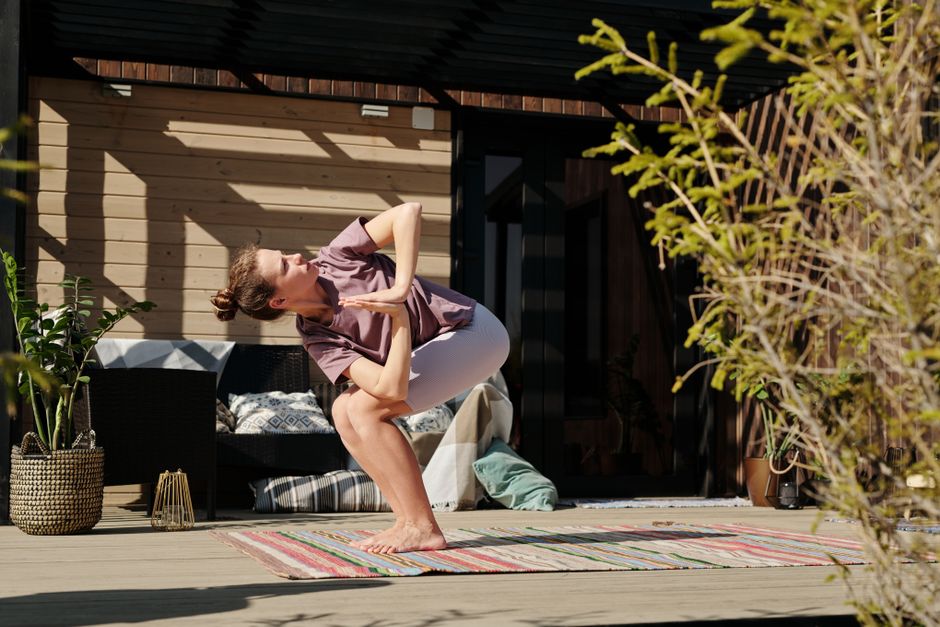
In short: revolved chair is chair pose with a twist: knees bent and hips back, palms together at the chest, and one elbow hooked outside the opposite thigh while the chest turns toward the ceiling. It works the legs and asks the upper spine to rotate. Keep the knees level and the weight in the heels, and twist from the ribs, not by cranking the neck.
Because it combines a strong squat with a twist, revolved chair is a step up from chair pose and we class it as intermediate. Below we explain the name, the cues that keep the pelvis steady, the precautions and where the pose leads.
The name
The Sanskrit name is Parivṛtta Utkaṭāsana: parivṛtta means revolved or turned around, and Utkaṭāsana is chair pose, from utkaṭa, powerful or fierce. Yoga Journal and Yoga International both use this name, and Yoga Journal also calls it “revolved powerful pose”. It does not appear in Light on Yoga, which teaches only the upright Utkatasana, so treat it as a widely taught variation rather than a classical asana.
Iyengar’s upright chair pose is still the best foundation. In Light on Yoga he joins the palms overhead, bends the knees until the thighs are parallel to the floor, and asks you not to stoop forward but to keep the chest as far back as possible while breathing normally. He describes it as like sitting on an imaginary chair, admits it is difficult to balance in, and suggests staying a few seconds, with 30 being sufficient. If that upright version already shakes, build it up before adding the twist.
Making the twist work
Set up a solid chair pose first: weight in the heels, hips back, knees over the ankles rather than out over the toes. Yoga Journal’s cue is to draw the thighbones back to anchor the pelvis, which is what later lets the upper body twist further. Bring the palms together at the chest, inhale to lengthen up through the crown of the head, and on an exhalation turn to the right and hook the left elbow outside the right thigh.
The most common fault shows in the knees: as you twist, one knee slides forward of the other and the pelvis tips. Yoga Journal advises drawing the back-side thigh (here the left) back so the knees stay level. Keep pressing the palms together, use the lower hand to widen the top collarbone, and let the belly, chest, neck and head turn in that order. When the twist is steady you can open the arms wide, lower hand to the floor or a block outside the foot, top arm reaching up. Hold for about five breaths, unwind on an inhalation and change sides.
Protect the knees as you go deeper. Yoga Journal’s advice is not to let the knees move in front of the toes, and to keep pressing the shins back and the weight in the heels so the knees stay free of pressure. Even, level knees also keep the pelvis and lower back steady, which is what makes a deeper twist possible without pain.
Props and simpler versions make the pose work for more bodies. These options come from Yoga Journal’s guide to modifying the pose:
- Tight shoulders or chest: keep the palms pressing together and draw them down toward the navel instead of opening the arms. This asks less of the hips and knees and still widens the collarbones.
- Twisting is hard or the back is tender: stand with the feet hip-width apart and set a block on its tallest side between the feet. Press the lower hand into the block and reach the top arm straight up. The wider stance is steadier, and the height keeps the lower back from rounding.
- The lower hand does not reach the floor: place a block outside the foot on the side you are turning toward, and press into it to create space across the chest and upper back.
Breathe steadily throughout. Lengthen on each inhale and turn a little more on each exhale, and if the breath becomes short or held, ease out of the twist. Do the same number of breaths on each side.
Precautions in plain words
Twists put load on the spine and the squat on the knees. With a back or disc problem, keep the twist small and the spine long, or skip it. With knee pain, bend less. If turning the head strains the neck, look down or straight ahead. Deep closed twists that compress the belly are usually avoided in pregnancy; a gentle open twist with the knees apart, or a seated twist, is a common alternative. Ask your teacher.
Preparation and what comes next
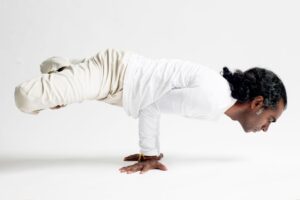
Prepare with chair pose and a gentle twist such as revolved lunge with the back knee down. Yoga International uses revolved chair as a preparation for arm balances that need a twisting torso, such as side crow. Yoga Journal also places it on the path toward noose pose (Pāśāsana), a deep squatting twist that asks for the same rooting down through the heels while the chest turns. After both sides, stand in mountain pose or fold into standing forward fold.
Where it is taught
Revolved chair is common in vinyasa and power yoga classes and in many hatha classes as a standing twist. Browse other twists in the pose library.