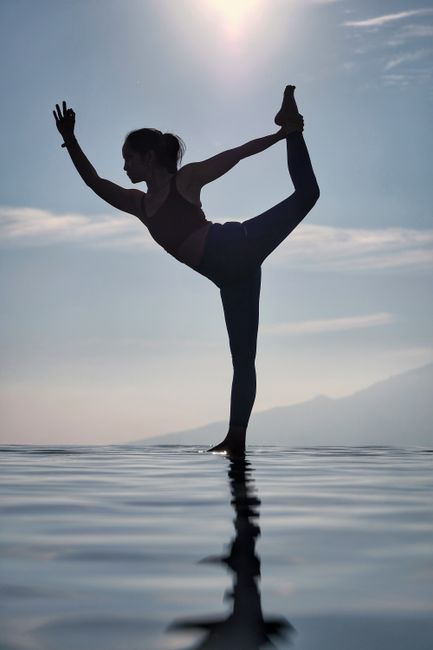
In short: dancer pose is a standing balance and backbend. You stand on one leg, hold the other foot or ankle behind you, press the foot back and up into the hand and reach the free arm forward. The version taught in most classes holds the ankle with the arm low; the classical form holds the big toe with the elbow pointing up and is very advanced.
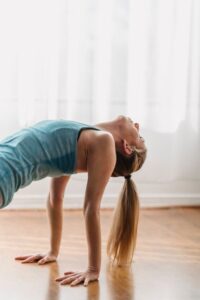
Dancer is one of the most photographed yoga poses, and the photos usually show its deepest form. In a class you will mostly practise a gentler shape: a quadriceps stretch that turns into a balance and then into a backbend as the lifted leg moves back. Below we cover the name and its forms, the cues behind the steps and how to approach the backbend safely.
The name and its forms
Naṭa means dancer and rāja king or lord: Naṭarāja, Lord of the Dance, is a name of Shiva, and the pose is also called Lord of the Dance. In Light on Yoga (1966), Natarajasana is among the most difficult poses of the book: the big toe is held with the hand, the elbow and shoulder rotate so the arm reaches up behind the head, and the raised thigh is parallel to the floor with the shin vertical. The Bihar School’s Asana Pranayama Mudra Bandha gives a preparatory form, holding the ankle with the other arm reaching forward, and a full form holding the big toe with the elbow pointing up. Yoga Journal teaches the ankle-hold form for general classes and the overhead grip as a deeper option.
Hot yoga has a related posture, Standing Bow Pulling Pose (Dandayamana Dhanurasana), in the 26+2 series. It also balances on one leg holding the foot behind with the opposite arm forward, but it is taught with its own cues and its own place in that fixed order, so we list it as a tradition name rather than the same pose.
How to make it work
Start from symmetry. Yoga Journal’s instruction is to bring the knees side by side after catching the ankle and restore the alignment of mountain pose before you lift anything: press the standing big-toe mound down, draw the standing outer hip in and bring the lifted side of the pelvis forward. Then press the thigh back and up, leading with the inner thigh, while the free arm reaches forward and up. The chest lifts as the leg rises, so the bend spreads along the whole spine instead of collecting in the lower back.
Keep the lifted knee in line with the hip rather than splaying out. Flex the lifted foot slightly if the back of the thigh cramps. Look at one fixed point ahead. A strap around the foot, held over the shoulder, keeps the hips square for people whose hands do not reach comfortably, and a hand on a wall in front of you lets you work the backbend without fighting for balance.
Precautions in plain words
Dancer combines a demanding balance with a backbend. Skip or soften it with lower back pain, a recent knee or shoulder injury, or a disc condition, and check with your doctor or physical therapist. The overhead grip asks a lot of the shoulder; keep the ankle hold if the shoulder pinches. With low blood pressure or dizziness, practise beside a wall. In pregnancy, balance changes and deep backbends are usually avoided, so ask your midwife or doctor. Yoga Journal suggests practising dancer near the end of the standing part of a class, once the hips, legs and chest are warm. This page is general information, not individual advice.
Preparation and next poses
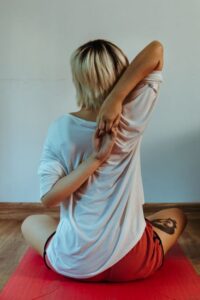
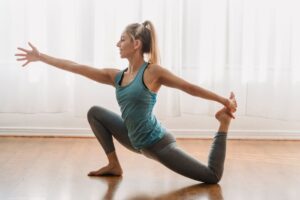
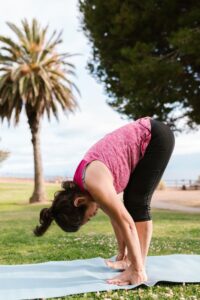
Prepare with tree pose for balance, low lunge for the front of the hip, and cow face pose arms for the shoulders, as Yoga Journal suggests. A standing quadriceps stretch holding the ankle is the first stage of the pose itself. Related backbends include bow pose and camel pose; sugarcane is the sideways cousin. Afterward, a standing forward bend lets the back settle.
Where it is taught
Dancer appears in vinyasa, hatha and Iyengar classes, usually late in the standing sequence. Explore more standing balances in the pose library.