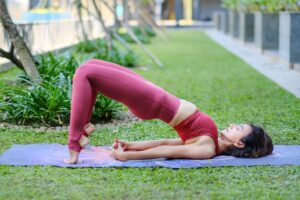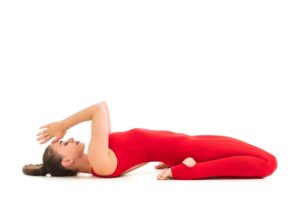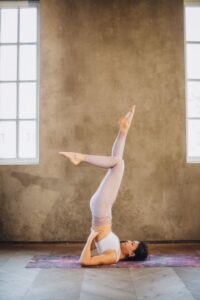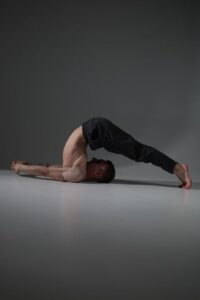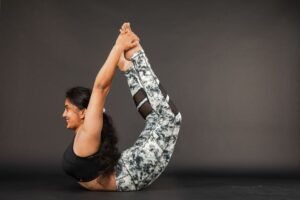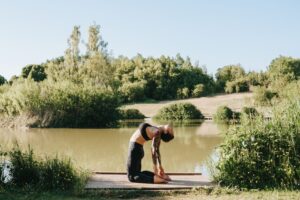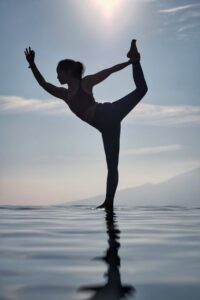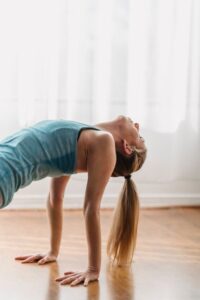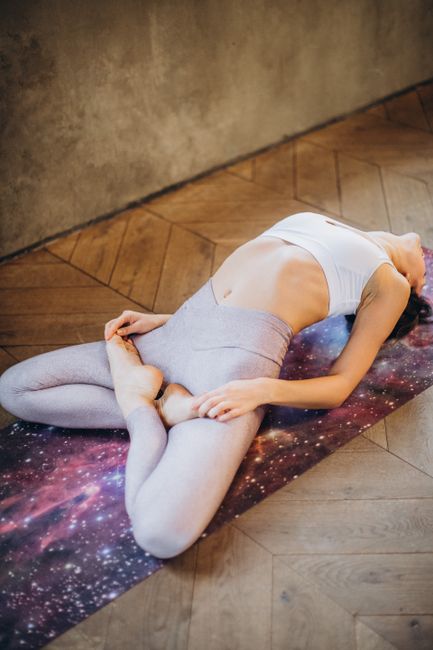
In short: fish pose is a backbend done lying on the back: you lift and arch the chest, take the head back and rest it lightly on the floor, so the chest and throat open. It is often practised after shoulderstand as its counterpose. There are two classic versions, one with the legs straight and one with the legs in lotus, and in both the head should carry very little weight.
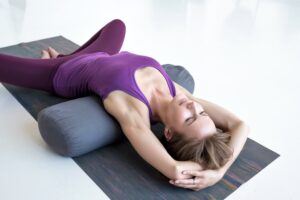
Below we explain the name and the two versions taught by different schools, how to protect the neck, the precautions, the supported option and where fish pose is taught. The restful version over a bolster or blanket has its own page, supported fish.
The name and the two versions
The Sanskrit name is Matsyāsana, from matsya, fish. Light on Yoga dedicates the pose to Matsya, the fish incarnation of Vishnu; the Sivananda centres say the name comes from the idea that you would float easily in this position in water; the Bihar School compares the folded legs to a fish’s tail. The name is the same everywhere, but two shapes are taught:
- Legs straight (Sivananda and most beginner classes). Lying on the back with the feet together, the hands go under the buttocks, the elbows press down, the chest arches up and the crown of the head rests on the floor. This is the fish of the Sivananda twelve basic asanas, held for about 30 seconds after shoulderstand and plough. Yoga Journal teaches it with the knees bent or the legs straight.
- Legs in lotus (Light on Yoga, the Bihar School, Ashtanga). Sitting in lotus, you lie back, arch the chest, rest the crown of the head on the floor and hold the feet or toes, or, in Light on Yoga‘s final form, fold the forearms behind the head. Ashtanga’s finishing sequence uses this version after shoulderstand and plough. It needs a comfortable lotus and is not a beginner pose.
How to make fish work
The arch comes from the upper back and the elbows, not the neck. Press the forearms and elbows firmly down and lift the chest first; only then let the head tip back. Yoga Journal stresses keeping minimal weight on the head; the Bihar School tells you to lower into and rise from the pose using the elbows, with control. Depending on how high the chest lifts, the back or the crown of the head touches the floor. Keep the legs active (pressing out through the heels in the straight-leg version) and breathe deeply into the chest.
To come out, press the elbows down, lift the head slightly, lower the upper back and then the head. Holds vary: 15 to 30 seconds (Yoga Journal), about 30 seconds (Sivananda), 30 to 60 seconds per leg-cross in lotus (Light on Yoga), and one to three minutes in the Bihar School. If the full arch is too much, Light on Yoga suggests simply lying flat with the arms stretched overhead.
Precautions in plain words
The neck is the main concern. The Sivananda centres advise skipping the pose, or holding it only for a few breaths, if extending the neck causes discomfort or dizziness. With a neck injury, keep the head on a folded blanket or use supported fish. The Bihar School advises against it with heart disease, peptic ulcer, hernia, back conditions, serious illness and during pregnancy. The lotus version adds risk to the knees: never force the legs into lotus.
Preparation and what comes next
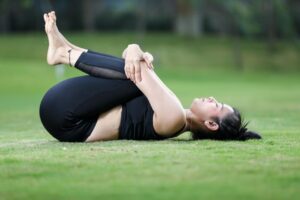
Fish is traditionally a counterpose to shoulderstand and plough, which flex the neck forward. Prepare with bridge, cobra and reclining hero. In the Sivananda order it is followed by seated forward bend; afterwards hug the knees in and rest in corpse pose.
Where it is taught
Fish is the fourth pose of the Sivananda twelve basic asanas, part of the Ashtanga finishing sequence (in lotus), in Light on Yoga (Iyengar) and the Bihar School system, and in many hatha classes. Supported fish appears in restorative yoga.