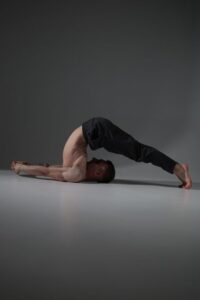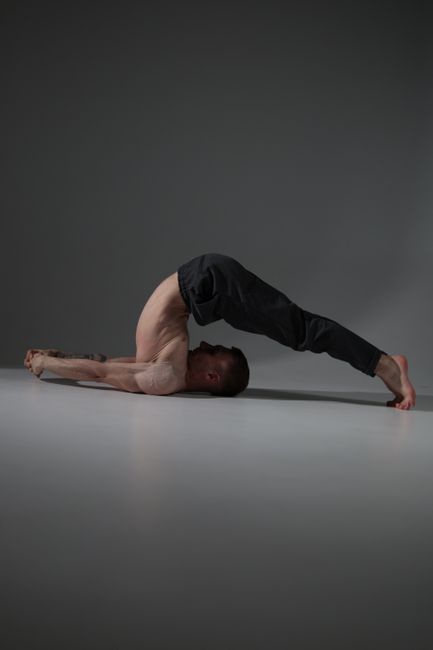
In short: in plow pose you lie on your back, lift the legs and hips over the head and lower the feet to the floor behind you, resting on the tops of the shoulders with the arms on the floor or the hands on the back. It stretches the whole back of the body, but it also bends the neck strongly, so it is an intermediate inversion that needs a careful set-up, usually with folded blankets under the shoulders.
Plow usually follows shoulderstand: it is the third of the Sivananda 12 basic asanas and the second pose of the Ashtanga finishing sequence.
The name
Hala means plough, and the shape, with the feet reaching the ground over the head, recalls the old Indian plough. British spelling gives Plough Pose, used by the Sivananda centres; Yoga Journal uses Plow. The Iyengar Yoga (UK) syllabus lists Halāsana at plate 244 of Light on Yoga, with Pārśva Halāsana at plate 249. AshtangaYoga.info describes the Ashtanga version: from shoulderstand, the legs lower until the tops of the feet touch the floor, and the hands clasp behind the back with the arms on the floor.
Making the pose work
Protect the neck first. Yoga Journal’s set-up stacks three folded blankets so the tops of the shoulders are on the edge and the back of the head rests on the floor, leaving space between the back of the neck and the floor. From shoulderstand, or by rolling up with the hands on the back, stack the hips over the shoulders and lower the legs over the head until the toes reach the floor. Then you can release the hands to the floor or clasp them. Press the outer upper arms and shoulders down to create lift along the spine, keep the gaze straight up and do not turn the head.
Yoga Journal suggests five breaths or more; the Sivananda Ranch starts at 30 seconds and builds toward two minutes, and Ashtanga holds five breaths. If the feet do not reach the floor, keep the hands on the back; the Sivananda Ranch notes that, with practice, the weight of the legs gradually brings them down. To come out, roll down slowly one vertebra at a time and let the back settle.
Precautions in plain words
Yoga Journal advises avoiding plow with back or neck pain or injuries, including bulging or herniated discs, and asking your ophthalmologist first if you have glaucoma, a detached retina, diabetic retinopathy or another eye condition. The Sivananda Ranch adds: be very gentle with an exaggerated upper-back rounding (kyphosis), and with asthma hold it briefly and move straight into fish pose. Avoid it with high blood pressure, and do not start it in pregnancy. Never practise it flat on the floor if your neck is pressed into the mat. This page is general information, not individual advice.
Easier versions
Yoga Journal offers several. With a chair behind the head, rest the thighs on the seat. In half plow the hips do not stack fully over the shoulders, which keeps space between chin and chest. At a wall, lower the feet onto the wall instead of the floor. Or lie on your back with a block under the sacrum and the legs straight up. For the long, passive version of the shape, see the yin snail.
Side Plow (Parsva Halasana)
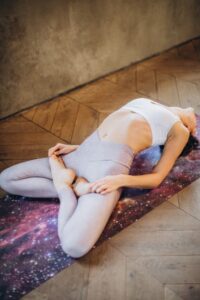
In side plow, the legs walk around to one side so that both feet rest on the floor beside the head, the trunk turning with them while the hands support the back. Pārśva means side. The Iyengar Yoga (UK) syllabus lists Pārśva Halāsana at plate 249 of Light on Yoga, in its first-level syllabus alongside Halāsana and Karṇapīḍāsana. It adds a twist to an already strong neck position, so keep the head still, move slowly and stop if the neck complains. Learn it with a teacher.
Preparation and what comes next
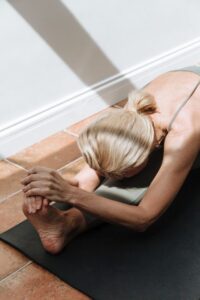
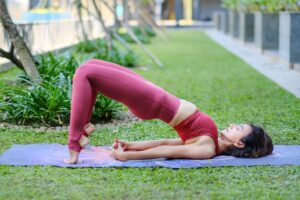
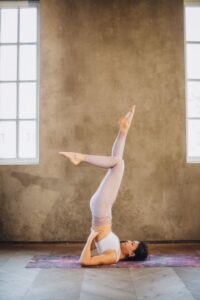
Prepare with seated forward bend, bridge and shoulderstand. From plow, bending the knees down beside the ears gives ear pressure pose, which the Sivananda Ranch offers as a variation and Ashtanga practises next. Afterwards, counter with fish pose, as both Yoga Journal and the Sivananda order recommend, and rest in corpse pose.
You will meet plow in Sivananda, Iyengar, Ashtanga and hatha classes.