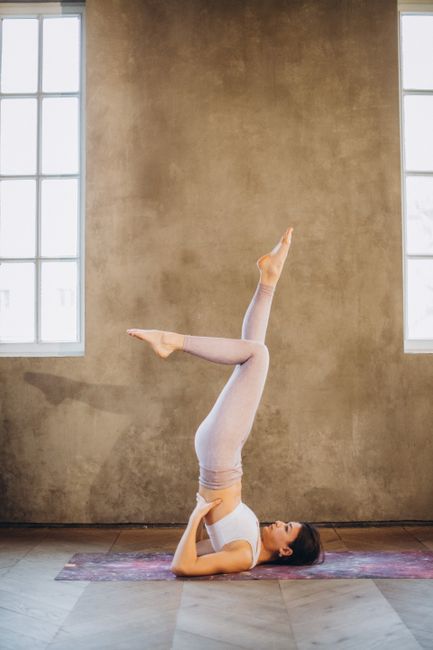
In short: in supported shoulderstand you lie on your back, lift the legs and hips overhead and straighten the body up toward the ceiling, resting on the tops of the shoulders and the backs of the upper arms with the hands supporting the back. Folded blankets under the shoulders protect the neck. It is an intermediate-to-advanced inversion: learn it with a teacher and respect the precautions below.
Shoulderstand is one of the core inversions of hatha yoga. It is the second of the Sivananda 12 basic asanas, the first pose of the Ashtanga finishing sequence, and the parent of a family of variations described further down this page.
The name
Sarva means all and aṅga limb, so Sarvāṅgāsana is the all-limbs pose; sālamba means supported, referring to the hands on the back. The Sivananda Ashram Yoga Ranch explains the name the same way. The Iyengar Yoga (UK) syllabus lists Sālamba Sarvāṅgāsana I at plates 223 to 224 of Light on Yoga, and II at plate 235. Yoga Journal calls it an intermediate to advanced pose and recommends not doing it without sufficient experience or the supervision of an experienced instructor.
Making the pose work
The blankets matter. Yoga Journal’s set-up uses two or more firm blankets folded to about one foot by two feet and stacked, with the shoulders on the blankets parallel to the long edge and the head on the floor. That lift lets the neck keep its natural space instead of being pressed flat. Bend the knees, press the arms down and roll the pelvis and back up, then bring the elbows in, no wider than the shoulders, and spread the palms on the back. Walk the hands up the back toward the shoulder blades, lift the bent knees, then straighten the legs.
In the pose, soften the throat, keep the head still and do not turn it, and gaze softly at the chest. Yoga Journal suggests staying about 30 seconds at first and adding 5 to 10 seconds every day or so toward 3 minutes, and later 5 minutes. The Sivananda Ranch starts at 30 seconds and builds to 3 minutes; the Ashtanga finishing sequence holds it for about ten breaths. To come down, lower the knees toward the face and roll down slowly, one vertebra at a time, keeping the back of the head on the floor.
Precautions in plain words
Do not practise shoulderstand with a neck injury or neck pain, glaucoma, a detached retina or other serious eye conditions, uncontrolled high blood pressure or heart conditions. The Sivananda Ranch advises that people with high blood pressure hold it no more than 30 seconds, and suggests a short hold or skipping it during menstruation. Yoga Journal notes that experienced practitioners may continue during pregnancy, but it should not be started then. Never turn the head while you are up, and always use blankets if your neck flattens against the floor. This page is general information, not individual advice.
Unsupported Shoulderstand (Niralamba Sarvangasana)
Nirālamba means without support: the hands leave the back and the arms extend, either along the floor overhead or alongside the legs, while the body balances on the shoulders. The Iyengar Yoga (UK) syllabus lists Nirālamba Sarvāṅgāsana I and II at plates 236 and 237 of Light on Yoga, a step beyond the supported pose. Without the hands, the back muscles and core must hold the spine upright; if the body tips back toward the head, return the hands to the back.
One-Legged Shoulderstand (Eka Pada Sarvangasana)
From shoulderstand, one leg lowers over the head toward the floor, as in plow, while the other stays vertical; then the legs change. The Iyengar Yoga (UK) syllabus lists Eka Pāda Sarvāṅgāsana at plate 250, and the Sivananda Ranch teaches the same movement as a shoulderstand variation, exhaling one foot to the floor behind the head and inhaling it back up. Keep the upright leg truly vertical. In Pārśvaika Pāda Sarvāṅgāsana (plate 251) the lowered leg goes out to the side instead.
Side Shoulderstand (Parsva Sarvangasana)
In Pārśva Sarvāṅgāsana the trunk and legs turn to one side and the body is supported on one hand placed under the hip, so the legs tilt sideways in a twisting, side-bending shape. The Iyengar Yoga (UK) syllabus lists it at plates 254 to 255. It is an advanced variation: the weight shifts onto one wrist and elbow and the neck must stay still, so learn it with a teacher.
Lotus in Shoulderstand (Urdhva Padmasana)
In Ūrdhva Padmāsana the legs fold into lotus while upside down on the shoulders. In the Ashtanga finishing sequence it follows plow and ear-pressure pose: from shoulderstand the right then the left leg fold into lotus, the hands release from the back and press up against the knees with straight arms, and the pose is held for five breaths (AshtangaYoga.info). The Iyengar Yoga (UK) syllabus lists Ūrdhva Padmāsana in Sarvāṅgāsana at plate 261. Only practise it if lotus is easy for your knees; folding the legs upside down is harder than sitting.
Embryo in Shoulderstand (Pindasana)
From lotus in shoulderstand, the folded legs lower toward the chest and the arms wrap around them, the right hand holding the left wrist; the spine rounds fully and the pose is held for five breaths in Ashtanga (AshtangaYoga.info). Piṇḍa means a rounded mass or ball. The Iyengar Yoga (UK) syllabus lists Piṇḍāsana in Sarvāṅgāsana at plate 269. Because the front of the body is compressed, breathe into the back. Do not confuse it with the seated embryo in the womb (Garbha Piṇḍāsana).
Preparation and what comes next
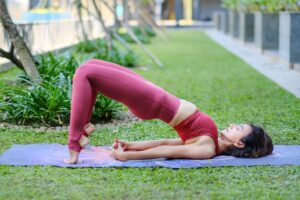
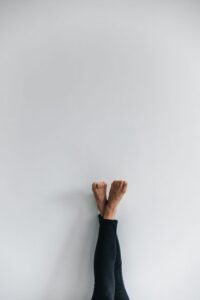
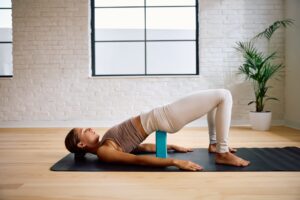
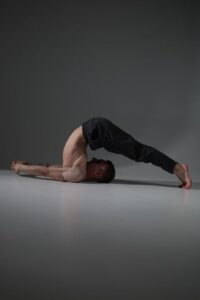
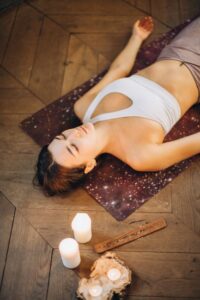
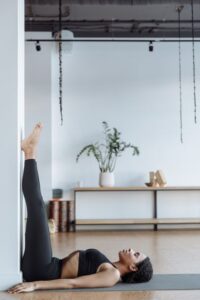
Prepare with bridge pose and legs up the wall, and with a supported version: lying with a block under the sacrum and the legs straight up. From shoulderstand, the legs lower into plow; fish pose is the classic counterpose in both the Sivananda and Ashtanga orders. Then rest in corpse pose.
You will meet shoulderstand in Sivananda, Iyengar, Ashtanga (finishing sequence) and hatha classes.