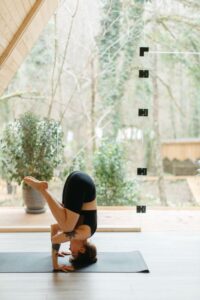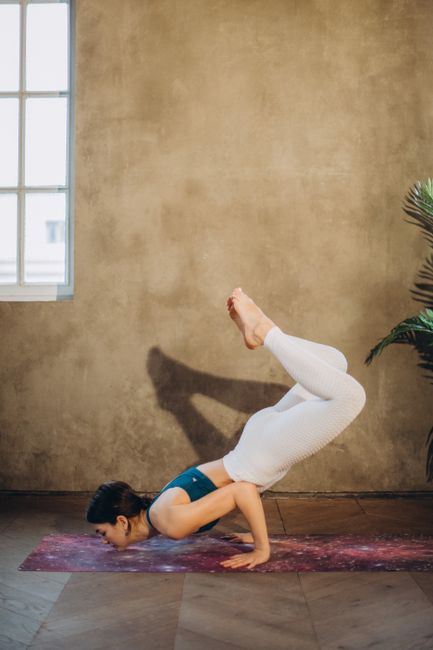
In short: scorpion pose is an inverted balance combined with a deep backbend. You balance upside down, usually on the forearms, lift the chest and head and bend the knees so the feet curve down toward the head, like a scorpion’s tail arching over its back. There is also a harder version on the hands. It is among the most demanding poses in the library: learn it only with a teacher, after a steady forearm stand and wheel.
This page explains the name and the two versions, how the pose is approached, the precautions and the long preparation. It describes the pose for understanding; it is not a self-teaching guide.
The name and the two versions
The Sanskrit name is Vṛścikāsana (also spelled Vrischikasana), from vṛścika, scorpion. Iyengar describes a scorpion arching its tail over its back to strike beyond its head. He also gives the pose a symbolic reading: by bringing the feet toward the head, the seat of pride, the yogi works to humble the ego. Light on Yoga teaches two versions, and it helps to name which one you mean:
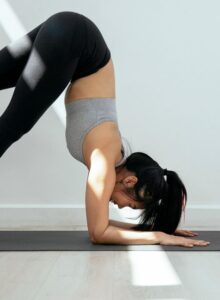
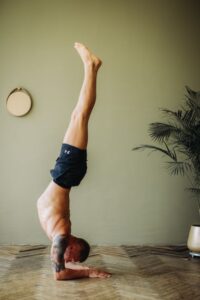
- Vṛścikāsana I, on the forearms. From forearm stand (Pīnca Mayūrāsana), the head and chest lift, the knees bend and the heels lower toward the crown of the head. This is the version most classes mean. The Bihar School enters it from headstand by moving the forearms beside the head and lifting the head; Yoga Journal builds it from forearm stand at a wall.
- Vṛścikāsana II, on the hands. From handstand (Adho Mukha Vṛkṣāsana), the same tail-curl is made on straight arms. Iyengar calls it extremely difficult and much harder than the forearm version.
How the pose is approached
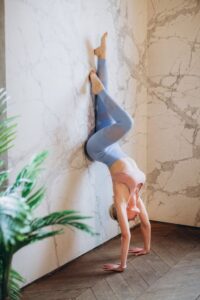
Teachers usually build scorpion in stages at a wall. Yoga Journal’s progression starts with forearm stand with the feet on the wall, then learns to draw the chest forward between the arms, the change that turns forearm stand into scorpion, while the lower back keeps lifting. Next the knees bend and the toes press into the wall, then the feet leave the wall one at a time. Throughout, the upper outer arms stay firm and the gaze goes forward. Yoga Journal’s key point is to keep the backbend even rather than chasing the feet to the head; collapsing the lower back to touch the head is how scorpion hurts.
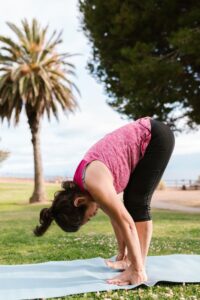
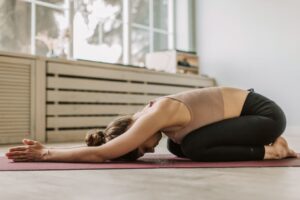
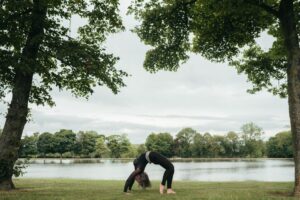
In the full forearm version of Light on Yoga, the forearms are parallel and no wider than the shoulders, the upper arms are vertical, and the shins end parallel to the upper arms with the heels on the crown of the head. Breathing is fast and heavy. Holds are short: about 30 seconds in the forearm version and 10 to 15 seconds on the hands (Iyengar); the Bihar School suggests up to 30 seconds at first. Iyengar comes out by lowering the feet to the floor beyond the head into wheel, then folding forward in standing forward bend to release the back; Yoga Journal returns to forearm stand and rests in child’s pose.
Precautions in plain words
Scorpion is a teacher-only pose. The Bihar School says not to practise it with high blood pressure, vertigo, cerebral thrombosis, chronic catarrh or heart disease, and only once all inverted poses are easy. Avoid it with neck, shoulder, wrist or back injuries, glaucoma or other eye pressure problems, and in pregnancy. Practise near a wall and learn how to come down safely before trying to balance. If the lower back pinches, straighten the legs back toward forearm stand.
Preparation and what comes next
Preparation includes dolphin, forearm stand at a wall and then free, headstand, wheel, two-legged inverted staff and camel. After scorpion, fold forward in standing forward bend or rest in child’s pose for at least as long as you held the pose; the Bihar School follows it with a forward bend and then relaxation.
Where it is taught
Scorpion appears in Light on Yoga (Iyengar), in the Bihar School system and in advanced vinyasa and inversion workshops.