In short: bird of paradise is a standing balance in which one leg is bound by the arms, wrapped under the thigh and behind the back, and then extended up to the side. It needs open hips and shoulders, long hamstrings and steady balance, so it is an advanced pose. Work in stages: the bind in a lunge, then standing with the knee bent, and straighten the leg only if it comes easily.
The pose is named after the bird-of-paradise flower: the standing leg is the stalk and the lifted leg opens like a petal. It is a peak pose in many flow classes, built from extended side angle with a bind. Below we explain the name, the stages that make it reachable and the precautions.
A modern name
Bird of paradise is a modern descriptive name. Yoga Journal gives the Sanskrit-style name Svarga Dvijāsana, which can be read as “heaven” (svarga) and “twice-born”, a common word for a bird (dvija). We did not find the pose or that name in older manuals such as Light on Yoga or the Bihar School’s Asana Pranayama Mudra Bandha, Yoga International uses the same name and also reads it as “twice born” (a bird is born twice: as an egg, then from the egg). Because no older source has it, we list Svarga Dvijasana as a name used in modern classes rather than as an established classical name.
How to make it work
Build the bind first, where you are stable. In extended side angle with the front knee bent, the top arm wraps behind the back and the bottom arm threads under the front thigh until the hands meet or hold a strap. Keep the chest open and the shoulders drawing back rather than hunching forward. Then step the back foot up beside the front foot, keeping the bind, and shift your weight into the foot that will stand.
Rise slowly. Yoga Journal’s instructions are to lift the torso and straighten the standing leg at the same time, letting the bound knee come up with you, hooked over the arm. Once upright, lengthen both sides of the waist and lift the chest. Only then, with the hip turned outward, extend the bound leg up and to the side. Many experienced practitioners keep the lifted knee bent; it is still the pose. Fix your gaze on a point on the floor ahead while you rise, then straight ahead.
Precautions in plain words
Rising out of the bind is where most strain happens, in the lower back and in the shoulder of the threading arm. Yoga Journal advises returning to the preparatory poses if the bind or the knee position causes pain in the lower back or shoulder. Skip the pose with a shoulder, lower back, hamstring or knee injury, and check with your doctor or physical therapist. With balance problems, practise near a wall. In pregnancy, deep binds that compress the belly are usually avoided. This page is general information, not individual advice.
Preparation and next poses
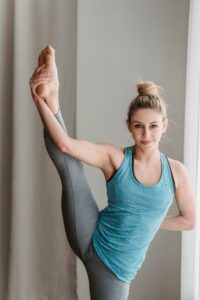
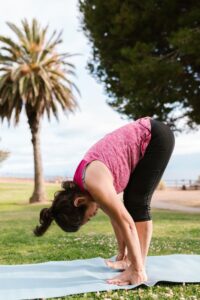
Prepare with extended side angle and its bound version, garland pose for the deep hip bend, cow face arms for the shoulders, and extended hand-to-big-toe pose with the leg to the side, which uses the same leg action without the bind. To come out, bend the lifted knee, lower the foot, step back into the lunge and release the bind, then rest in a standing forward bend.
Where it is taught
Bird of paradise is a pose of modern vinyasa and power yoga classes, usually as a peak after side-angle work. Find related poses in the pose library.