In short: in this pose you stand on one leg with the other foot in half lotus at the top of the thigh, catch that foot with the hand reaching around the back, and fold forward over the standing leg. It is an advanced pose that combines a balance, a deep hip rotation, a hamstring stretch and a shoulder bind. The knee in half lotus must never be forced; the upright standing half lotus, described below, is the first stage.
Ardha Baddha Padmottānāsana is known to most practitioners from the Ashtanga standing sequence, where it comes early and stops many students for a long time. That is not a failure: the pose asks the hip to rotate outward a long way, and hips differ. Below we explain the name, the safe order of learning, the precautions and the standing half lotus stage.
The name and where it comes from
Ardha means half, baddha bound or caught, padma lotus and uttāna an intense stretch. In Light on Yoga (1966) the technique is: place the foot on the opposite thigh, catch the big toe from behind with the same-side hand, fold forward with the free hand on the floor, first with a concave back and then resting the chin on the knee; if the toe cannot be caught, both palms go to the floor. The pose has the same name and order of actions in the Ashtanga standing sequence, where it follows extended hand-to-big-toe pose and is held for five breaths, as listed by AshtangaYoga.info.
Standing half lotus: the first stage
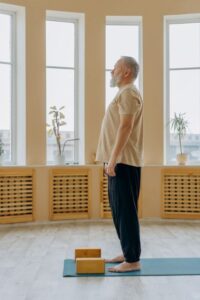
Before folding, learn to stand in half lotus. From mountain pose, lift one foot and, turning the thigh out from the hip, rest the outer edge of the foot high in the crease of the opposite hip, sole facing up. The hands come together at the chest, or one hand steadies the foot. Yoga Journal describes this upright shape as a half-lotus variation of tree pose, and in the Hot Yoga 26+2 series the posture called Tree Pose is done this way. There is no established Sanskrit name for the upright stage on its own; you may hear “Ardha Padma Vrksasana” in modern classes, which is a descriptive label rather than a classical name. Stay in this stage, on both sides, until it is comfortable for the knee, before adding the bind or the fold. Yoga Journal’s article on protecting the knees in lotus poses suggests exactly this order: upright first, folding later.
How to make it work
All the rotation must come from the hip joint. Lift the foot by turning the whole thigh outward, never by pulling the foot up while the knee bends sideways. If the bound hand cannot reach the toe, hold the foot with the opposite hand or keep both hands on the floor or on blocks. As you fold, hinge from the hips with the standing leg straight but not locked; in Light on Yoga the back is first concave, with the head up, before the forehead and then the chin come toward the knee. Yoga Journal lists the usual ways students force the pose: bending the standing knee, pushing the shoulder out of line to reach the foot and twisting the knee. Each is a sign to step back to an earlier stage.
Precautions in plain words
Forcing half lotus is a known cause of knee injury in yoga. Yoga Journal warns that if the hips are tight and you force your way in, the knees suffer, and the US National Center for Complementary and Integrative Health advises people new to yoga to avoid the lotus position. Skip this pose with any knee injury, knee surgery, or hip or ankle problem, and stop at once at any pain or pinching in the knee. People with a shoulder injury should leave out the bind. The fold is a forward bend on one leg, so with high blood pressure, glaucoma or dizziness keep the head above the heart and ask your doctor. Learn it with a teacher. This page is general information, not individual advice.
Preparation and next poses
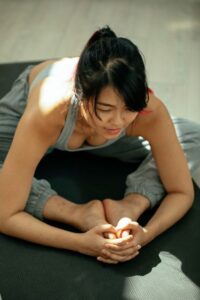
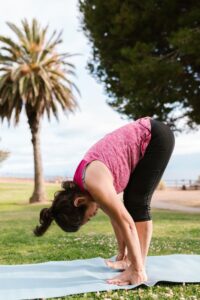
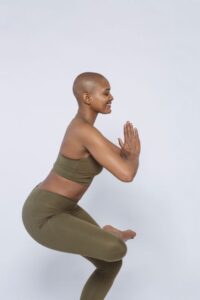
Hip preparation such as reclining figure four, bound angle and seated half lotus comes first, along with tree pose for the balance and standing forward bend for the hamstrings. In the Ashtanga order, chair pose follows. Seated relatives include the half-bound lotus seated forward bend and bound lotus.
Where it is taught
The full pose belongs to Ashtanga and Iyengar practice; the standing half lotus stage also appears in hot yoga and some vinyasa classes. Find related poses in the pose library.