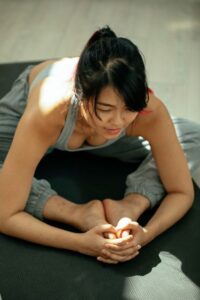
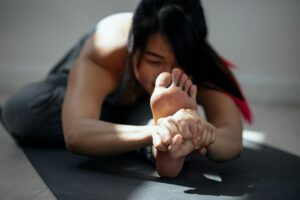
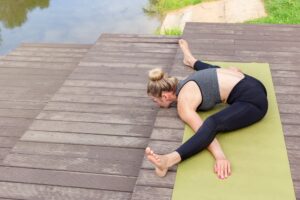
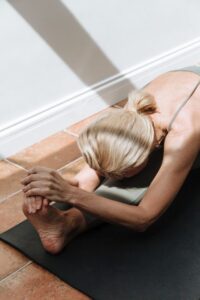
In short: in this seated forward bend one leg is folded into half lotus with the foot high on the opposite thigh, the arm on that side wraps behind the back to hold the foot, and you fold over the other, straight leg. It combines a hamstring stretch with a strong outward rotation of the hip. It is an advanced pose because of the knee: the half-lotus leg must come from the hip, never from twisting the knee.
The pose is the first one-legged fold of the seated part of the Ashtanga primary series, and Yoga Journal has taught it since at least the 1980s. If your hips are not ready for half lotus, head-to-knee pose gives a similar fold with the foot against the inner thigh instead of on top of it, and it is the right place to work for now.
What the name means
Ardha Baddha Padma Paścimottānāsana joins ardha (half), baddha (bound), padma (lotus) and paścimottānāsana, the seated forward bend or intense stretch of the back of the body. So the name says exactly what happens: a half lotus, bound by the hand holding the foot, in a seated forward bend. The standing version of the same legs and bind is half-bound lotus standing forward bend (Ardha Baddha Padmottanasana).
Making the pose work, and protecting the knee
Start with a test. A 1984 Yoga Journal article suggests sitting in bound angle pose: if the thighs are far from the floor while the lower back keeps its curve, the hips probably are not open enough yet and the knee will take the strain. Work on hip openers first.
When you are ready, fold the knee completely before placing the foot, so the calf presses against the thigh and the joint is closed and stable. Then turn the whole thigh outward from the hip and lift the foot into the opposite groin, the top of the foot in line with the shin. AshtangaYoga.info stresses that most of the rotation must come from the hip, not the knee or ankle. If the foot only reaches the thigh near the knee, leave it there and skip the bind. Reach the arm on the lotus side behind the back to hold the foot (Yoga Journal suggests catching the big toe); if you cannot reach, hold a strap or simply rest the hand on the floor. Then fold over the straight leg with the spine as long as possible, holding the straight-leg foot with the other hand. Ashtanga holds it for five breaths; the Yoga Journal article suggests 30 to 60 seconds per side.
Precautions in plain words
Any pain in the bent knee means stop. Knee injuries, meniscus problems or a recent knee or hip operation are reasons to choose head-to-knee pose instead. Do not use the arm bind or the forward fold to lever the foot higher. Lower-back problems need the same care as in every forward fold. Because of the half-lotus leg, learn this pose with an experienced teacher. This page is general information, not individual advice.
Preparation and what comes next
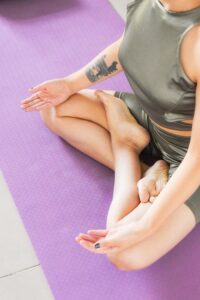
Prepare the hips with bound angle, head-to-knee pose, half lotus sitting and the reclined figure four. In the Ashtanga primary series it is followed by three-limbed forward bend, which turns the bent leg inward and balances the strong outward rotation of this pose. Other poses that use the half-lotus leg include Marichi’s pose B and lotus pose itself.
A simple way to practise it. Work the two halves separately before you put them together. On some days, sit in half lotus with the foot low on the thigh and simply stay upright, breathing, to let the hip get used to the rotation. On other days, practise the fold over the straight leg with the bent leg in the head-to-knee position. Only when both feel easy, combine them, and add the bind last. If you practise on a retreat or in a led class, tell the teacher about any knee history before the seated poses begin.
You will meet the pose mainly in Ashtanga classes, and occasionally in advanced vinyasa classes.