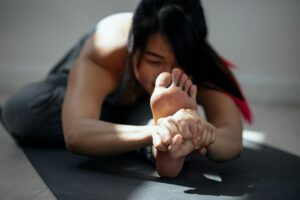
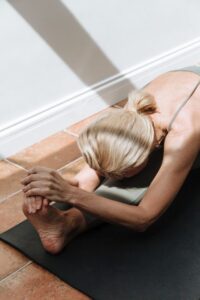
In short: Marichi’s pose A is a bound seated forward bend. One leg is straight, the other knee is bent with the foot flat on the floor close to the hip, the arm on the bent-leg side wraps around the shin, the hands clasp behind the back, and you fold over the straight leg. Version B is the same bind with the straight leg replaced by half lotus. Both are forward bends; the twisting versions, C and D, have their own page.
Marichi’s poses are part of the Ashtanga primary series and of the Iyengar repertoire. The two traditions number them differently, which causes a lot of confusion, so we start with the names.
The names: letters, numerals and the sage
Marīcyāsana (often written Marichyasana) is dedicated to Marīci, one of the seven sages of Hindu tradition; the word marīci means a ray of light. There are four Marichi poses. Ashtanga uses letters, A to D; Iyengar-style teaching, and Yoga Journal, use numerals, I to IV. They line up like this: A = I and B = II are forward bends; C = III and D = IV are twists. In both systems the second of each pair adds a half-lotus leg. Because the same name covers forward bends and twists, YogaVacation gives each pair its own canonical page: this one for A/I and B/II, and Marichi’s twist for C/III and D/IV. The record shows that these poses are 20th-century: they are described in Krishnamacharya’s teaching and by his pupils Pattabhi Jois and B.K.S. Iyengar, not in the medieval hatha texts.
Making Marichi’s pose A work
The key is getting the shoulder in front of the shin before you bind. Set the bent-leg foot about a fist’s width from the straight thigh and as close to the hip as you can. Lean the torso forward past the inside of the bent thigh, reaching that arm forward until the armpit is near the shin, then turn the arm inward and wrap it around the shin and back. AshtangaYoga.info warns that if there is a gap between shin and side body, the bind becomes a lever on the shoulder joint, which you want to avoid. Reach the other arm behind and clasp a wrist, or hold a strap. Then lengthen the chest forward and fold over the straight leg.
Yoga Journal describes the leg position as half in a squat and half in a seated forward bend. Expect the spine to round a little; the work is in keeping the breastbone reaching forward. Ashtanga holds five breaths per side; Yoga Journal suggests 10 to 12. If the bind is not available, hold the straight-leg foot with the free hand and simply hug the bent knee with the other arm.
Precautions in plain words
Do not force the bind: wrenching the arm around a leg that is not close to the body strains the shoulder. With a shoulder injury, skip the clasp. With lower-back problems or sciatica, keep the fold small and the spine long. Version B adds a half-lotus leg and with it the knee risks of lotus. This page is general information, not individual advice.
Marichi’s Pose B (Marichyasana B, Iyengar Marichyasana II)
In version B one leg goes into half lotus first, with the foot high in the opposite groin; then the other foot is set flat on the floor close to the hip as in A, the arm on that side wraps the shin and the hands clasp behind the back. You fold forward toward the floor in front of the half-lotus knee; in Ashtanga the chin aims for the floor and you stay five breaths. AshtangaYoga.info’s advice for protecting the half-lotus knee is to place the lotus foot as close to the trunk as possible and tilt the pelvis toward the half-lotus side so that thigh stays on the floor. Treat B as advanced: learn it with a teacher, and only once half lotus is comfortable. Yoga Journal’s long article on Marichyasana II describes it as a forward bend built from several simple folds.
Preparation and what comes next
Prepare with seated forward bend, head-to-knee pose and a garland squat, which teaches the bent-leg position. For B, work on half lotus and the half-bound lotus fold. In the Ashtanga primary series A and B are followed by the twists, Marichi’s twist C and D, and then boat pose.
You will meet these poses in Ashtanga and Iyengar classes, and A in many vinyasa classes.