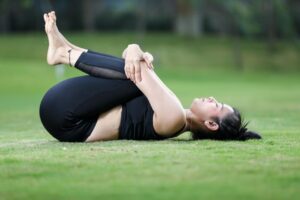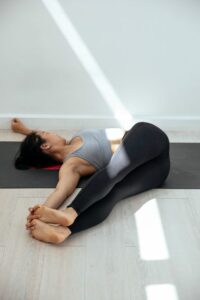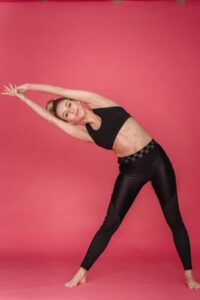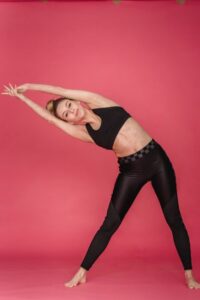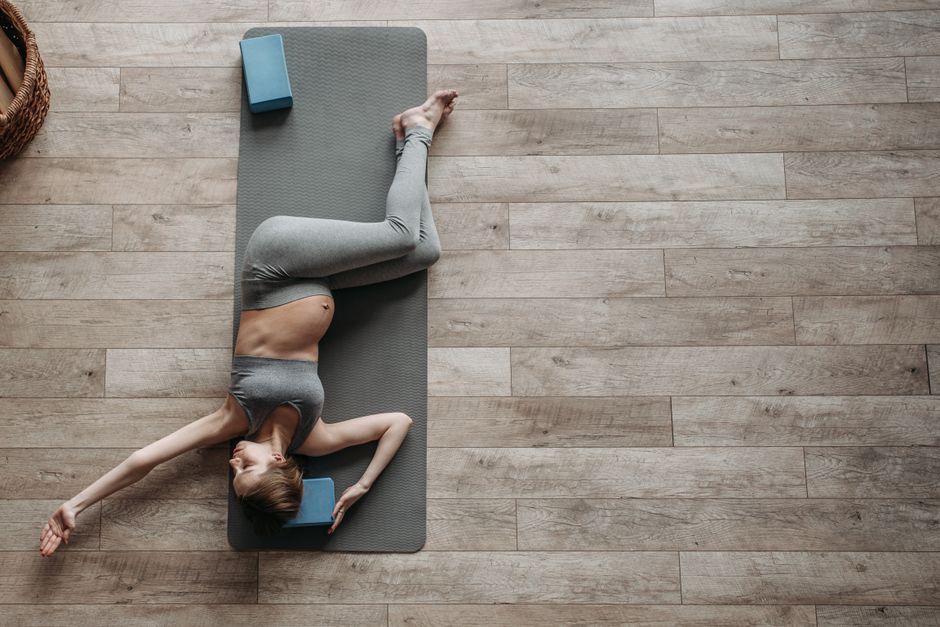
In short: banana is a side bend done lying on your back. You reach the arms overhead, then move the feet and the upper body toward the same side of the mat until the body curves like a banana, keep both hips on the floor and rest there for a few minutes. It is a gentle, long stretch along one whole side of the body.
Below: the playful name, how it relates to the standing side bend, the setup and the cautions.
The name and the related asana
“Bananasana” is a yin-community name that bolts the Sanskrit ending -āsana onto the English word banana. It is not a classical Sanskrit name, so we use Banana as the main name. Bernie Clark describes it as the lying-down equivalent of half moon or a standing side bend; lying down means nothing has to hold you up, so the side body can stay relaxed for minutes.
Setting up
Lie with the legs straight and together, arms overhead holding the hands or elbows. Clark keeps the buttocks firmly planted and moves the feet and the upper body to one side. Yoga Journal’s 12-pose sequence starts with the knees bent, shifts the hips a couple of inches the other way, then walks the straight legs to the far corner of the mat, crosses the ankles and scoots the upper body over. Either way, keep the hips flat; this is a side bend, not a twist. If the hands tingle with the arms overhead, support them on a bolster or cross the arms over the chest.
The long hold
Clark gives three to five minutes per side; Yoga Journal suggests four to five. Start with a modest curve and deepen it gradually as the side body softens. Crossing the outer ankle over the inner one adds a little more stretch along the outer hip.
Playing the edge
Bernie Clark’s instruction is to find your “first edge”: move the feet and upper body to the side only until you feel a clear, comfortable stretch, then stop. As the body opens during the hold, move both feet a little further over and draw the upper body a little further across. Keep playing that edge, small step by small step, rather than starting at your deepest curve. Only once the feet are as far to the side as they will go does Clark suggest crossing the ankles. Most students feel more by crossing the outside ankle over the inside one, but some feel more the other way round, so try both.
Where you feel it varies. Clark describes the stretch running along the whole side of the body, from the outer hip and thigh up through the waist and the side ribs, and sometimes into the armpit when the arms are overhead. A tug at the outside of the hip is normal. Sharp or pinching sensation in the lower back is not: make the curve smaller.
How long to stay, in practice
If you are new to yin, Clark suggests starting with holds of one or two minutes and building toward longer ones. On your own, a timer helps: three to five minutes may work well. If you are struggling to stay, come out, whether or not the timer has sounded. Pain is always a signal to leave the pose.
Breathe slowly and let the belly move. Each long exhale is a chance to let the side ribs soften a little more. Before the second side, take a few breaths flat on your back and notice the difference between the two sides of the body.
Coming out and the rebound
Bring the legs and arms back to the middle and lie still. Clark suggests hugging the knees to the chest or circling them to ease the lower back, before the second side.
Precautions in plain words
Watch for tingling in the hands when the arms are overhead, and make the curve smaller if the lower back complains. With a shoulder injury, keep the arms by the sides. After the first trimester of pregnancy, lying on the back for long periods is not recommended (ACOG), so keep it short or choose a seated side bend. This page is general information, not individual advice.
Before, after and where it is taught
Banana is often followed by twisted roots and then knees to chest. Standing relatives include swaying palm tree and half moon. You will meet it in yin yoga classes, which hold mostly floor poses for several minutes with the muscles relaxed, and in some gentle and restorative classes.