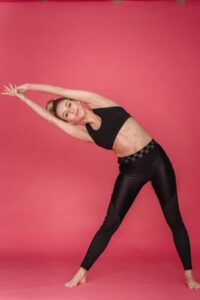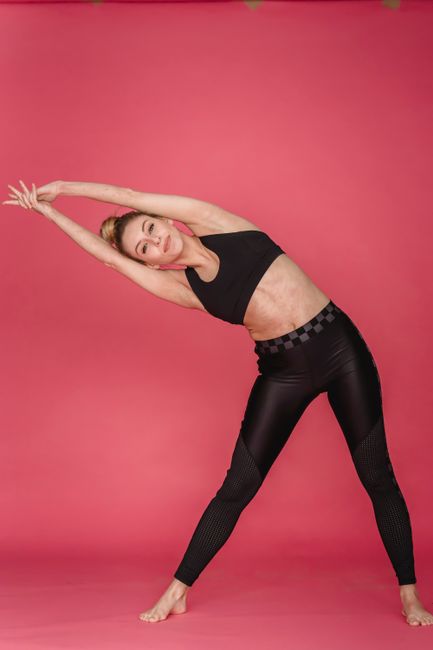
In short: swaying palm tree is a standing side bend from the Bihar School of Yoga. You raise the arms overhead with the fingers interlocked, then bend from the waist to one side and the other, repeating the movement several times. The classic version is done balancing on the toes; doing it with the feet flat is a perfectly good way to start.
It is a mild, rhythmic stretch rather than a long hold, and it belongs to a small group of standing practices that Satyananda Yoga teachers often do together. Below we explain the name, how the movement is done in the Bihar sources, the precautions and where it fits.
The name
The Sanskrit name is Tiryaka Tāḍāsana. Tiryak means sideways or oblique, and in the Bihar School system Tāḍāsana is the “palm tree pose”: standing with the arms overhead and the fingers interlocked, rising onto the toes. So the name means a palm tree bending sideways. Yoga Magazine, the Bihar School’s journal, calls it “swaying palm tree pose”; the scan of Asana Pranayama Mudra Bandha we read gives the English as “the wind blown tree pose”. Both describe the same side-bending practice.
Note that in Iyengar and Ashtanga yoga, Tadasana means the even, flat-footed standing posture we call mountain pose. The “palm tree” reading of Tadasana is specific to the Bihar School and India’s Common Yoga Protocol.
How the movement is done
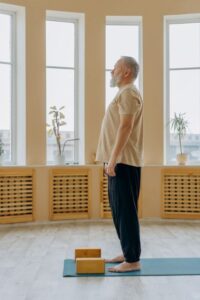
Start in the Bihar palm tree position: feet a little apart, fingers interlocked, palms turned upward above the head. From there, bend from the waist first to the right and then to the left. Asana Pranayama Mudra Bandha gives ten bends to each side, then a rest standing with the feet flat. The book also says that if balancing on the toes is difficult you may do the practice with the feet flat until balance improves, and suggests trying a few seconds on tiptoe each time.
Make the movement a true side bend: keep the arms in line with the body and the chest facing forward, so you do not twist or lean forward. Move slowly enough to feel the long side of the trunk stretch and the short side contract. Yoga Magazine describes the effect as mild: the muscles on each side of the spine alternately contract and stretch, which many office workers and students find a welcome break from sitting. In Satyananda Yoga it is often done after palm tree pose and before kati chakrasana (a standing waist rotation).
The starting position and the breath
Because the book says “all other details as for tadasana,” it helps to know the Bihar palm tree pose itself. Asana Pranayama Mudra Bandha describes it this way: stand with the feet 4 to 6 inches apart, raise the arms overhead with the fingers interlocked and the palms facing up, look up at the hands, then lift the heels and feel as if you are being drawn upward. In the swaying version you hold that tall, stretched shape while you bend from side to side.
The book’s breathing note for palm tree pose is to keep the breath in while you are on tiptoe. That is a short breath retention, and it is not for everyone. If you are new to the practice, have high blood pressure or heart problems, or feel any strain, keep breathing slowly and normally through the nose instead. Many people simply let the breath flow, breathing out as they bend and in as they come back to center.
Count the bends so both sides get the same work. The book gives ten to each side as the usual practice. In shankhaprakshalana, the Bihar School’s intestinal washing practice with salty water, swaying palm tree is the second of five asanas done eight times each. The book says that whole technique should not be attempted without the guidance of a yoga teacher; the side bend on its own needs no such preparation.
Precautions in plain words
Yoga Magazine notes that the sideways movement can ease or, sometimes, increase pressure on a pinched spinal nerve, so people with sciatica or disc problems should practise it gently and carefully, or ask a teacher first. Keep the feet flat if your balance is uncertain or if you have ankle problems. With a shoulder injury, keep the hands lower or on the hips.
Preparation and what comes next
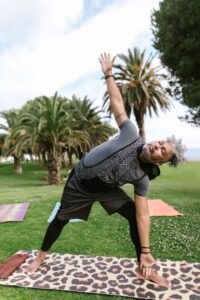
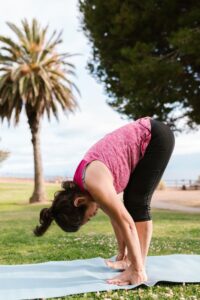
Prepare with mountain pose and upward salute. Afterwards, a standing twist or a standing forward fold works the spine in the other directions. If you like the stretch, the held standing side bend and triangle pose take it further.
Where it is taught
It is mainly taught in Bihar School and Satyananda-style hatha yoga, including as part of the hatha cleansing practice of shankhaprakshalana, and in many yoga schools in India. It also adapts well to a seated position in chair yoga.