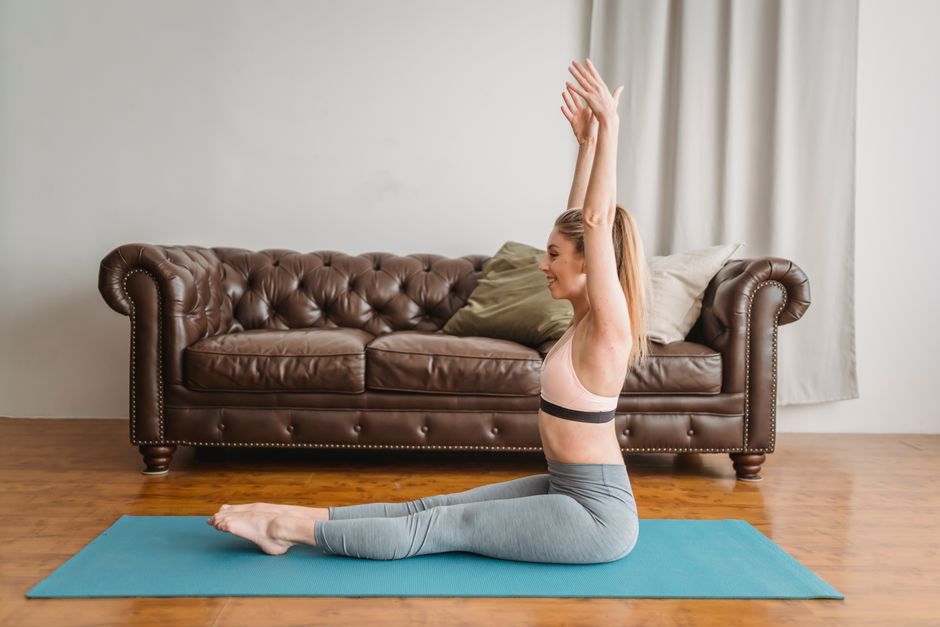
In short: staff pose is sitting upright with the legs straight out in front, feet together and flexed, hands on the floor beside the hips. It looks simple, but it teaches the upright spine and active legs that every seated forward bend and twist builds on. If the lower back rounds, sit on a folded blanket.
Staff pose is the starting point of most seated practice: in Ashtanga’s Primary Series it is the position from which the seated forward bends begin, and in Iyengar teaching it is the base for poses such as seated forward bend and cow face pose. Yoga Journal calls it a foundational seated pose that sets the tone for alignment in the rest of a practice. Below we explain the name, the cues that make it work, precautions and where it leads.
The name
Daṇḍa means a staff or rod, and the image is of the spine as an upright staff. In B.K.S. Iyengar’s Light on Yoga (1966), Daṇḍāsana is sitting with the legs stretched straight in front, the palms on the floor by the hips with the fingers pointing toward the feet, arms straight and back erect. Yoga Journal teaches the same pose with the big toes touching and a small space between the heels. The Ashtanga Primary Series sheet published by AshtangaYoga.info lists Daṇḍāsana as the opening of the seated sequence.
How to make it work
The pelvis decides everything. Tight hamstrings pull the back of the pelvis down, so the lower back rounds and the chin pokes forward. Sitting on the edge of one or more folded blankets tips the pelvis forward enough for the spine to rise. A simple check from Yoga Journal: sit with your back against a wall so the sacrum and shoulder blades touch it, but not the lower back or the back of the head.
Then make the legs active. Press forward through the big-toe mounds and out through the heels, turn the inner thighs slightly down and press the thigh bones into the floor. Lift the breastbone, broaden the collarbones and draw the upper arms back without hardening the front ribs. If the knees tend to hyperextend, or the hamstrings are very tight, a rolled blanket under the knees helps. If the hands do not reach the floor with straight arms, place them on blocks.
Precautions in plain words
Staff pose is gentle, but rounding the back or sticking the chin forward restricts the breath and can strain the lower back, as Yoga Journal notes; over-arching the back to look upright overworks the hip flexors. Use height under the seat instead of forcing either. With a lower back or sacroiliac problem, a wrist injury or very tight hamstrings, sit higher, put the hands on blocks or sit against a wall, and ask your doctor or physical therapist if you are unsure. This page is general information, not individual advice.
Preparation and next poses
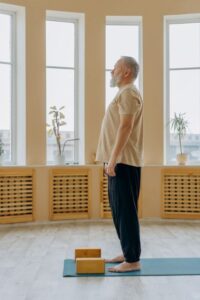
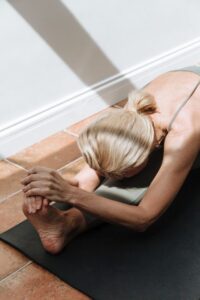
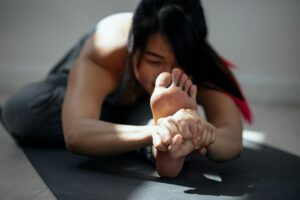
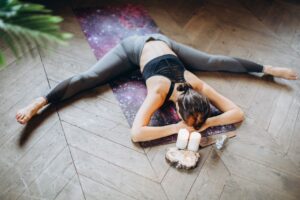
Mountain pose teaches the same upright alignment standing. From staff pose, natural next poses are seated forward bend, head-to-knee pose, seated wide-angle forward bend, bound angle and boat pose, as well as seated twists. Upward plank is a common counterpose to seated forward bends that begins from staff pose.
Revolved Staff: a gentle twist from staff pose
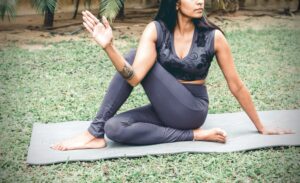
Revolved staff is a simple seated twist taken from staff pose: the legs stay straight and together, and you turn the chest to one side. “Revolved staff” is a modern descriptive name; you may also see Parivrtta Dandasana in modern classes and apps, but we have not found it in the classic manuals, so we treat it as modern usage. To practise it, sit in staff pose on a blanket if needed and inhale to lengthen the spine. Exhale and turn to the right, placing the right fingertips on the floor behind the hips and the left hand on the outside of the right thigh. Keep both legs active and the heels level, so the pelvis does not slide; turn from the belly and ribs and let the head follow last. Stay for a few breaths, return to the centre and repeat to the left. Because the legs are straight, tight hamstrings make the back round, so sit higher or bend the knees slightly. Keep the twist gentle with back or sacroiliac problems. It is a beginner-level warm-up for deeper seated twists such as Marichi’s twist and half lord of the fishes.
Where it is taught
Staff pose is part of Ashtanga, Iyengar, hatha and vinyasa classes, usually at the start of the seated section. Browse other seated poses in the pose library.