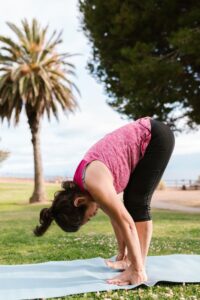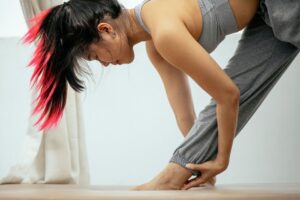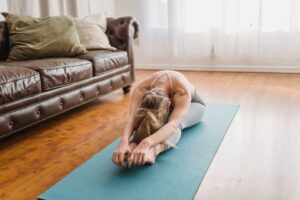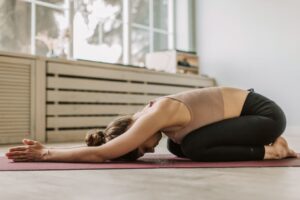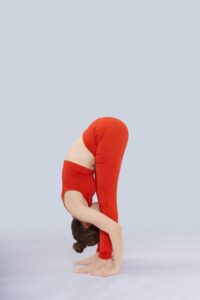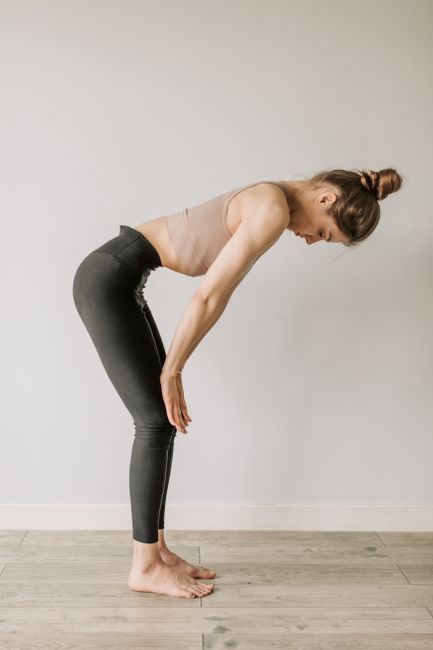
In short: half standing forward fold is the “half lift” of the sun salutation: from a forward fold you lengthen the spine forward until the back is long and roughly flat, hands on the shins, blocks or the floor, gaze slightly forward. It teaches you to bend from the hips with a long spine, a skill many other poses depend on. Bend the knees and move the hands up the legs as much as you need to keep the back long.
Because it is usually done for a single inhalation between two folds, the half lift is easy to skip over. It has its own page here because sequences count it as a separate step and because its cues are worth learning slowly.
The name
The Sanskrit name is Ardha Uttānāsana: ardha means half and Uttānāsana is the standing forward fold. Yoga Journal and Yoga International both use this name; teachers also say “half lift”, “halfway lift” or “flat back”. In Ashtanga’s Sun Salutation A, AshtangaYoga.info labels the same movement Uttanasana B. B.K.S. Iyengar describes the same concave-back position as a stage of his Uttanasana, with the head up and the back stretched, before folding down, without naming it separately.
His instructions for that stage are useful for anyone learning the half lift. With the palms on the floor beside the feet, he asks you to hold the head up and stretch the spine, and to move the hips a little forward so the legs become perpendicular to the floor. He suggests staying there for two deep breaths before folding. In the Ashtanga sun salutation the movement has its own count: AshtangaYoga.info gives it as count 3 (trīṇi), on an inhalation, and it comes back at count 7 after you jump or step forward. See our page on Sun Salutation A for the full count.
Making the half lift work
From the forward fold, press the fingertips or palms into the floor, blocks or shins and, on an inhalation, lengthen the trunk away from the thighs. Yoga Journal’s cue is to find as much length as possible between the pubic bone and the navel and to lift the top of the breastbone forward. The hips stay over the ankles rather than shifting back.
Most people need to bend the knees a little to get a long back; that is the point of the pose, not a compromise. Look a little forward without crunching the back of the neck. If the hands do not reach the floor with a long back, bring them to the shins or thighs, or place blocks in front of the feet. In a sun salutation you stay one breath; held on its own, take a few breaths and then exhale back into the full fold.
Think of the movement as a hinge. Yoga Journal asks you to bend from the hips rather than the waist, and to keep the ankles, knees and hips stacked as you fold. A simple test: put your hands on your hip creases and fold. If your fingers get pinched, you are hinging at the hips; if the lower back rounds first, you are bending at the waist. Bend the knees more and try again.
Blocks help a lot. Yoga Journal suggests two blocks in front of the feet, about shoulder-width apart, or one just outside each foot. Press into them and lift the chest away from the thighs. If the floor is still far away, practice facing a chair and rest the hands on the seat, back flat, looking down at your hands. This chair version is also a good way to learn the shape before you add it to a sun salutation.
- Rounding the upper back: the hands are probably too low. Move them up the shins or onto blocks.
- Straight, locked knees: bend them. A long spine matters more than straight legs here.
- Lifting the chin too far: look at the floor a little ahead of you so the back of the neck stays long.
- Rushing: even in a flow, let the inhale finish before you fold or step back.
Precautions in plain words
Yoga Journal advises not lifting the head to look forward if you have a neck injury; keep the gaze down instead. Otherwise the cautions are those of the standing forward fold: with a lower back injury, hamstring tear or sciatica, keep the knees bent and the hands high, on a chair seat if needed. Because the head stays above the hips, the half lift is a gentler choice than the full fold for people who get dizzy in head-down positions. If you have high or low blood pressure, are pregnant or have a recent back injury, ask your doctor which forward bends suit you, and use the chair version until you know.
Preparation and what comes next
It follows the standing forward fold in Sun Salutation A and leads into stepping or jumping back to plank and four-limbed staff pose. On the way up, it follows the step forward and precedes the full fold. As practice in folding from the hips it prepares you for pyramid, triangle and seated forward bends.
Where it is taught
The half lift is part of the Ashtanga sun salutations and nearly every vinyasa and power yoga class; see our sun salutation guide.