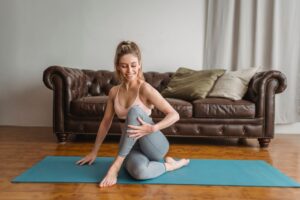
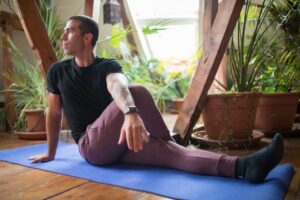
In short: full lord of the fishes is the complete form of the seated twist named after the sage Matsyendra. The bottom leg is folded into half lotus with the heel against the lower belly, the other foot stands outside the half-lotus knee, and you twist deeply toward the raised knee, the front arm wrapping outside it to hold the foot and the back arm reaching behind. Because the half-lotus knee is loaded during a deep twist, it is an advanced pose to learn with a teacher.
Most people know the easier half lord of the fishes. This page is about the full version, which is far less common in classes.
The name and its roots
The pose is called Matsyendrāsana, and the complete form is often written Paripūrṇa Matsyendrāsana or Purna Matsyendrasana: paripūrṇa and pūrṇa both mean full or complete. Matsyendra (lord of the fishes) is remembered as one of the founding teachers of hatha yoga. It is one of the few postures described in the Hatha Yoga Pradipika, the 15th-century hatha manual, which places one foot at the root of the opposite thigh and the other foot outside the knee, with the body turned and the hands holding the feet. The text says the posture kindles the digestive fire, destroys diseases and awakens kundalini; we report those as the text’s claims, not as medical facts. The 17th-century Gheranda Samhita also includes a Matsyendrasana. In modern teaching, B.K.S. Iyengar’s Light on Yoga describes it as Paripurna Matsyendrasana (asana 122), and Swami Sivananda’s Yoga Asanas gives it as Matsyendrasana, the full pose, to be tried only after the half pose.
How the pose is built
Yoga Journal’s step-by-step, by Ashtanga teachers Richard Freeman and Mary Taylor, builds it in four stages. First fold one leg into half lotus from staff pose, gently rolling the calf so the knee folds comfortably, with the heel in the lower belly on the opposite side, well below the navel. Next draw the other foot up and place it flat outside the half-lotus knee, and begin to turn the belly toward it. Then roll the front shoulder forward, wrap that arm outside the raised thigh and reach for the outer edge of the standing foot. Finally take the other arm behind the back toward the half-lotus shin, turn the head and soften the face. They suggest holding for at least ten breaths, inhaling to stabilise and exhaling to deepen, working slowly and never forcing.
Light on Yoga and Sivananda describe the same shape with two small differences. Both place the half-lotus heel at the navel rather than lower in the belly, and both have the back hand catch the half-lotus foot or heel from behind. Iyengar builds it in stages too, catching the ankle from behind first and then placing the other foot outside the knee, and holds the final pose for 30 to 60 seconds, noting that the breath is faster because of the pressure on the diaphragm.
If any stage is not available, stop there. If the half-lotus knee hurts, practise half-bound lotus forward bend to learn the leg position comfortably first, and use the half lord of the fishes instead, with the bottom heel beside the opposite hip.
Precautions in plain words
Only attempt it with a pain-free half lotus and a comfortable half lord of the fishes. Avoid it with knee, hip, sacroiliac or disc problems, and during pregnancy. Never use the arm wrap to force the twist; stop at any sharp feeling in the knee, hip or back. Learn it with an experienced teacher. This page is general information, not individual advice.
Preparation and what comes next
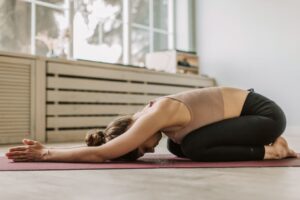
Work on half lord of the fishes, Marichi’s twist (including the half-lotus version D), half lotus and Bharadvaja’s twist. Afterwards, unwind slowly, release the half lotus carefully with both hands and rest the spine in a gentle forward fold or child’s pose.
How to know you are ready. You should be able to sit in half lotus for a few minutes without any sensation in the knee, and to practise the bound version of half lord of the fishes with a long spine and easy breathing. Even then, build the full pose in stages as Freeman and Taylor suggest, stopping at the first stage that asks for force. If you are working with a teacher, ask them to watch the half-lotus knee as you begin to twist.
You will meet the full pose occasionally in Ashtanga-based and hatha classes that study the classical postures.