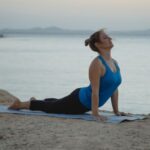
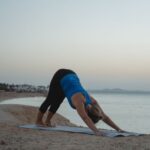
In many flowing classes, when the teacher says “take a vinyasa”, they mean a short linking sequence: from plank, lower to chaturanga, lift into upward-facing dog, and press back to downward-facing dog. It is the bridge between poses, between sides and between sun salutations. This page breaks it into its parts, explains where it comes from, and gives knees-down and cobra options at every stage.
What “vinyasa” means here
The word vinyāsa has a broader meaning: in Ashtanga yoga it is the system of linking breath and movement, and every movement of a pose is a numbered vinyasa (see Sun Salutation A for the counts). In everyday class language, “a vinyasa” has come to mean this one linking chain. AshtangaYoga.info’s practice sheets for the Ashtanga series show the same idea: between seated poses and between sides, practitioners pass through a plank-based vinyasa (or a backward roll) to downward dog and come back through. The order of the chain is common, but how teachers enter and leave it, and whether they add a held plank, varies, so we list it as “varies by school”.
How the breath and counting work
The classic pattern is: exhale as you lower to chaturanga, inhale into upward dog, exhale back to downward dog. If you start from a seated pose, there is usually an inhale to lift or set up and an exhale to jump or step back. There is no left or right side, although if you step back rather than jump, alternate which foot goes first. In a class you might do a vinyasa a dozen times or more, which is why the details below matter: small habits get repeated.
Common alignment points
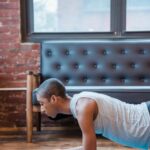
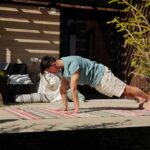
- Plank: shoulders over the wrists, body in one line, belly lifted.
- Chaturanga: shift slightly forward, bend the elbows straight back alongside the ribs, and stop when the upper arms are about parallel to the floor or higher. Many shoulder complaints come from lowering too far or letting the chest sag.
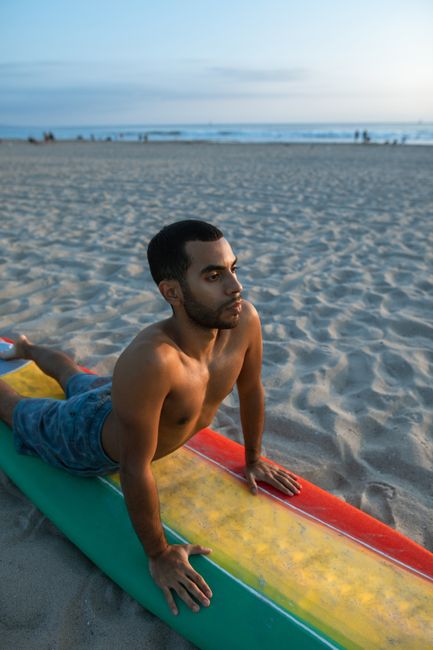
- Upward dog: roll over the toes (or flip one foot at a time), press the hands down, lift the chest forward and up with the thighs off the floor and the shoulders away from the ears.
- Downward dog: roll back over the toes, lift the hips, bend the knees as needed to keep the back long.
Building the strength for chaturanga
Chaturanga is the hard part of the chain, and Yoga Journal stresses that it is not simply a push-up. Its instructions start in plank with the shoulders slightly ahead of the wrists, the legs active and the heels reaching back. As you breathe out, bend the elbows and lower with the body as straight as a plank of wood, elbows over the wrists and drawn in against the sides, until the shoulders are level with the elbows. Do not go lower than that, and do not bend the elbows past about 90 degrees. Look at the floor a few inches ahead rather than up.
Yoga Journal offers three ways to practise while the strength builds:
- Knees down. Lower the knees to the mat and keep the belly engaged; this is stage 2 below.
- At a wall. Stand a few inches from a wall with the hands on it slightly below shoulder height, and press as if pushing yourself away. You feel the shoulder action without carrying your body weight.
- With a strap. If the elbows splay out, loop a strap just above the elbows, shoulder-width apart. As you lower, the strap catches the ribs and keeps the arms in line.
Yoga Journal also advises avoiding or modifying chaturanga with rotator cuff injuries, shoulder weakness or arthritis, and with wrist pain, wrist arthritis or carpal tunnel syndrome. In those cases the knees-down, belly-down version below, or skipping the vinyasa altogether, is the better choice.
How to practise it safely
The vinyasa loads the shoulders and wrists repeatedly. Use the knees-down version until you can lower with control, and skip some vinyasas in a class (rest in downward dog or child’s pose instead) if your shoulders tire. With wrist, shoulder or lower-back problems, use cobra instead of upward dog and ask a teacher. In pregnancy, avoid lowering to the belly and work with a prenatal teacher. These instructions have not yet been reviewed by a qualified teacher.
Easier alternatives
In order of difficulty: (1) from tabletop, lower all the way to the belly, lift into a low cobra and push back to child’s pose; (2) knees-down chaturanga to cobra to downward dog; (3) full chaturanga to cobra; (4) the full vinyasa as shown. Spend a week or more at each stage. The beginner sun salutation uses stage 1. Read the pose pages for plank, chaturanga, upward-facing dog and downward-facing dog for detail, and see vinyasa yoga for the style.