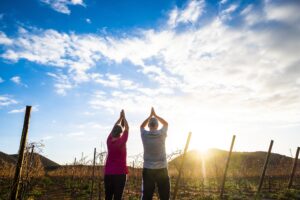




A moon salutation (Chandra Namaskar) is a flowing sequence offered as a counterpart to the sun salutation: usually slower, often practised in the evening, and in its best-known form done standing, moving from side to side rather than forward and back. Unlike Sun Salutation A in Ashtanga, there is no single fixed order. Different schools teach quite different sequences under the same name, and this page shows the main ones with their sources.
The step list on this page is the Kripalu version, because it is the most widely published one with a named origin. Its full page is the Kripalu moon salutation.
The name
Chandra means moon in Sanskrit and namaskar means greeting or salute, as in Surya Namaskar. The Sanskrit name is used widely in modern classes, but it is a name for modern sequences rather than a posture from the old hatha yoga texts. We know of no evidence that any moon salutation is ancient, and the best-documented one has a specific modern origin.
Version 1: the Kripalu moon salute
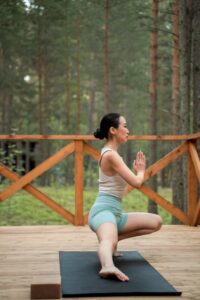
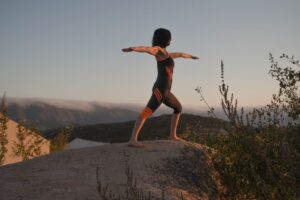
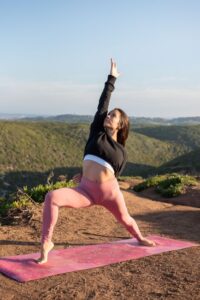
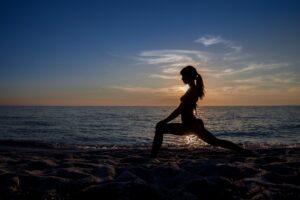
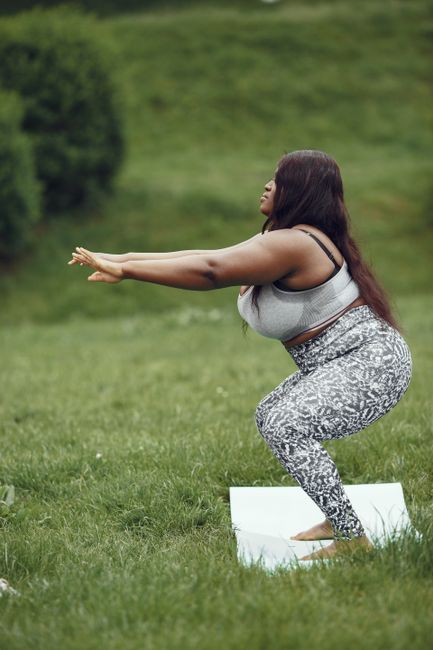
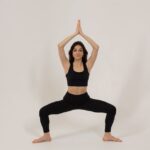
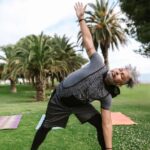
Kripalu Center for Yoga & Health states that its moon salute was created at Kripalu in the late 1980s by a group of teachers including Megha Nancy Buttenheim. It is a standing, side-to-side sequence: from mountain pose with the hands in prayer, a standing side bend (called half moon at Kripalu) to each side, a goddess squat, five-pointed star, triangle, a standing runner’s stretch over the front leg, a runner’s lunge, then a wide squat with one leg extended, and back again through the same poses on the other side. The flow is mirrored, so one round covers both sides. Bernie Clark’s YinYoga.com publishes a moon salutation “based on the Kripalu tradition” with the same arc, adding a central squat between the two sides.
Version 2: Kripalu’s gentle and seated moon salutes
Megha Nancy Buttenheim later modified the classical sequence into a gentle standing version (without the deep squats and runner’s lunges, adding Warrior I and II) and a seated version done in a chair. Kripalu publishes both. Our gentle moon salutation and seated moon salutation pages follow them.
Version 3: a forward-and-back moon salutation
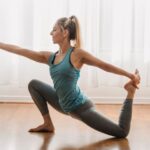
Other teachers use the name for something closer to a slow sun salutation. Yoga International publishes a meditative moon salutation by ParaYoga teacher Karina Mirsky that moves forward and back: standing, a fold, a lunge with the arms raised, downward dog, tabletop, child’s pose, a kneeling backbend, upward-facing dog and back up through the lunge, with a moon visualisation at the start and end. It shares the name, not the order, with the Kripalu sequence. Iyengar, Bihar and other schools have their own uses of the term; we will add them only once we have checked a source.
How counting and sides work
In the Kripalu versions one round travels to one side and back through the centre to the other, so both sides are done in each round. Kripalu’s gentle version suggests repeating at your own pace; its seated version suggests two more repetitions after the first. Moon salutations are usually practised slowly, with a full breath for each movement; many teachers use them as a cooling or evening practice, though that is a teaching choice, not a rule.
Practising safely
The deep squats and runner’s lunges of the classical Kripalu version ask a lot of the knees and hips. Keep the knees tracking over the toes, use a block under the hands in the lunges, and rise higher in the squats. Choose the gentle or seated version if the knees, hips or balance are a concern, and stop with any sharp pain. These pages have not yet been reviewed by a qualified teacher.