


Gentle Moon Salutation: a standing flow based on Kripalu’s version

A gentle standing moon salutation based on Kripalu's published version: side bends, star, goddess, triangle and Warriors I and II on both sides, without deep squats or lunges.

Not yet reviewed by a qualified teacher Needs verification: names and instructions not yet confirmed by two sources

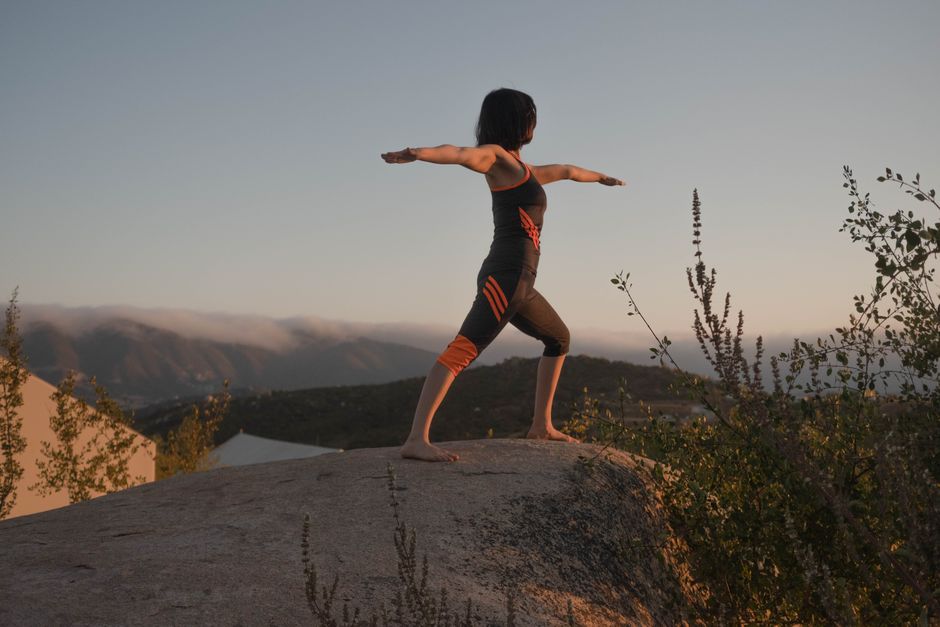
Woman in warrior II yoga pose on a rock at sunset, embracing wellness and mindfulness.
Also called
Gentle Moon Salute, Gentle Chandra Namaskar
Tradition
Kripalu Yoga
Order
Newly designed educational flow
Level
Beginner
Approximate duration
about 10 minutes
Focus
Gentle
Audience
Beginners, Older adults
Props
Block, Mat
Styles
Hatha Yoga: The Historical Term and the Modern Class
Body areas
Hips, Legs, Spine

A newly designed educational flow, not a traditional sequence. Teachers order these poses in many ways.

Printable view

Origin and source

Our educational flow based on the gentle moon salute by Megha Nancy Buttenheim, published by Kripalu Center for Yoga & Health (moon salutations vary between schools).

Who it is for

Able to stand with the feet wide and hold a warrior stance briefly. Beginners welcome.

The steps in order

Version shown: Based on Kripalu's gentle moon salute (Megha Nancy Buttenheim): her 25 cues in her order, grouped here into 17 steps

#StepBreathSideCues and options
1Mountain, hands in prayer; sweep arms overhead to a steeple
Tāḍāsana
Inhale

Transition: Exhale hands down, inhale sweep up.

Easier option: Arms to shoulder height.

2Side bend right, centre, side bend left, centreExhaleEach side

Transition: Exhale to bend, inhale to centre.

Easier option: Hand on the hip.

3Step out to five-pointed starExhale

Transition: Step wide, arms at shoulder height.

Easier option: Narrower stance.

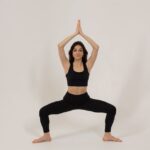
4GoddessExhale

Transition: Turn the feet out and sink.

Easier option: Shallow bend.

5Five-pointed starInhale

Transition: Straighten the legs.

Easier option: Hands on the hips.

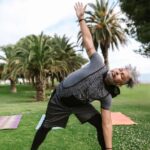
6Triangle, right
Utthita Trikoṇāsana
ExhaleRight

Transition: Left foot in 45°, right foot out 90°, pinwheel the arms to the right.

Easier option: Hand on the shin or a block.

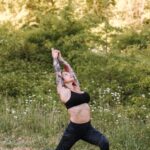
7Warrior I, right
Vīrabhadrāsana I
InhaleRight

Transition: Flow the arms down, pivot to face the right leg, bend the right knee and rise with the arms overhead.

Easier option: Shorter stance; back heel up.

8Warrior II, right
Vīrabhadrāsana II
ExhaleRight

Transition: Turn the torso to the side, arms to shoulder height.

Easier option: Bend the front knee less.

9GoddessExhale

Transition: Straighten, inhale, then exhale to goddess.

Easier option: Shallow.

10Five-pointed starInhale

Transition: Rise to star.

Easier option: Hands on hips.

11Triangle, left
Utthita Trikoṇāsana
ExhaleLeft

Transition: Left foot out 90°, right foot in 45°, pinwheel left.

Easier option: Block.

12Warrior I, left
Vīrabhadrāsana I
InhaleLeft

Transition: Pivot, bend the left knee, arms up.

Easier option: Shorter stance.

13Warrior II, left
Vīrabhadrāsana II
ExhaleLeft

Transition: Open the torso, arms out.

Easier option: Less knee bend.

14GoddessExhale

Transition: Straighten, inhale, exhale to goddess.

Easier option: Shallow.

15Five-pointed starInhale

Transition: Rise to star.

Easier option: Hands on hips.

16Step to centre, arms overhead; side bends right and leftExhaleEach side

Transition: Inhale step the right foot in, arms to steeple; exhale bend, inhale centre.

Easier option: Hand on hip.

17Sweep the arms down, hands to prayer
Tāḍāsana
Inhale

Transition: Exhale the arms down in a full circle, inhale to prayer; repeat or rest with eyes closed.

Easier option: Pause between rounds.

Left and right

Side bends right then left; triangle and warriors on the right first, then the left; side bends again at the end.

Repetitions and counting

One round covers both sides; repeat at your own pace (Kripalu), finishing with eyes closed and long breaths.

Props and adaptations

Shallow goddess, shorter warrior stances, hand on a block in triangle, arms lower for sore shoulders, wall or chair nearby for balance.

Precautions

  • Knees: keep them over the toes in goddess and the warriors.
  • Balance: practise near support.
  • Recent surgery, injury or pregnancy: ask a health professional first.

Learn it with a teacher: Suitable to learn on your own; a Kripalu or gentle-yoga teacher can refine the transitions.

General information, not medical advice. Poses do not cure illness. If you are pregnant, injured or have a health condition, check with your doctor and tell your teacher before you practise.

Beginner and chair alternatives

Seated Moon Salutation: a chair flow based on Kripalu’s version

Moon salutations are not one fixed sequence: different schools teach different versions, and there is no single standard gentle one. The gentle moon salutation on this page is our educational flow based on the gentle version that Megha Nancy Buttenheim, one of the co-creators of the classical Kripalu moon salute, published with Kripalu Center for Yoga & Health. We keep her order of poses and her breath cues; the grouping into steps, the safety notes and the adaptations are ours. Her version leaves out the deep extended-leg squats and the runner’s lunges of the classical moon salute. In their place come Warrior I and Warrior II, which keep the legs working without asking the knees to bend so far. Everything is done standing, slowly, with the breath.

We chose to build on Kripalu’s published gentle version rather than invent a new flow, because a named, sourced starting point is more useful to you. We have found it documented only by Kripalu, so treat this page as one school’s approach, not the only correct one. The general picture of moon salutations, including other schools’ versions, is on the moon salutation overview.

The shape of the flow

From mountain pose with the hands in prayer, the arms sweep overhead into a steeple, and you take a standing side bend (Kripalu’s “half moon”) to the right and to the left. Then you step out wide into five-pointed star, bend the knees into goddess, and straighten again. Turning the right foot out, the arms “pinwheel” into triangle; then you pivot to face the right leg, lowering the torso towards the knee, bend the right knee and rise into Warrior I, turn the torso and lower the arms into Warrior II, and straighten the legs back to goddess and star. The same happens on the left. Finally you step back to centre, repeat the side bends, and sweep the arms down to prayer.

Breath, sides and rounds

Unlike the classical page, Kripalu’s gentle version gives breath cues, and we follow them: exhale into each side bend and inhale back to centre, exhale as you step out or sink into goddess, inhale back up to star. The right side comes first, then the left, inside one round. Kripalu suggests repeating at whatever pace suits you and finishing with the eyes closed and a few long, deep breaths. Three slow rounds take about ten minutes.

When to practice it, and why “moon”

Kripalu’s own article on the moon salute explains the idea behind the name. Buttenheim and her colleagues created the classical sequence in the late 1980s, and she describes wanting it to recognize “the downward flow of energy,” as a counterpart to the sun salutation. Kripalu says a moon salute can be done at any time of day, at the end of a yoga practice, or whenever you want to quiet the mind, and calls it especially comforting in the evening as a way to wind down. Buttenheim calls the salutation “a meditation in motion,” and says the sequence keeps changing and evolving.

Two details in her gentle cues are worth noticing. When you pivot from triangle to face the front leg, she asks you to lower the torso toward the knee only as far as feels comfortable. And in Warrior II the gaze stays over the front shoulder. Neither needs to be deep; the flow works best when each shape is easy enough that the breath stays smooth.

How to practise it safely

  • Keep goddess shallow and the knees in line with the toes.
  • In Warrior I, shorten the stance if the back heel will not stay down or the lower back pinches; let the back heel lift if needed.
  • In triangle, rest the lower hand on the shin or a block rather than reaching for the floor.
  • If shoulders are sore, keep the arms lower, at shoulder height or with the hands on the hips.
  • Stand near a wall or chair if wide stances feel unsteady.

Check with a health professional first if you are recovering from surgery or injury, or are pregnant. Our step notes and adaptations are our own and have not yet been reviewed by a qualified teacher.

Easier and harder

Easier still: the seated moon salutation, our chair flow based on Kripalu’s seated version. More challenging: the classical Kripalu moon salute, with runner’s lunges and extended-leg squats. The poses are explained on their own pages: Warrior I, Warrior II, goddess and triangle. In the evening, it pairs well with our bedtime yoga plan.
Frequently asked questions

Is this the official Kripalu gentle moon salutation?

It follows the order and breath of the gentle version Megha Nancy Buttenheim published with Kripalu; the step grouping, notes and adaptations are ours. Moon salutations vary between schools, so this is one approach, not the only one.

What makes this moon salutation gentle?

Kripalu's gentle version leaves out the runner's lunges and deep extended-leg squats of the classical moon salute and uses Warrior I and II instead.

When is a good time to practise it?

Any time; many people like it in the evening as a slow, standing practice. Kripalu suggests finishing with the eyes closed and a few long breaths.

Sources

  1. Variations on the Moon Salute: Gentle and Seated Versions (Megha Nancy Buttenheim), Kripalu Center for Yoga & Health (accessed October 6, 2026)
  2. Chandra Namaskar: Honoring the Moon Salute (classical version and creators), Kripalu Center for Yoga & Health (accessed October 6, 2026)

Facts checked on October 6, 2026