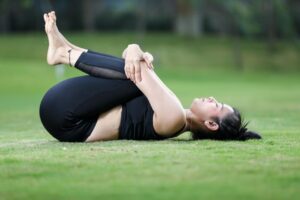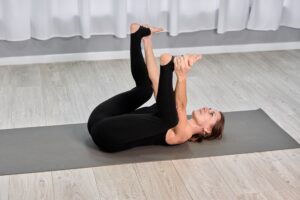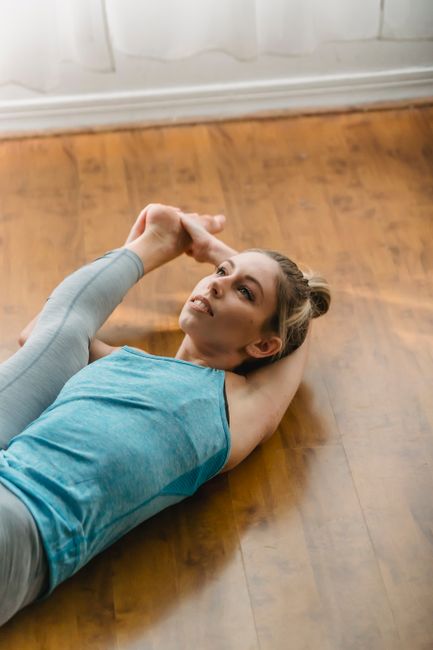
In short: reclining figure four, also called eye of the needle, is a hip stretch done lying on your back: one ankle crosses over the opposite thigh, just above the knee, and you draw the lower leg toward your chest. It stretches the outer hip and buttock of the crossed leg with no weight on the knees, which makes it the usual starting point before pigeon pose.
The legs make the shape of the number 4, hence the name; the gap between them is the “eye” that one arm threads through. Because you are lying down, the spine is supported and you can control the intensity precisely, simply by how close you draw the leg. That is why teachers so often offer it as the alternative when pigeon bothers the knee or the lower back.
About the name
Reclining figure four is a modern descriptive name. Yoga Journal also calls it figure four, dead pigeon or eye of the needle, and Yoga International calls it eye of the needle or reclining pigeon, describing it as the reclined version of the yin pose sleeping swan. You will sometimes see the Sanskrit-style name Sucirandhrasana (sūci needle, randhra opening) on yoga websites; we have not found it in the lineage references we checked, so we treat it as modern usage. “Thread the needle” is also used for a different pose, a shoulder twist on hands and knees, so check which one your teacher means.
How to make it work
Lie on your back with the knees bent and the feet hip-width apart. Cross the right ankle over the left thigh, just above the knee, and flex the right foot, which keeps the ankle and knee stable. Then lift the left foot and draw the left thigh toward you, holding behind the thigh with both hands; the right arm threads through the gap. Yoga Journal’s advice is to hold the front of the shin only if you can do it without lifting the shoulders or rounding the upper back; otherwise stay behind the thigh or use a strap. The head stays down and the neck soft. If that is already plenty, leave the left foot on the floor and simply press the right knee gently away from you.
Hold for five to ten slow breaths in an active class. In a yin class, the same shape is often held for a few minutes, with the muscles relaxed.
Precautions in plain words
This is one of the gentlest hip openers, but the crossed knee should still feel nothing but comfortable; if it does not, move the ankle further toward the thigh or keep the bottom foot on the floor. With a hip replacement, follow your surgeon’s guidance on crossing the legs and bringing the knee toward the chest. Lying flat on the back for long holds may not suit later pregnancy; ask your health care provider and use a seated or chair version. This page is general information, not individual advice.
Preparation and what comes next
Little preparation is needed: a few knee-to-chest hugs in wind-relieving pose are enough. From here you can move on to floor pigeon pose, fire log pose and, much later, half lotus. A natural follow-up lying down is reclining spinal twist; you can also flow into a bridge with the leg still crossed.
Where it is taught
Reclining figure four turns up in almost every style: in hatha and vinyasa as a cool-down, in yin as a substitute for sleeping swan, and seated in chair yoga. It appears in our bedtime yoga plan. Browse more gentle hip openers in the pose library.