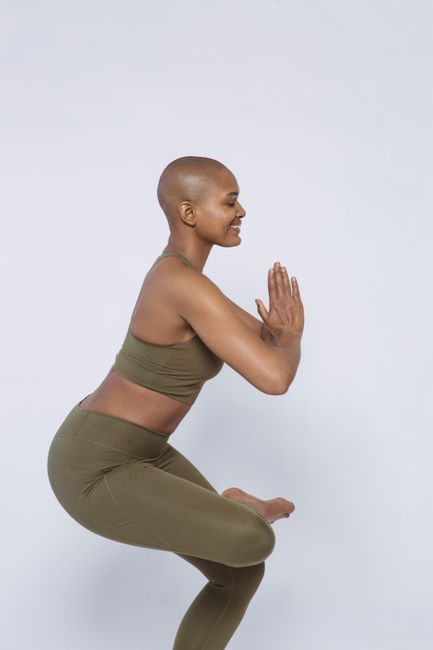
In short: chair pose is a standing squat with the arms raised: you bend the knees as if sitting back onto an invisible chair, keep the weight in the heels and reach the arms up beside the ears. It strengthens the legs and back and asks for steady breathing. Sit the hips back so the knees stay over the feet, and only go as low as you can hold without strain.
Few poses heat the body as quickly. Chair pose is short to describe and demanding to hold, which is why it appears in so many flowing classes and in the Ashtanga sun salutation. Below we explain the name, the cues that protect the knees and lower back, the precautions and where the pose is taught.
The name: fierce, powerful, awkward
The Sanskrit name is Utkaṭāsana. B.K.S. Iyengar glosses utkaṭa as powerful, fierce or uneven, and says the pose is like sitting on an imaginary chair; AshtangaYoga.info translates it as intense. That is why you will hear “fierce pose” and “powerful pose” as well as “chair pose”. The 26-posture hot yoga sequence associated with Bikram Choudhury calls its version “awkward pose”; it is taught there in three parts that differ from the single shape described here, so check with the teacher if you practise that style.
Making chair pose work
The safest chair pose comes from the hips, not the knees. As you bend the knees, send the hips back and down as if reaching for a seat, and keep the weight toward the heels so you can still wiggle the toes. AshtangaYoga.info’s cue is that the knees should stay above, not in front of, the toes, which is only possible by drawing the pelvis further back. Keep the knees pointing the same way as the toes.
The upper body lifts while the legs sit. Iyengar asks you not to stoop forward but to keep the chest as far back as possible; Yoga Journal adds that the deeper the legs bend, the more you need to lift the lower belly to avoid over-arching the lower back. Arms go up beside the ears, palms facing or joined. If the shoulders are tight, keep the arms apart or forward. Breathe steadily. Iyengar suggests staying a few seconds and notes that 30 seconds is enough; Ashtanga holds it for five breaths.
Learning chair pose in two halves
Yoga Journal suggests a useful way in: practice the legs and the arms separately, using a wall as a guide. For the legs, stand with your back to a wall, hands on your hips, and walk the feet about two feet forward. Bend the knees as if sitting in a chair, ankles under the knees, and press the heels down on an exhale until the backs of the legs wake up. Notice that the backs of your sitting bones, ribs, shoulders and head touch the wall while the lower back and neck curve gently away. Keep those natural curves without tucking the tailbone hard, which flattens the lower back.
For the arms, stand with your back to the wall and lift the arms alongside the ears, shoulder-width apart. The ribs will want to follow the arms forward. Draw the lower ribs back toward the wall and take the arms only as high as you can while the ribs stay in contact. Stay for five breaths. Then put the two halves together, at the wall or away from it.
Common mistakes and simple fixes
- Knees shooting past the toes: shift the weight back into the heels and send the hips further back.
- Chest collapsing onto the thighs: lift the chest away from the legs, as if leaning the upper back on a wall behind you.
- Lower back arching hard: lift the lower belly, more so the deeper you bend.
- Head tipped back to look up: keep the neck long and rest the gaze on the floor a few feet ahead.
- Brow scrunched and jaw clenched: soften them, and if the breath gets labored, make the exhales longer.
Feet together asks more of the inner thighs. If you feel unsteady, set the feet hip-width apart. If the shoulders ache or you get winded, hold the arms straight in front of you or by your sides.
Precautions in plain words
Come up if you feel pain in the knees, and work higher with a shorter bend. With a knee injury, ask a physiotherapist before squatting poses. With lower back pain, keep the bend shallow and the belly gently lifted. With a shoulder injury, keep the hands on the hips or at the chest. If balance is uncertain, practise with your back near a wall.
Preparation and what comes next
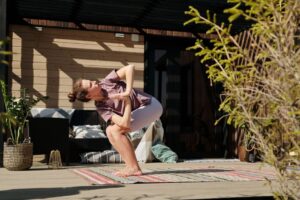
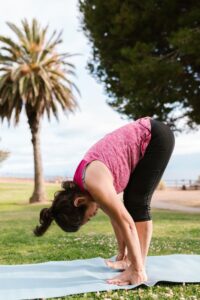
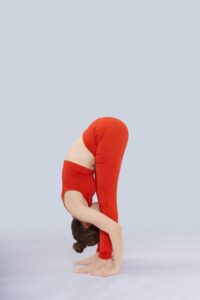
Warm up with mountain pose and upward salute; a few rounds of sun salutations help. From chair pose you can twist into revolved chair, fold into standing forward fold, or come back up to mountain. In Ashtanga’s Sun Salutation B, chair pose is the first movement and the last before standing.
Where it is taught
Chair pose is in Iyengar yoga (Light on Yoga), in Ashtanga as part of Sun Salutation B and the start of the primary series proper, in almost every vinyasa and power yoga class, and, as awkward pose, in the 26-posture hot yoga sequence.