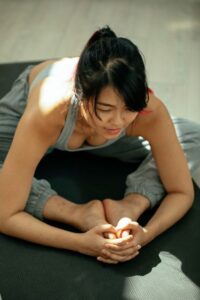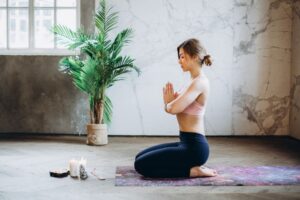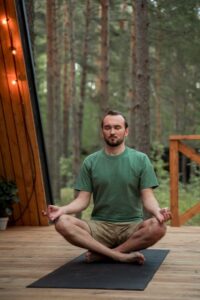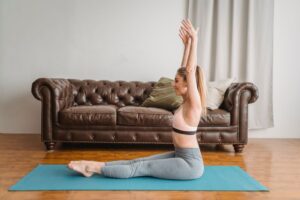
In short: Bhadrāsana, the gracious or auspicious pose, is one of the four seated postures the Hatha Yoga Pradipika calls most important. In that text the soles come together with the heels drawn in beside the perineum and the feet held firmly with the hands, a shape close to bound angle pose. The Indian government’s Common Yoga Protocol teaches the same soles-together shape, so it is the main version on this page. The Bihar School uses the same name for a different, kneeling seat, which we also explain.
Gracious pose is rarely taught as a pose of its own in modern classes, but it matters for anyone reading the classical texts or following a Bihar School or Satyananda-style class. Below we explain the name, the two main versions, how to practise them with props, the precautions and related seats.
The name and the two versions
Bhadra means blessed, auspicious, gracious or good, according to the Monier-Williams dictionary. In the Hatha Yoga Pradipika (15th century), Bhadrasana closes the list of four main postures, after Siddha, Padma and Simha. In Pancham Sinh’s 1914 translation, the heels are placed on either side of the perineum, left on the left and right on the right, and the feet are held firmly joined with both hands; the text adds that adepts also call this Gorakṣāsana and that it destroys all diseases, which we record as the text’s claim, not a fact. Srinivasa Iyangar’s earlier translation renders the hand position differently, as binding the thighs with the hands, which is one reason the shape is described differently today. Some modern teachers simply equate Bhadrasana with Baddha Koṇāsana. Swami Sivananda’s Yoga Asanas keeps the text’s essentials in a few lines: sit erect, press the heels against the sides of the perineum and gaze at the tip of the nose.
The Common Yoga Protocol of India’s Ministry of AYUSH, the official routine for the International Day of Yoga, glosses bhadra as firm or auspicious and teaches the pose this way: from staff pose, bring the soles together, clasp the hands over the toes and draw the heels as close to the perineum as you can, with a soft cushion under the knees if the thighs stay high, and stay for a while with normal breathing.
The Bihar School’s Asana Pranayama Mudra Bandha, which calls it the gentle pose, describes something else: from thunderbolt pose, the knees separate as far as is comfortable, the toes stay in contact with each other and the buttocks rest on the floor between the feet, hands on the knees, gaze toward the tip of the nose. The sitting-between-the-feet version is legitimate within the Bihar School, but it is the less common reading of the name. When a teacher names Bhadrasana, the style of class tells you which they mean.
How to practise it
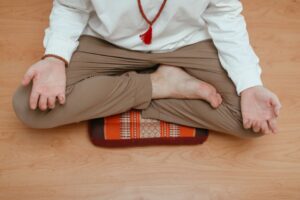
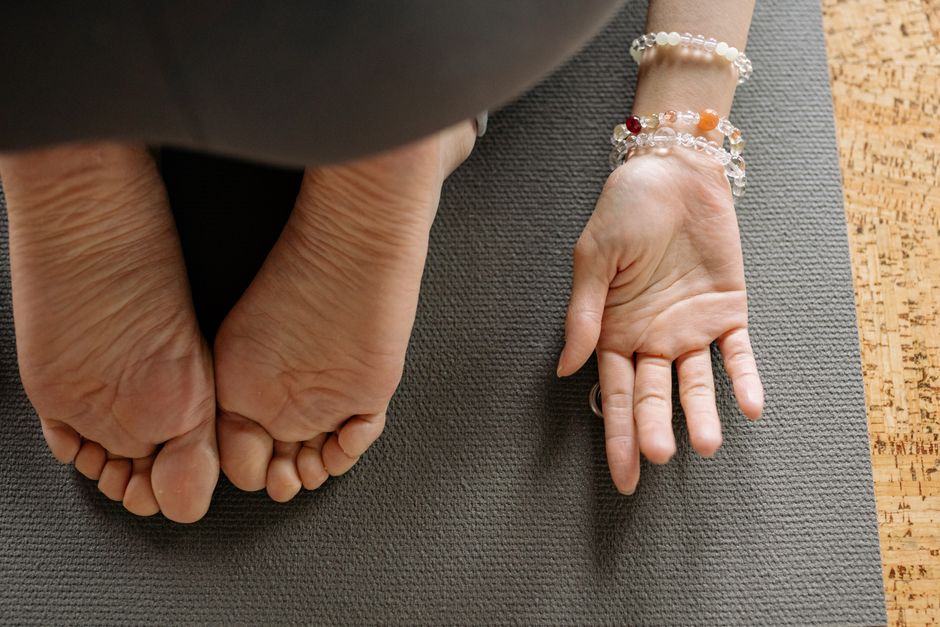
For the text version, sit on a folded blanket, bring the soles together and draw the heels in toward the body as far as the hips allow. Clasp the hands over the toes, hold the feet together and sit tall. Most people cannot bring the heels all the way to the perineum; there is no need to. Let the knees release without pushing, and support them on a cushion or blocks if they stay high, as the Common Yoga Protocol suggests. Breathe normally.
For the Bihar version, kneel, separate the knees wide while the big toes stay together, and lower the buttocks to the floor between the feet, or onto a block or cushion there. The Bihar School’s instructions are to try to widen the knees further only without strain, to breathe slowly and rhythmically, and to end the pose if any strain is felt.
Precautions in plain words
Both versions need open hips, and the kneeling one also bends the knees deeply. With a knee, groin or hip injury, use plenty of height under the seat and support under the knees, or choose easy pose, and ask your doctor or physical therapist. The Common Yoga Protocol advises avoiding it with severe arthritis or sciatica. Never press the knees toward the floor. Come out if the legs go numb. This page is general information, not individual advice.
Preparation and related seats
Bound angle pose is the best preparation for the text version, and thunderbolt and hero pose prepare the kneeling version. The other seats in the Hatha Yoga Pradipika’s group of four are accomplished pose, lotus and lion pose; auspicious pose comes from the same chapter.
Where it is taught
Gracious pose is used as a seat for breathing practices and meditation in traditional hatha and Bihar School teaching. Explore the other seated poses in the pose library.