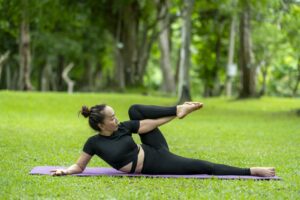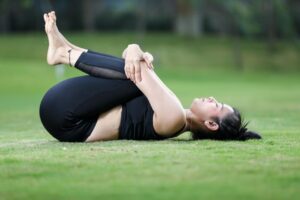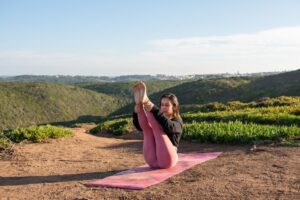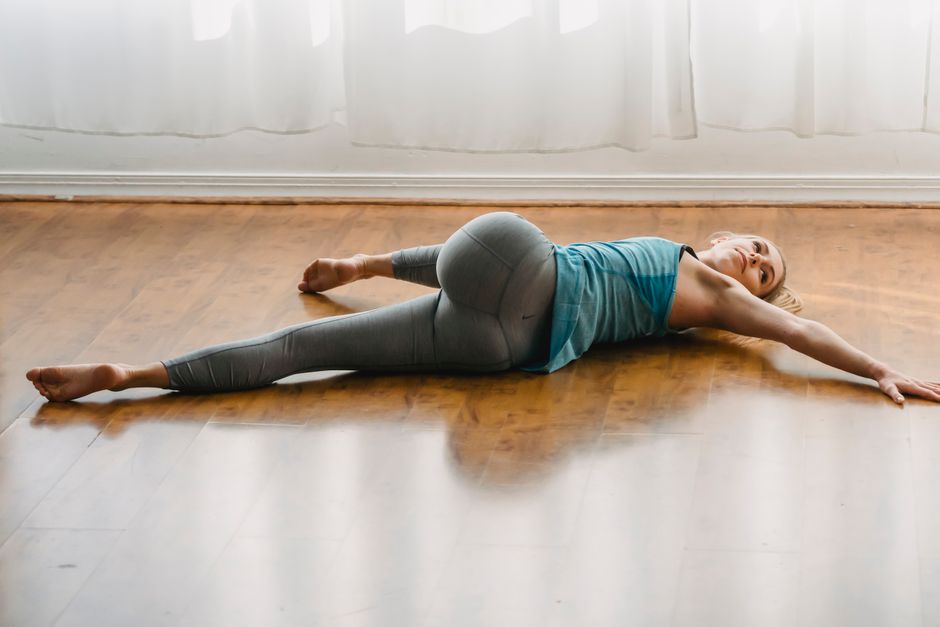
In short: revolved abdomen pose is an active twist lying on your back. With the arms spread at shoulder height, you lift the legs and lower them slowly to one side, keeping the opposite shoulder pressed to the floor, then lift them back through the centre and lower them to the other side. In its full form the legs stay straight, which makes it a demanding core exercise; with bent knees it is much easier.
It is not the same as the relaxed reclining spinal twist, although many classes use this name for both. Below we sort out the names, describe the bent-knee and straight-leg versions, and explain how to protect the lower back.
What the name means, and the naming muddle
Jaṭhara Parivartanāsana joins jaṭhara (abdomen, belly), parivartana (turning around, revolving) and āsana: the posture of turning the abdomen. The pose is not found in the medieval hatha texts; the straight-leg form is described in B.K.S. Iyengar’s 1966 Light on Yoga. Teachers today use the name in two ways. In the Iyengar sense, and in Sandra Anderson’s description for Yoga International, the full pose lowers straight legs to the side as a strength exercise. Many other classes, and a Yoga Journal how-to by Tias Little, use the same name for a version with the knees bent toward the chest. Both are the same movement at different levels of difficulty. The fully relaxed knees-down twist that ends many classes is on its own page, the reclining spinal twist.
Making it work: bent knees first
Start with bent knees. Lie on your back, arms out at shoulder height, and draw the knees toward the chest. Engage the lower belly and press the lower back gently toward the floor, then lower both knees to one side, only halfway at first, keeping the opposite shoulder down. Yoga Journal warns against two things: letting the knees slide down below the level of the pelvis, which strains the lower back, and letting the opposite arm and shoulder blade lift, which removes the anchor of the twist. Bring the knees back through the centre and repeat to the other side. Sandra Anderson suggests shifting the pelvis slightly away from the side the legs will go to before lowering, which keeps the knees stacked and takes strain off the lower back; secondary sources describe the same shift in Iyengar practice.
Move to straight legs only when the bent-knee version feels easy. Lift the straight legs to vertical, shift the hips, squeeze the legs together and lower them slowly to the side without letting them touch the floor, reaching the feet toward the hand. Keep the opposite shoulder grounded. Stay for three to five breaths, then lift back to the centre on an inhalation. An intermediate step is to lower bent knees and then straighten the legs at the side. The moment the back arches or the legs drop rather than lower, bend the knees and come back.
Precautions in plain words
The straight-leg version puts real load on the lower back and abdominal wall. Avoid it, or stay with small bent-knee movements, if you have lower-back pain, disc problems, sacroiliac pain, a hernia, or have recently given birth or had abdominal surgery, and ask your doctor or physiotherapist first. Avoid it during pregnancy. Never let the legs drop under their own weight. This page is general information, not individual advice.
Preparation and what comes next
Build the core with raised legs pose (double leg lifts) and boat pose, and learn the twist with the reclining spinal twist. Afterwards, hug the knees in with knees-to-chest and rest in corpse pose.
You will meet revolved abdomen pose in Iyengar, hatha and vinyasa classes, often in the core-strength part of the practice.