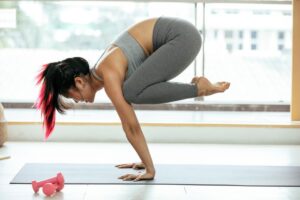
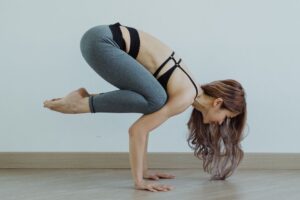
In short: in pendant pose you kneel with the ankles crossed, place the hands beside the knees, round the back into a tight ball and press the floor away until knees, shins and feet lift and the body hangs between the arms like a pendant. It is short and intense, it asks a lot of the wrists, arms and belly, and most people need blocks under the hands to lift at all. Treat it as an advanced pose.
Pendant pose matters well beyond itself: the same rounded back and pressing action are used in crane and in the jump-backs of flowing practice.
The name and its history
Lola carries the sense of swinging or dangling; Yoga Journal calls Lolāsana the Pendant, or Swinging, Pose, because once lifted the ball of the body can be rocked between the arms. B.K.S. Iyengar’s Light on Yoga (plate 83) explains lola as tremulous, moving to and fro, or dangling like an earring, and describes the same lift: sitting on the crossed feet, hands on the floor beside the hips, the trunk and legs are raised on straight arms and gently rocked forward and back, like a dangling pendant. The Iyengar Yoga (UK) syllabus lists it at the same plate, and Lolasana also appears in the contents of Swami Sivananda’s book Hatha Yoga; we have not been able to check that the Sivananda posture is the same shape. In a Yoga Journal article, Richard Rosen reports the researcher N.E. Sjoman’s view that the pose was once a swinging exercise called jhula in an Indian gymnastics manual, the Vyayama Dipika, and that T. Krishnamacharya probably renamed it as an asana. That is one researcher’s reading of the history, not settled fact.
Making the pose work
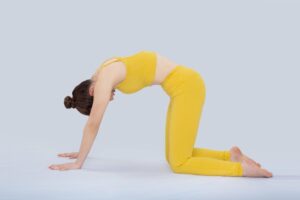
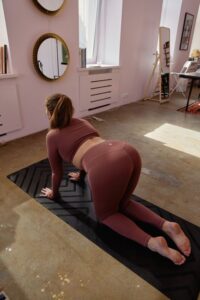
Rosen’s preparation starts on hands and knees: round the back up to the ceiling, spread the shoulder blades wide while squeezing the outer arms in, and initiate the rounding by drawing the navel toward the spine while pressing the bases of the index fingers down. That is the whole pose in miniature. Arm length matters: with a long torso and short arms, blocks under the hands are almost essential. Start with the modified version, knees lifted and feet still on the floor, for 15 to 30 seconds. When that feels steady, use the crossed ankles as a lever: press the top knee down against the lower ankle so the shins lift.
Hold only as long as the shape stays rounded, often just a few seconds at first. Swing gently between the arms only once you feel stable. Repeat with the other ankle crossed in front. Light on Yoga sets the legs up from a seated position instead of kneeling: each foot is tucked under the opposite buttock so the shins cross, toes pointing back; then, on an exhale, you lift and balance as long as you can, breathing normally, and repeat with the legs crossed the other way.
Precautions in plain words
The whole body hangs from the wrists. Avoid pendant pose with wrist, elbow or shoulder injuries, and skip the kneeling, crossed-ankle position if your knees or ankles object; sitting on side-by-side heels is an alternative. The strong abdominal contraction is not suitable in pregnancy or soon after abdominal surgery. This page is general information, not individual advice.
Preparation and what comes next
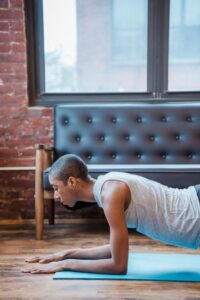
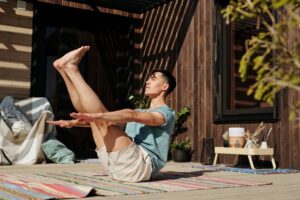
Prepare with cat-cow and the rounded tabletop drill, plank, boat pose and scale pose, which uses the same hand position with the legs in lotus but keeps the torso more upright. Afterwards, Rosen suggests sitting on the heels with the palms behind the feet, fingers pointing toward the toes, leaning back and lifting the chest for 30 seconds to a minute. Pendant pose leads toward crane and other arm balances.
A simple way to practise it. A short practice plan helps. Begin with a minute of cat-cow, then three rounds of the rounded tabletop drill, holding each for 10 to 15 seconds. Kneel with blocks beside the hips and practise the knees-only lift three times, 15 to 30 seconds each, crossing the ankles one way and then the other. Once that is easy, add the full lift for a few seconds. Finish with the backbend counterpose and a gentle wrist stretch. Practised a few times a week, this builds the strength the pose needs without straining the wrists.
You will meet pendant pose in Iyengar, hatha and vinyasa classes.