Sage Koundinya’s Pose I and II (Eka Pada Koundinyasana): steps and names

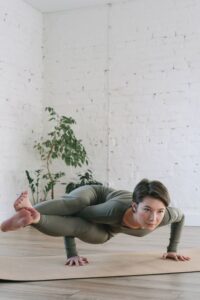
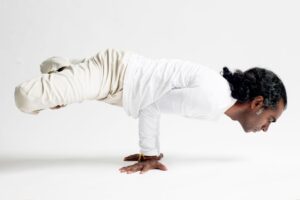
Sage Koundinya’s pose (Eka Pada Koundinyasana) I and II are bent-arm balances with split legs: version I twists from side crow, version II extends one leg forward over the arm. Advanced poses.

Not yet reviewed by a qualified teacher Names and shape checked against 6 sources

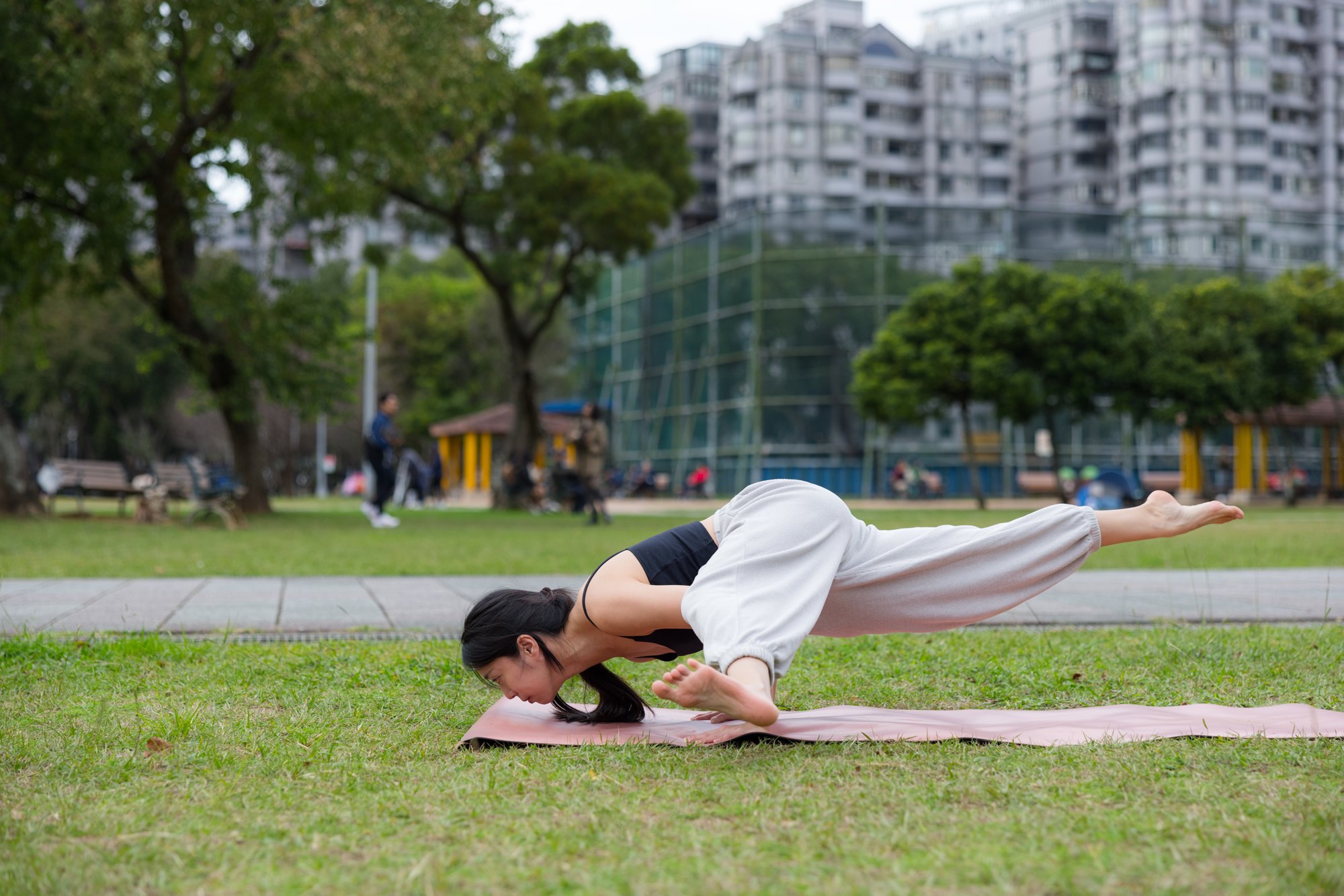
Sage Koundinya arm balance in a city park
Sanskrit name
Eka Pāda Kauṇḍinyāsana I एक पाद कौण्डिन्यासन (source) (varies by tradition, see below)
Pronunciation
AYE-kah PAH-dah Kown-din-YAH-sah-nah (source)
Also called
Pose Dedicated to the Sage Koundinya, Sage Koundinya’s Pose II, Flying Splits
Other spellings
Eka Pada Koundinyasana, Eka Pada Kaundinyasana, Koundinyasana, Kaundinyasana, Eka Pada Koundinyasana II
Pose family
Arm balance, Twist
Starting position
Hands-supported
Movement
Balance, Twist
Taught in
Vinyasa Yoga: Flow, Breath and What to Expect
Difficulty
Advanced
Prerequisite skills
A steady side crow (version I) or shoulder-pressing pose and lizard (version II); strong chaturanga; open hamstrings and hips.
Body areas
Arms and wrists, Core, Hamstrings, Hips, Shoulders
Props
Block, Bolster, Chair, Mat
Practised
Solo

Names in different traditions

TraditionName usedNote
Iyengar (Light on Yoga)Eka Pāda Kauṇḍinyāsana I and IIPlates 441 (I) and 442–443 (II); Dwi Pāda Kauṇḍinyāsana pl. 438 (Iyengar Yoga UK I8 Teaching Syllabi).
Ashtanga vinyasa (Pattabhi Jois lineage)Kauṇḍinyāsana A and BThird series. A: both legs together to one side (= Iyengar Dwi Pāda); B: one leg forward over the arm, the other back (= version II here). Entered from tripod headstand, five breaths (AshtangaYoga.info).

Step by step

Coming into the pose

  1. Version I: from a squat with the knees together, twist to the right and place both hands on the floor outside the right thigh, shoulder-width apart, as for side crow.
  2. Bring the left upper arm across the right thigh, sliding the outer armpit far down its outside edge. Bend the elbows toward 90 degrees.

In the pose

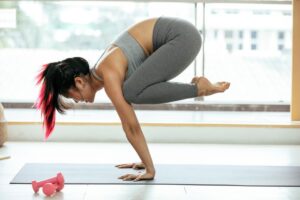
  1. Lean forward, lift both feet into side crow, then straighten the legs: the bottom (right) leg extends out to the side, the top (left) leg extends straight back.
  2. Reach through the balls of both feet, keep turning the torso and level the shoulders. Hold for 20 seconds or longer (Yoga Journal).

Coming out

  1. Bend the knees, release the feet to the floor with an exhale and repeat on the other side. Version II has its own steps in the section above.

Breathing

Exhale as you lean forward and lift; keep the breath smooth while the torso stays parallel to the floor. Come down before you hold the breath.

Alignment cues

  • Elbows bent and hugging in to make a shelf.
  • Version I: outer armpit far down the outside of the opposite thigh.
  • Version II: back of the front thigh as high as possible on the upper arm.
  • Shoulders level; torso parallel to the floor.

Common alignment errors

  • Dropping one shoulder lower than the other.
  • Straightening the elbows so there is no shelf.
  • Losing the twist in version I so the leg slides off the arm.

Modifications and easier variations

  • Version II with the front knee bent on the triceps, or the back toes left on the floor. none

Advanced variations

Props and chair adaptations

  • Support the side leg on a bolster and/or the back leg on a chair seat. bolster
  • Two blocks under the shoulders to hold some of the upper body (version II). block
  • Standing version: one foot on a chair seat, twist toward that leg with the opposite hand on the thigh. chair

Precautions

  • Wrist or lower back injury: avoid (Yoga Journal).
  • Shoulder or elbow pain: avoid.
  • Pregnancy: avoid twisting arm balances unless your provider agrees.

Learn it with a teacher: Learn these with a teacher once side crow or shoulder-pressing pose is steady; the Ashtanga entries from headstand need direct supervision.

General information, not medical advice. Poses do not cure illness. If you are pregnant, injured or have a health condition, check with your doctor and tell your teacher before you practise.

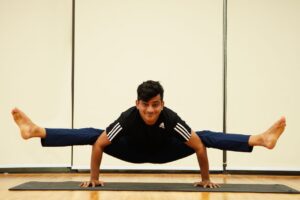
In short: Sage Koundinya’s pose is a pair of arm balances with the elbows bent, the torso parallel to the floor and the legs split. In version I the body twists: both knees start on one arm as in side crow, then the bottom leg extends out to the side and the top leg straight back. In version II, often nicknamed flying splits, the front leg rests over the same-side upper arm and extends forward while the back leg extends behind. Both are advanced poses.

The two versions share one page because they share the name, the bent-arm shelf and most of the preparation. Each has its own steps below.

The name

Eka pāda means one leg, and the pose is dedicated to the sage Kauṇḍinya, a figure who appears in both Hindu and Buddhist traditions; AshtangaYoga.info retells stories of him from India to the old kingdom of Funan in present-day Cambodia. The Iyengar Yoga (UK) syllabus lists Eka Pāda Kauṇḍinyāsana I at plate 441 and II at plates 442 to 443 of Light on Yoga, alongside Dwi Pāda Kauṇḍinyāsana (both legs to one side, plate 438). Yoga Journal uses the same I and II numbering.

Ashtanga labels differ. In the third series, Kauṇḍinyāsana A has both legs together pointing to one side, which matches the Iyengar two-legged version, and Kauṇḍinyāsana B has one leg crossing forward over the arm and the other extending back, which matches version II on this page. Both are entered from a tripod headstand and held for five breaths.

Making the pose work

Both versions rest on the same chaturanga shelf: elbows bent toward 90 degrees, hugging in, so the torso can lie on the upper arms. The weight then tips forward like a see-saw until the legs float. For version I, Yoga Journal stresses that keeping the outer armpit far down the outside of the opposite thigh is the secret of the pose, exactly as in side crow; Yoga International describes coming into side crow and then scissoring the legs open, the bottom leg out to the side and the top leg back, while the torso keeps turning so the shoulders square to the front. For version II, slide the shoulder as far under the front thigh as possible, creep the front foot forward until it lifts, then lean forward to float the back leg. AshtangaYoga.info’s cue is to keep both shoulders at about the same height.

Yoga Journal suggests holding each side for 20 seconds or longer; the Ashtanga versions are held for five breaths.

Sage Koundinya’s Pose II (Eka Pada Koundinyasana II)

Start in downward dog or plank. Step the left foot far forward outside the left hand, bend the left elbow and twist slightly to the right, dropping the left shoulder low on the inner thigh and sliding the upper arm under the back of the thigh just above the knee. Walk the left foot forward until it is light, straighten the knee as much as you can, then bend both elbows and shift forward until the back leg lifts. Lift the chest until the torso is parallel to the floor, look forward and breathe. Step back to downward dog and repeat on the other side. If the hamstrings will not allow a straight front leg, keep the front knee bent on the triceps; if the back leg will not lift, leave the back toes down.

Precautions in plain words

Yoga Journal lists any wrist or lower back injury as a contraindication for both versions. The shoulders also work hard on bent arms, so skip them with shoulder or elbow pain. Version I adds a deep twist. In pregnancy, avoid twisting arm balances unless your health care provider and a prenatal teacher agree. This page is general information, not individual advice.

Preparation and what comes next

For version I, master side crow and twists such as revolved lunge and revolved triangle. For version II, work lizard, shoulder-pressing pose and chaturanga. A bolster under the side leg or a chair under the back leg can hold you while you learn. Both versions can flow back into chaturanga. Related poses include eight-angle pose and flying pigeon.

You will meet these poses in Iyengar, Ashtanga (third series) and advanced vinyasa and power yoga classes.
Preparatory poses

Follow-up poses and transitions

Counterposes

Related poses

More arm balance poses

Frequently asked questions

What is the difference between Koundinyasana I and II?

Version I twists: from side crow, one leg extends to the side and the other back. Version II faces forward: the front leg rests over the same-side arm and extends forward while the back leg extends behind.

Is Ashtanga Kaundinyasana A the same as version I?

No. Ashtanga A has both legs together to one side (Iyengar’s Dwi Pada Koundinyasana); Ashtanga B matches version II.

What should I learn first?

Side crow for version I; shoulder-pressing pose and lizard for version II; and a strong chaturanga for both.

Sources

  1. Pose Dedicated to the Sage Koundinya I (Eka Pada Koundinyasana I), Yoga Journal (accessed October 6, 2026)
  2. Pose Dedicated to the Sage Koundinya II (Eka Pada Koundinyanasana II), Yoga Journal (accessed October 6, 2026)
  3. Arm Balance Mini-Tutorial: Eka Pada Koundinyasana I, Yoga International (accessed October 6, 2026)
  4. Kauṇḍinyāsana B: Position dedicated to Kauṇḍinya, AshtangaYoga.info (Dr. Ronald Steiner) (accessed October 6, 2026)
  5. Kauṇḍinyāsana A: Position dedicated to Kauṇḍinya, AshtangaYoga.info (Dr. Ronald Steiner) (accessed October 6, 2026)
  6. I8 Teaching Syllabi (asanas with Light on Yoga plate numbers), Iyengar Yoga (UK) (accessed October 6, 2026)

Facts checked on October 6, 2026