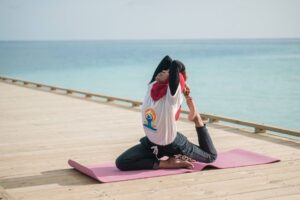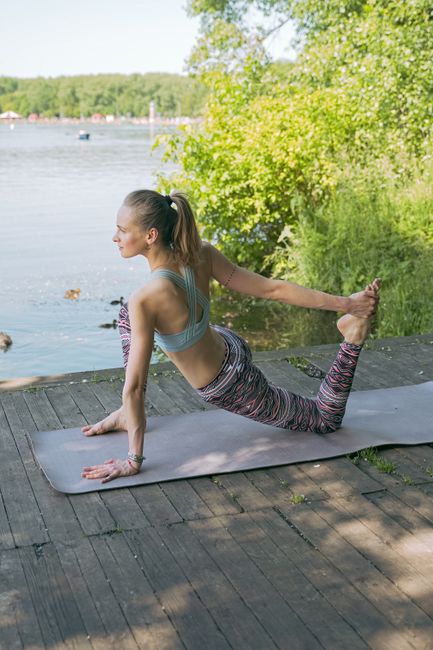
In short: swan is the yin version of the pigeon shape. One leg folds in front with the knee bent, the other stretches long behind, and instead of holding the hips level you let the front hip sink and the weight settle into it. With the chest lifted it is Swan; folded forward over the front leg it is Sleeping Swan.
Below we compare it with pigeon pose, explain the knee-safe setup, the hold, coming out and the cautions.
The name and the related asana
Swan is an English yin name with no Sanskrit of its own. It shares its shape with pigeon pose, the preparation for Eka Pāda Rājakapotāsana. Yoga Journal’s 12-pose sequence puts the difference simply: unlike in pigeon, you may let the front hip come all the way down and the weight shift to that side. The muscles stay soft and the hold is long.
Setting up with props
From hands and knees (Bernie Clark also allows downward-facing dog for experienced students), slide one knee forward toward the hand of the same side and lean a little toward it to check how the knee feels. If the knee feels stressed, bring the foot closer to the hip; keep the foot flexed before you fold. Then slide the back knee away, tucking the back toes and sliding back again, until the buttock of the front leg reaches the floor. If it does not, a folded blanket or block under that hip makes the pose restful.
The long hold
Clark suggests one to three minutes in Swan, on straight arms or on the elbows, then folding into Sleeping Swan for one to three minutes more. Yoga Journal holds Swan for three to five minutes. Look for sensation in the outer hip of the front leg and the front of the back thigh, never in the front knee.
Upright Swan and folded Sleeping Swan feel quite different. Bernie Clark describes Swan with the chest raised as a moderately active, yang-leaning posture: it is a deeper hip opener than Sleeping Swan because more of your weight sits right above the front hip, and it is also a moderate backbend that compresses the lower back. That is one reason his holds for the upright version are shorter. If the lower back complains, fold forward sooner.
Clark’s rule for finding the right spot is simple: if you are feeling it, you are doing it. If the sensation fades, wiggle around until you find it again. Small changes in the legs shift the stretch. Moving the front foot or back knee slightly can increase the sensation in the front hip while reducing the stretch along the front of the back thigh, or the other way round, so decide which one you want to work on today. As you lower toward Sleeping Swan, keep the weight back in the hips rather than sliding it forward onto the front knee.
Sleeping Swan
Sleeping Swan is the folded version: from Swan, walk the hands forward and lower onto the forearms, a bolster laid lengthwise under the chest, or the floor. Clark gives three to five minutes per side when you practise it on its own; Janice Quirt (Yoga International) holds it for three minutes, then lifts into downward dog for a minute before the second side. Quirt suggests a flexed front foot if the shin is parallel to the front of the mat and a neutral foot if the shin is on a diagonal. Tucking the back toes and lifting the back knee increases the stretch, as Clark notes, but most people are happy with the back knee down.
Coming out and the rebound
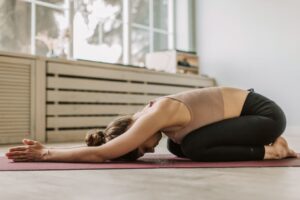
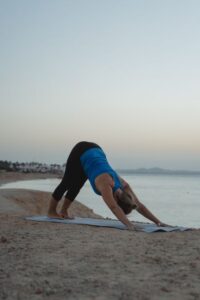
Push the floor away and come up slowly. Tuck the back toes, plant the hands as for downward-facing dog and step back, then rest in child’s pose. Clark also suggests windshield-wiper knees lying on the back as a counterpose.
Precautions in plain words
The knee is the weak point. Clark advises avoiding swan with knee problems, especially of the inner meniscus, and notes that tight hips push the pressure into the knee. In that case use eye-of-the-needle, the reclining figure four, which stretches the same outer hip on your back. In pregnancy, stay upright on the hands or a bolster. This page is general information, not individual advice.
Before, after and where it is taught
Dragon often comes before it, and shoelace and square work the same outer hip seated. You will meet it in yin yoga classes, which hold mostly floor poses for several minutes with the muscles relaxed, and in some gentle and restorative classes.