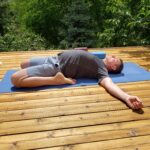
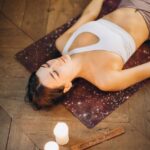
A restorative yoga sequence is a short series of poses in which props hold the body, so the muscles can let go while you rest and breathe. Nothing is stretched hard and nothing is held by effort. This page is a newly designed educational sequence by YogaVacation: supported child’s pose, supported bridge, supported fish, legs up the wall, reclining bound angle and a long corpse pose, about 45 minutes in all. Restorative yoga has no fixed traditional order; teachers choose poses for the person in front of them.
Whose approach this follows
Restorative yoga as a named practice grew out of the prop work of B.K.S. Iyengar and was popularised by his student Judith Hanson Lasater, whose book Relax and Renew describes supported poses held for several minutes each. Summaries of her teaching give holds of roughly 3 to 10 minutes per pose and at least 15 minutes for the final relaxation; we use those as our guide and say so on every step. See also restorative yoga.
Lasater met Iyengar in 1974 and studied with him for 25 years. In a Yoga Journal interview she says his use of props inspired her approach to restorative yoga, and she recalls his idea that you bring the pose to the person rather than force the person into the pose. That is the spirit of this page: change the props until the pose fits you.
Restorative yoga is not the same as yin yoga, although the two are often mixed up. Yoga Journal describes yin as holding a pose at a gentle edge for about 3 to 5 minutes, so the joints take some load. Restorative yoga does the opposite: props fill the space under the body so nothing has to work. If you want the yin approach instead, see our yin sequence.
Before you start: props
You need a mat, a bolster (or two firm pillows), two or three blankets, one or two blocks, a wall and something warm to put on, because the body cools when it is still. An eye pillow or folded cloth is welcome. Spend a minute adjusting each setup: the aim is to feel held everywhere, with no part hanging or straining. If any pose produces pain, tingling or numbness, come out and change the props.
How the sequence is built
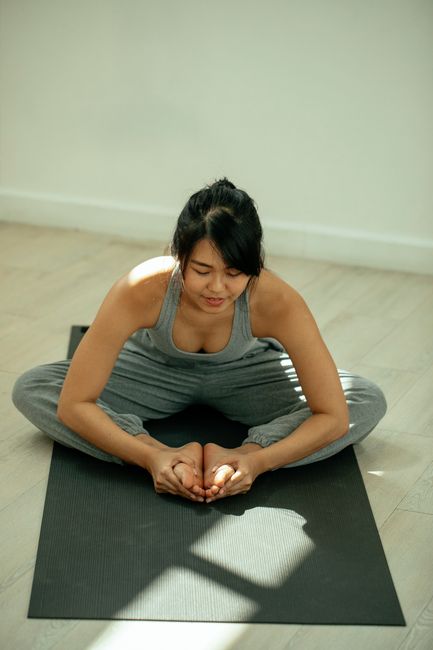
It begins face down with a gentle forward fold, moves to two mild chest openers on the back, then a supported inversion, an open-hip reclining pose and the final rest. Each pose is done once; there are no rounds. Breathe naturally through the nose and let each exhalation be a little slower. Come out of every pose slowly, rolling to the side before you sit up. Between poses, pause on your side for a few breaths.
The order, step by step
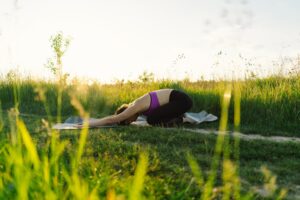
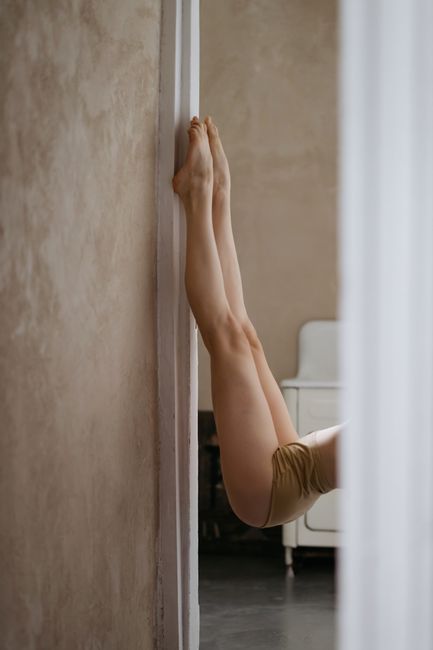
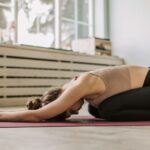
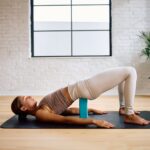
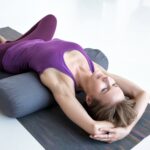
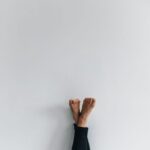
Supported child’s pose comes first because it is easy to arrange and lets you settle face down while the breath slows. Turn the head the other way halfway through. Supported bridge follows: the block lifts the pelvis a little and the front of the hips opens without effort. Supported fish then opens the chest over a bolster, with the head resting on a folded blanket. Legs up the wall is the quiet inversion of the sequence, so it sits in the middle, once you are already calm. Reclining bound angle opens the hips with the thighs held by blocks, and corpse pose closes the practice with the longest hold.
Hold lengths and how to change them
Holds on this page follow the 3 to 10 minutes given in summaries of Lasater’s teaching. Yoga Journal describes a typical one-hour restorative class as only two to four poses, each held for 10 to 20 minutes, and notes that some teachers give less time because long stillness can feel uncomfortable at first. Both are fine. If you like longer holds, choose two or three of the poses and stay. If stillness is new to you, start with three minutes per pose and add a little each week. Use a gentle timer so you do not need to check the clock.
Yoga Journal also notes that body temperature tends to drop as you relax, so blankets are used to cover the body as well as to support it. Put on socks and a sweater before you start. Many people use this sequence in the evening or on a day off after a hard week; any quiet time works.
How to practise it safely
- Pregnancy: avoid lying flat on the back for long periods after the first trimester; ask your midwife or doctor, and use side-lying rest instead of the supine poses.
- Legs up the wall and supported bridge raise the legs above the heart. With glaucoma, uncontrolled high blood pressure or a heart condition, ask a health professional first.
- Lower back discomfort in supported fish or bridge: lower the height of the props.
- Knees or groin strain in reclining bound angle: put blocks or cushions under the thighs.
- If lying still brings up distress, keep the eyes open and shorten the holds. Rest should feel safe.
Restorative yoga is a practice for rest, not a treatment. Many people find it calming; it is not a substitute for medical care. This sequence has not yet been reviewed by a qualified teacher.
Easier alternatives
Short of time: do only legs up the wall and corpse pose (20 minutes). Cannot get down to the floor: sit in a chair with the forearms resting on a table and a pillow, then lie on a bed with the calves on a pillow. At home, a sofa, ottoman or chair seat can hold the calves for a half legs up the wall pose with the knees bent, as Yoga Journal suggests. For a quieter evening routine see bedtime yoga.