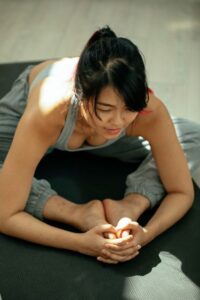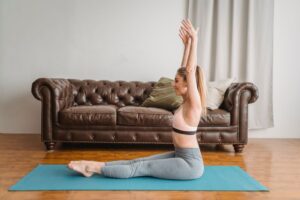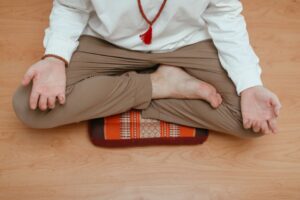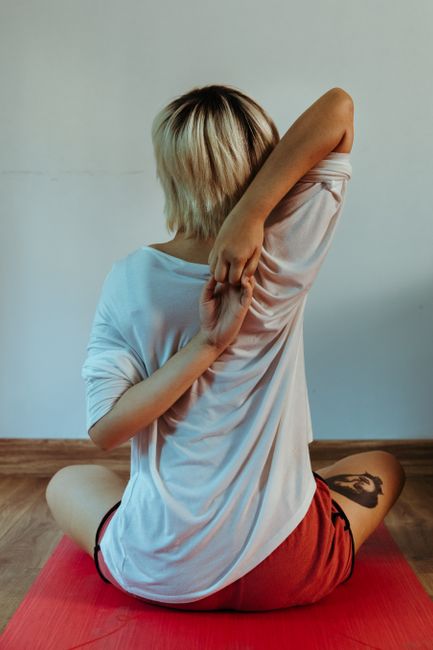
In short: cow face pose is a seated pose with the knees stacked one above the other and the feet beside the opposite hips, while one arm reaches down the back from above and the other up the back from below, the hands meeting between the shoulder blades. It stretches the outer hips and the shoulders. Sit on a block, use a strap for the hands, and never force the knees.
Cow face is two poses in one: a hip opener for the legs and a shoulder opener for the arms. Either half can be done on its own, which makes it easy to adapt. It also shows clearly how differently the two sides of the body move, as Yoga Journal points out: one cross or one arm position is often much harder than the other. Below we explain the name, how to make each half work, precautions and related poses.
The name
Go means cow and mukha face. Light on Yoga explains that gomukha describes something whose face resembles a cow, and also a musical instrument narrow at one end and broad at the other. Yoga Journal’s picture is helpful: the crossed legs look like the lips and the bent elbows, one up and one down, like the ears. The Hatha Yoga Pradipika (15th century) describes Gomukhāsana by the legs only: the right ankle placed by the left side of the seat and the left ankle by the right. B.K.S. Iyengar’s Light on Yoga (1966) and the Bihar School’s Asana Pranayama Mudra Bandha add the arm position with the hands joined behind the back.
Making the legs work
From staff pose, cross the right leg over the left, bringing the right knee on top of the left and the right heel beside the left hip; then bend the left knee and bring the left heel beside the right hip. Press both sitting bones evenly into the floor. If one hip lifts or the knees cannot stack, sit on a block or folded blankets, which gives the legs room; this is the most useful prop in the pose. If the stacked knees are too intense, extend the bottom leg straight forward instead.
Making the arms work
Take the arm that matches the lower knee out to the side, turn the palm back and bend the elbow to bring the hand up the middle of the back, palm facing out. Raise the other arm, bend the elbow and reach the hand down between the shoulder blades. Let the hands meet, or hold a strap between them. Keep the top elbow pointing up close to the head and the head upright: Yoga Journal notes that students tend to bend the neck and lean the head to the side. Light on Yoga suggests holding for 30 to 60 seconds, looking straight ahead.
Precautions in plain words
The stacked knees bend deeply with a slight twist, so with a knee injury or knee surgery keep the bottom leg straight or skip the leg position, and stop at any knee pain. With a shoulder injury, rotator cuff problems or a frozen shoulder, use a strap, keep the movement small or do only the legs, and ask your doctor or physical therapist. With a hip replacement, follow your surgeon’s guidance on crossing the legs. This page is general information, not individual advice.
Preparation and related poses
Prepare the hips with reclining figure four and bound angle, and the shoulders with simple arm circles and a strap stretch. In yin yoga, a similar leg position held for minutes with the spine rounding forward is called shoelace; it has its own page because the instructions and intention differ. Cow face arms are a useful preparation for eagle pose and dancer pose, and the legs prepare for seats such as auspicious pose.
Where it is taught
Cow face is common in hatha, Iyengar and vinyasa classes, often in the seated part of a session; the arm position on its own is widely used in chair yoga. Find related hip and shoulder openers in the pose library.