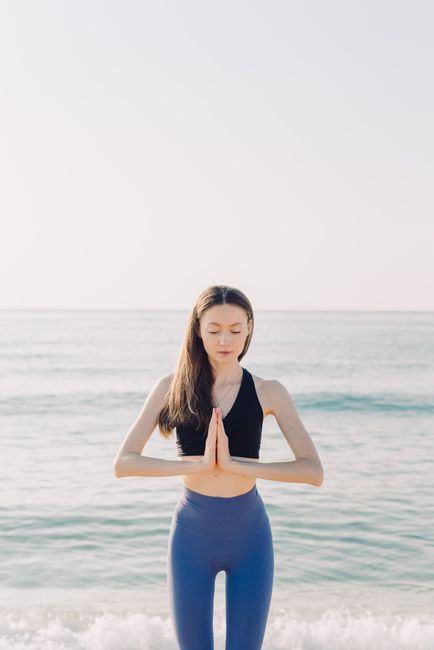
In short: prayer pose is standing upright with the feet together and the palms joined in front of the chest. It opens and closes the 12-position sun salutation, and many teachers use it to begin or end a class. Physically it is simple; its job is to settle the body and the breath before you move.
The pose is a standing posture with a hand gesture. The posture part is close to mountain pose; the hands come together at the heart. Below we explain the name, how it differs from the hand gesture itself, and where it is used.
The name: Pranamasana and Anjali Mudra
The Sanskrit name is Praṇāmāsana, from praṇāma (a bow or respectful salutation) and āsana (posture). The Bihar School of Yoga’s Asana Pranayama Mudra Bandha calls position 1 of its sun salutation “Pranamasana (the prayer pose)”, and the Art of Living uses the same name for step 1 and step 12. The Sivananda centres describe the same position in English: stand erect with the feet together and the hands in prayer position in front of the chest. The Bihar book uses the name a second time for a kneeling forward bend in its standing and bending section (“the bowing pose”), which is a different posture.
The joined-palms gesture on its own is a mudrā, a hand gesture, usually called Añjali Mudrā. Gestures are not postures, so we explain them separately in our guide to mudras; this page covers the standing pose. The gesture is also the one people use when saying namaste.
Making prayer pose work
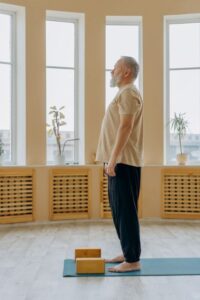
Stand with the feet together and spread the weight evenly, as in mountain pose. Bring the palms together in front of the chest, thumbs lightly touching the breastbone, elbows relaxed. Press the palms together only gently: the shoulders should stay soft and away from the ears. The Bihar text simply asks you to relax the whole body and breathe normally; the Art of Living version sweeps the arms out and up on an inhalation and brings the palms together on the exhalation.
Use the moment. Before a round of sun salutations, a few calm breaths here help the movement and breath line up. At the end of a round, coming back to prayer pose is a chance to notice the heart rate and breathing settle before the next one.
For the feet, the classic description of mountain pose in Light on Yoga is a good guide: heels and big toes touching, knees and thighs firm, spine stretched up, and the weight spread evenly between the heels and the toes rather than thrown onto either. Let the arms soften so the elbows drop a little below the hands, and keep the palms level with the middle of the chest rather than up at the chin.
The Bihar book adds a quiet inner focus. For both the first and the last position it suggests resting the attention at the center of the chest (it names anāhata chakra, the heart center), and it gives each position its own mantra: Om Mitrāya Namaḥ (“salutations to the friend of all”) at the start and Om Bhāskarāya Namaḥ (“salutations to he who leads to enlightenment”) at the end. In its words, the opening position establishes “a state of concentration and calmness” before the movement begins. You do not need the mantras to practice, but they show how the pose is meant: a pause to arrive, not just a place to stand.
The breath changes slightly between the two ends of the round. The Bihar text keeps the breath normal in position 1 and asks you to exhale as you return to the final position. The Sivananda centers exhale in step 1 too. They suggest starting with four rounds and building up to twelve, where one round is done twice, leading first with the right leg and then the left, so you pass through prayer pose many times in a session.
Precautions in plain words
There are few risks. If standing with the feet together is unsteady, stand with them hip-width apart. If you feel light-headed after a round of sun salutations, stay longer in prayer pose or sit down until it passes. With wrist or shoulder pain, rest the hands lightly together without pressing, or let the arms hang by the sides. After a set of sun salutations, the Bihar book advises lying in corpse pose for a few minutes so the heartbeat and breathing can return to normal. It also says women should not do the sun salutation after the fourth month of pregnancy; prayer pose on its own is gentle, but check with your doctor or midwife about the full sequence.
Preparation and what comes next
No preparation is needed. In the 12-position sun salutation prayer pose is followed by raised arms with backbend, and the round ends by returning here. It is also a natural place to begin tree pose, where the hands often come to the chest in the same gesture. The Bihar School even has a one-legged version of the prayer pose, Eka Pāda Praṇāmāsana: stand on one leg, place the sole of the other foot high on the inner thigh and join the palms in front of the chest, with the gaze on a fixed point.
Where it is taught
It is part of the 12-position sun salutation in Sivananda and Bihar/Satyananda hatha classes and in the Art of Living, and many vinyasa teachers open or close class with the hands at the heart. A seated version works well in chair yoga.