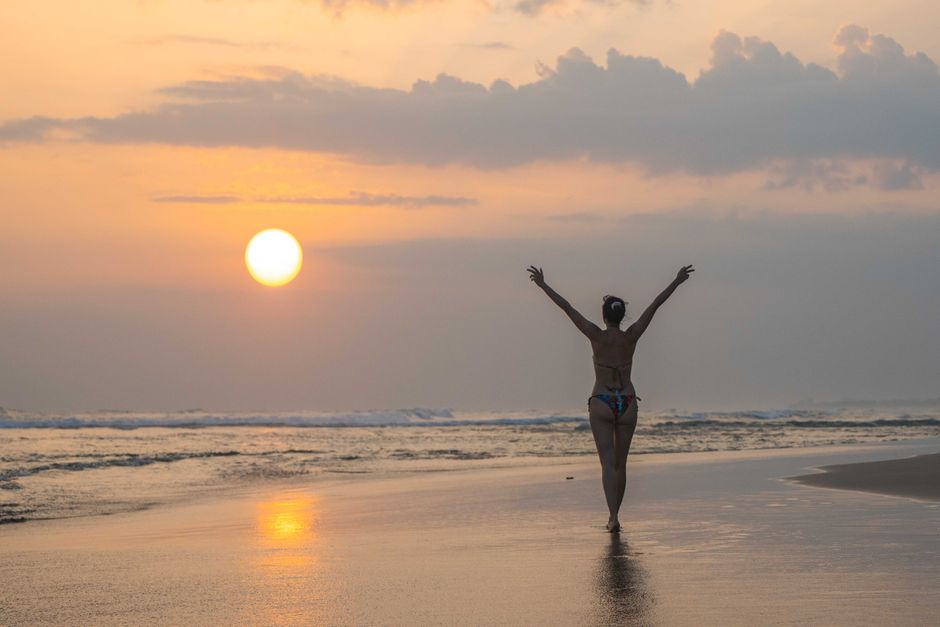
In short: raised arms with backbend is the second (and eleventh) position of the 12-position sun salutation: from standing with the palms together, you inhale, raise the arms overhead and bend gently backward from the upper back. It is a small, breath-led backbend, not a deep one. Keep the legs firm, lengthen up before you lean back and let the neck stay soft.
This pose belongs to the sun salutation taught by the Bihar School of Yoga, the Sivananda Yoga Vedanta Centres and the Art of Living, where it follows prayer pose and leads into the forward bend. It looks like upward salute with an added arch, and the difference matters: here the backward bend is the point of the movement, so it gets its own page.
The name, and a second pose with the same name
The Sanskrit name is Hasta Uttānāsana: hasta is the hand and uttāna means stretched out or extended, so “raised arms pose” or “hand stretching pose”. The Bihar School’s Asana Pranayama Mudra Bandha names position 2 of its sun salutation “Hasta uttanasana (the raised arms pose)”; the Art of Living writes it as one word, Hastauttanasana. The Sivananda centres describe the same movement in English: arms up and an arch back from the waist.
Be aware that the same Bihar book also uses “Hasta uttanasana” for a different standing exercise among its standing and bending asanas: the wrists cross in front of the body, the arms rise overhead and then open out sideways to shoulder level, repeated ten times. On this page we mean the sun-salutation backbend.
Making the backbend work
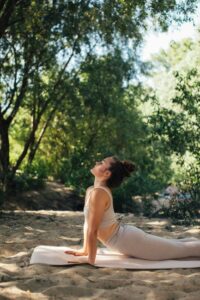
Think “up, then back”. Inhale and reach the arms up, shoulder-width apart as the Bihar text describes, and lengthen the whole front of the body before any bend happens. Then let the upper back and chest curve gently backward while the legs stay straight and active. The Sivananda instructions push the hips slightly forward to counterbalance; the Art of Living adds a useful caution, to stretch upward more than backward.
The bend should be spread through the upper and middle back, not dumped into the lower back or the neck. Let the head follow the line of the spine rather than dropping backward, and keep the arms beside the ears only if the shoulders are comfortable. In a sun salutation the pose lasts one inhalation: you arrive as the breath comes in and fold forward as it goes out.
How it fits into the round
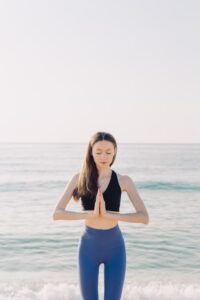
Raised arms with backbend makes most sense as part of the whole sun salutation. The Sivananda centres describe the 12 positions as one continuous exercise in which each position counteracts the one before, and the chest alternately expands and contracts to regulate the breathing. That is exactly the job of this pose. In position 1 you stand with the palms together and breathe out; in position 2 you breathe in, the arms rise and the chest opens; in position 3 you breathe out and fold forward. The small backbend balances the forward fold that follows it.
On the way back up, in position 11, the Sivananda instructions bring the arms forward first, then up and back over the head, before bending back slowly from the waist. Sweeping the arms forward on the way up gives the back time to straighten before it arches, which many people find kinder than snapping upright.
Because the pose comes twice in every half round, small habits add up. Common mistakes are bending the knees, throwing the head back, holding the breath and leaning back faster than the breath allows. Let the inhalation set the pace. The Sivananda centres suggest starting with four rounds and building up gradually to twelve, so there is plenty of time to learn the movement before you repeat it many times.
Precautions in plain words
Keep the arch small, or skip it and use upward salute, if you have lower back pain, a disc problem, a neck injury or feel dizzy when you look up. People with balance problems can do it with the feet hip-width apart, or with a wall behind them at arm’s length. In pregnancy, reach up rather than back. Backbends are best learned slowly; if anything feels sharp or pinched, come back upright.
Preparation and what comes next
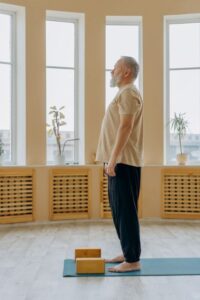
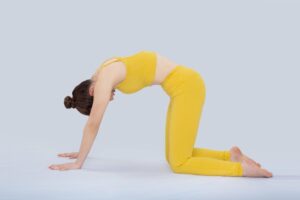
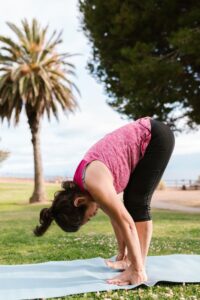
Start from prayer pose or mountain pose. In the 12-position sun salutation it is followed by a forward bend with the hands beside the feet (the Bihar School calls it Padahastasana, see standing forward fold), and it returns as position 11 on the way back up. A few rounds of cat-cow are a good warm-up for the spine.
Where it is taught
You will find it in Sivananda classes, Bihar/Satyananda-style hatha and many Indian schools that teach the 12-position sun salutation. Ashtanga and most vinyasa sun salutations use the upright upward salute instead.