Standing Figure Four (One-Legged Chair): steps, hip cues and options

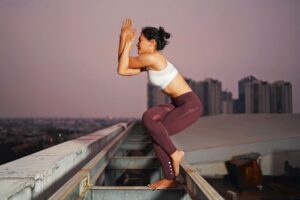
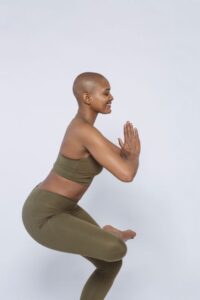
Standing figure four, also called one-legged chair, is a one-leg squat with the other ankle crossed over the thigh. Steps, hip and knee cues, chair and wall options, and the modern name explained.

Not yet reviewed by a qualified teacher Names and shape checked against 3 sources

Sanskrit name
No established Sanskrit name: a modern descriptive name
Also called
One-Legged Chair, Figure Four Chair, Figure-4 Chair, Eka Pada Utkatasana (modern usage)
Record
Modern descriptive name (no established Sanskrit)
Pose family
Balancing, Hip opener and leg extension, Standing
Starting position
Standing
Movement
Balance, Hip external rotation
Taught in
Vinyasa Yoga: Flow, Breath and What to Expect, Chair Yoga: Seated and Chair-Supported Practice
Difficulty
Intermediate
Prerequisite skills
Comfortable chair pose and tree pose; reclining figure four without knee discomfort.
Body areas
Core, Feet and ankles, Hips, Legs
Props
Chair, None, Wall
Practised
Solo

Names in different traditions

TraditionName usedNote
Modern vinyasa (Yoga Journal)Utkatasana variation / Figure-4 ChairDescribed as a chair pose variation in a Yoga Journal pigeon preparation sequence.
Modern vinyasa (Yoga International)One-legged chair pose (standing figure four)Flexed ankle crossed over the standing thigh, hips sitting back, hip points facing forward; arms up or hands at the heart; set-up for flying pigeon (eka pada galavasana).

Step by step

Coming into the pose

  1. Stand with the feet hip-width apart. Bend the knees slightly as if beginning chair pose.
  2. Shift your weight onto the left foot. Lift the right foot and cross the outer right ankle over the left thigh, just above the knee.
  3. Flex the right foot, drawing the toes back toward the shin.

In the pose

  1. Sit the hips back and down as if into a chair, only as far as both knees are comfortable. Keep the pelvis level and the left knee over the middle of the foot.
  2. Bring the palms together at the chest, or rest the hands on the crossed shin. To deepen, hinge forward with a long spine.
  3. Stay for about 5 to 10 breaths.

Coming out

  1. Rise slowly, uncross the right ankle and stand on both feet. Repeat on the other side.

Breathing

Breathe slowly through the nose. Lower the hips a little on an exhale; if the breath shortens, rise slightly.

Alignment cues

  • Ankle on the thigh above the knee, never on the kneecap.
  • Crossed foot flexed.
  • Pelvis level from side to side; the crossed knee may sit higher than the ankle.
  • Standing knee over the middle of the foot.
  • Spine long when hinging forward.

Common alignment errors

  • Resting the ankle on the standing kneecap.
  • Pressing the crossed knee down with the hand.
  • Dropping too low at once and loading the standing knee.
  • Letting the standing knee cave inward.

Modifications and easier variations

  • Reclining figure four: the same stretch lying on the back with no weight on the knee. none

Advanced variations

Props and chair adaptations

  • Seated figure four: sit on a chair and rest one ankle on the opposite knee. chair
  • Hold the back of a chair with one or both hands while standing. chair
  • Lean the back lightly against a wall and slide down a little. wall

Precautions

  • Stop if either knee hurts.
  • Knee arthritis, knee or hip injury, or hip replacement: ask your doctor or physical therapist; use reclining or seated figure four instead.
  • Balance problems or pregnancy: hold a chair or wall.

Learn it with a teacher: Usually learned from clear instructions. Ask a teacher if the crossed knee aches, or before using the pose as a step toward arm balances.

General information, not medical advice. Poses do not cure illness. If you are pregnant, injured or have a health condition, check with your doctor and tell your teacher before you practise.

In short: standing figure four is a one-leg squat with the other ankle crossed over the standing thigh, so the legs make the shape of a number four. It combines a balance, a strong standing leg and an outer-hip stretch like pigeon pose. Keep the crossed foot flexed, lower the hips only as far as the knee stays comfortable, and use a wall or chair while learning.

Many teachers use this pose as a standing version of pigeon: you control how much stretch reaches the outer hip simply by how low you sit. It is also a clear test of the pelvis, because the turned-out leg pulls the hips off level as soon as the hip runs out of range. Below we explain the name, how to make it work and the precautions.

A modern name, and “one-legged chair”

Standing figure four is a modern descriptive name; we found no established Sanskrit name for it. Yoga Journal describes it as a variation of chair pose (Utkatasana) and notes it is sometimes called Figure-4 Chair; another Yoga Journal sequence uses the same shape as a hip-opening preparation, with the palms together at the chest. Yoga International uses the same two names for the same shape: it calls it one-legged chair pose, “also known as standing figure four”, as the set-up for flying pigeon. In many modern classes “one-legged chair” means this pose, and you may see the label Eka Pāda Utkaṭāsana; that is a descriptive modern label, not a classical name.

Be aware that some teachers use “one-legged chair” for a different shape: chair pose with one leg lifted straight forward. If a class cue is unclear, look at what the teacher demonstrates. This page covers the ankle-over-knee version.

How to make it work

Start in a small chair pose with the feet hip-width apart, shift onto one foot and cross the other ankle just above the standing knee, on the thigh, not on the kneecap. Flex the crossed foot, drawing the toes back toward the shin, which keeps the ankle and knee of that leg stable. Then sit the hips back as if lowering into a chair. Yoga Journal’s cue is to keep the pelvis as neutral as you can, level from side to side; if the hip is tight, the crossed knee will sit higher than the ankle, and that is fine. The standing knee tracks over the middle of the foot. Hands can rest in prayer at the chest, on the crossed shin, or reach forward for balance; Yoga International also offers the arms reaching up beside the ears, as in chair pose. Another way in, taught by Yoga International, is to stand tall, lift the knee, turn the thigh out while the hip points keep facing forward, then cross the flexed foot and sit back.

To deepen the stretch, hinge forward with a long spine and rest the forearms on the crossed shin, as some classes teach. Lower the hips gradually over several breaths rather than dropping into the deepest version at once.

Precautions in plain words

The standing knee bears your full weight in a bent position, and the crossed knee is twisted outward. Stop if either knee hurts. With knee arthritis, a knee or hip injury, or after hip replacement surgery, ask your doctor or physical therapist before crossing the leg under load; the reclining or seated figure four gives a similar stretch without weight. With balance problems, hold a chair or wall. In pregnancy, a chair-supported version is safer than free balancing. This page is general information, not individual advice.

Preparation and next poses

Warm up with chair pose, tree pose and reclining figure four. From standing figure four, some flows move into arm balances such as flying pigeon, which builds on the same leg position; that is an advanced step. Afterward, stand in mountain pose and shake out the legs, or rest in a standing forward bend.

Where it is taught

Standing figure four is a pose of modern vinyasa and power classes, and a chair-supported version suits chair yoga. Find more hip openers and balances in the pose library.
Preparatory poses

Follow-up poses and transitions

Counterposes

Related poses

More balancing poses

Frequently asked questions

Is standing figure four the same as one-legged chair?

In most modern classes, yes: one-legged chair means sitting into a chair shape on one leg with the other ankle crossed over the thigh. Some teachers use the name for chair pose with one leg lifted straight forward instead.

Does standing figure four have a Sanskrit name?

Not an established one. You may hear Eka Pada Utkatasana, a descriptive modern label meaning one-legged chair.

How is it different from pigeon pose?

Both stretch the outer hip of the crossed leg. Standing figure four adds a balance and lets you control the stretch by how low you sit; pigeon is done on the floor with the back leg extended.

Sources

  1. Go-To Yoga Sequence for Coming Into Pigeon Pose (Utkatasana variation, Figure-4 Chair), Sarah Ezrin, Yoga Journal (accessed October 6, 2026)
  2. Flying Pigeon With Props: 4 Ways to Customize the Pose (one-legged chair, also known as standing figure four), Kat Heagberg, Yoga International (accessed October 6, 2026)
  3. 5 Poses to Build Balance + Stability in Toestand (ankle over thigh, hips lowered), Rina Jakubowicz, Yoga Journal (accessed October 6, 2026)

Facts checked on October 6, 2026