In short: diaphragmatic breathing, also called belly or abdominal breathing, means letting the diaphragm do most of the work so the belly rises as you breathe in and falls as you breathe out, while the chest stays fairly still. Learn it lying down with one hand on your chest and one on your belly, then practice it seated. It is gentle, needs no breath holding and is the foundation for almost every other breathing practice.

Diaphragmatic breathing sounds technical, but it is simply breathing low and slow. Many of us breathe high in the chest when we are busy or tense, with the shoulders and neck pitching in. Belly breathing invites the main breathing muscle, the diaphragm, back to center stage. This guide explains what the diaphragm does, how to practice lying down and seated, the most common mistakes, what research does and does not show, and how belly breathing leads on to the classical breathing practices of yoga.
What the diaphragm does
The diaphragm is a thin, dome-shaped muscle that sits under your lungs and heart and separates your chest from your abdomen. It is attached to the breastbone, the bottom of the rib cage and the spine. Cleveland Clinic calls it the most efficient muscle for breathing.
Here is what happens with each breath:
- Breathing in: the diaphragm contracts and flattens, moving down toward the abdomen. That creates space in the chest, the lungs expand and air flows in. Because the diaphragm presses down on the organs below it, the belly moves outward.
- Breathing out: the diaphragm relaxes and curves back up, and air leaves the lungs. The abdominal muscles can help move the diaphragm and empty the lungs more fully.
So when people say “breathe into your belly,” air does not literally go into your stomach. The belly moves because the diaphragm is moving. Watching the belly rise and fall is just an easy way to tell that the diaphragm is doing its job.
How to practice lying down
Lying down is the easiest way to learn, because the floor supports your back and you can feel the movement clearly. This sequence follows the instructions Cleveland Clinic gives for learning the technique.
- Set up. Lie on your back on a mat, rug or bed with your knees bent and your head supported. A pillow or rolled blanket under the knees helps the lower back relax.
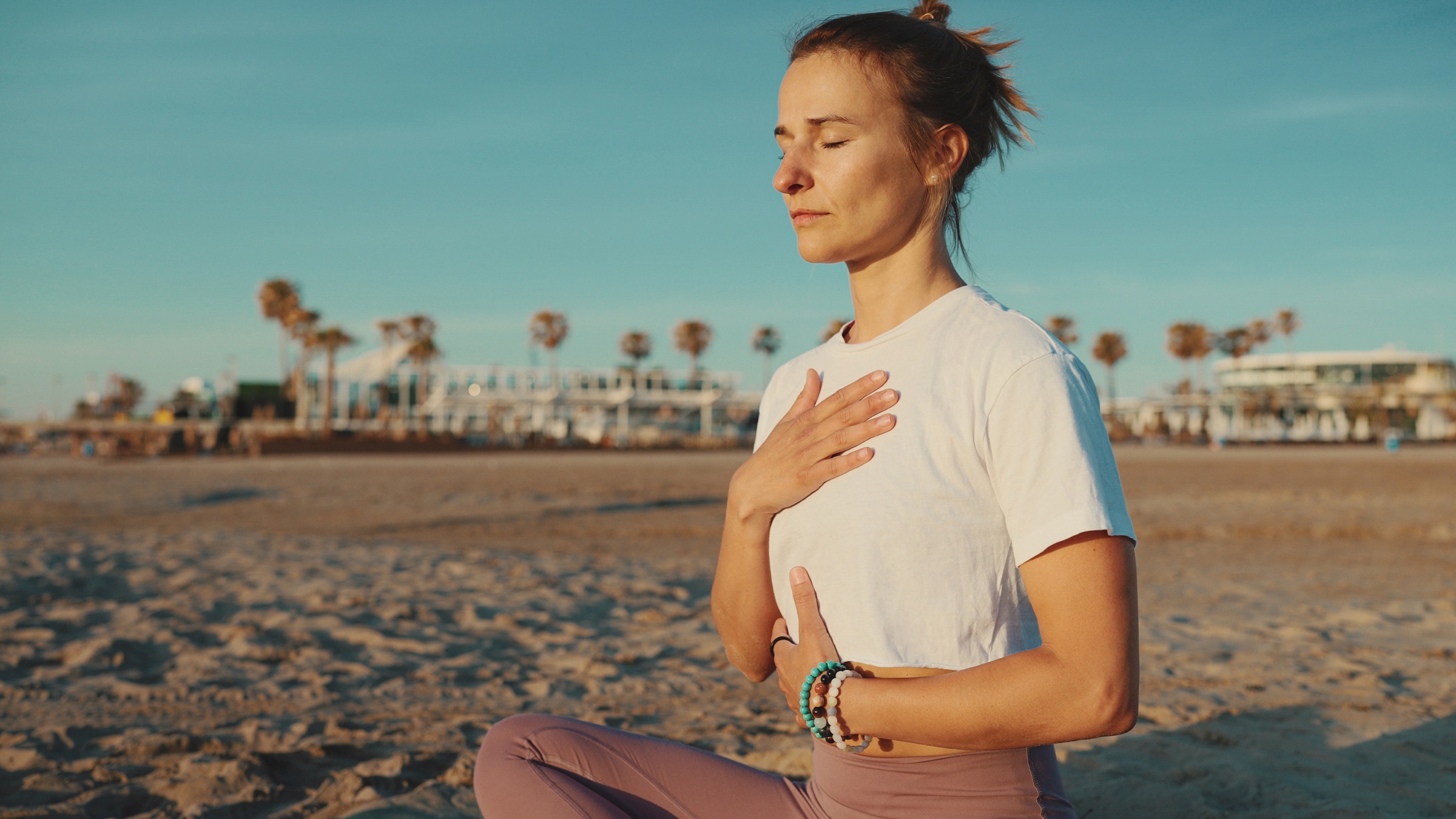
- Place your hands. Rest one hand on your upper chest and the other just below your rib cage, on the upper belly.
- Breathe in through your nose. Breathe in slowly so that your belly moves out and the lower hand rises. The hand on your chest should stay as still as possible.
- Breathe out. Gently draw the belly in as you breathe out, so the lower hand sinks. Cleveland Clinic suggests breathing out through pursed lips, as if blowing softly through a straw. The upper hand still stays quiet.
- Keep it easy. Continue for a few minutes. There are no holds and no counts to hit. If you want a count, try breathing in for about four and out for about six, as long as it feels comfortable.
If you practice yoga, this is the same position as the start of many relaxation sessions. You can also do it in Corpse Pose (Savasana) with the legs straight and a bolster under the knees.

How to practice seated
Once the lying version feels natural, try it sitting up. This is where the skill becomes useful, because you can practice at a desk, on a train or before a yoga class.
- Sit comfortably in a chair with your knees bent and your feet on the floor. Let your shoulders, head and neck relax.
- Place one hand on your upper chest and the other just below your rib cage.
- Breathe in slowly through your nose so your belly moves out against your hand, with the chest hand still.
- Draw the belly gently in as you breathe out through pursed lips, chest hand still.
Seated, it is common to feel the breath spread into the sides and back of the lower ribs as well as the front of the belly. That is fine; the goal is a low, relaxed breath, not a belly that balloons forward.
How often to practice diaphragmatic breathing
Cleveland Clinic suggests starting with five to 10 minutes about three or four times a day, then gradually increasing the time. It also says the exercise may feel like hard work at first, and that with practice it becomes more automatic. If that schedule sounds like a lot, start with one or two short sessions: one in bed at night and one sitting at your desk is a realistic beginning. Our guide to building a consistent practice has ideas for making it stick.
Common mistakes
- Pushing the belly out. Belly breathing is not about forcing the stomach forward with the abdominal muscles. Let the breath move the belly, not the other way round.
- Breathing too big. Slow does not mean huge. Very large breaths can make you lightheaded. A normal-sized breath taken slowly is the aim.
- Shoulders creeping up. If the upper hand rises, slow down and let the breath start lower. Practicing lying down for a few more days often fixes this.
- Holding the belly in all day. Habitually sucking the stomach in makes low breathing hard. When you practice, let the belly soften.
- Trying too hard. Concentrating fiercely on the breath can make it tight. If you notice strain, take a few ordinary breaths, then start again more lightly.
- Expecting it to fix things. Belly breathing is a skill for relaxing and breathing efficiently. It is not a treatment, and it does not replace care for anxiety, asthma or any other condition.

What the research says, with its limits
Diaphragmatic breathing is well established as a teaching tool, and the evidence that it reduces stress is encouraging but still thin.
- Relaxation. The US National Center for Complementary and Integrative Health (NCCIH) lists slow, deep breathing, also called diaphragmatic breathing, among the relaxation techniques that help bring about the body’s relaxation response, which includes slower breathing, lower blood pressure and a reduced heart rate.
- Stress. A 2019 systematic review set out to measure whether diaphragmatic breathing on its own reduces stress in adults. Only three studies qualified (one randomized trial and two quasi-experimental studies). All three found less stress on measures such as cortisol, blood pressure or a stress questionnaire, but the studies were small and too different to combine, so the reviewers called for more research.
- Attention and mood. In a 2017 trial, 40 healthy adults were randomly assigned to 20 sessions of diaphragmatic breathing training over eight weeks, using a feedback device and a very slow rate of about four breaths a minute, or to no training. The trained group showed lower negative mood, better sustained attention and lower cortisol afterward. It was a small study with an unusually intensive method, so it shows what is possible rather than what an occasional practice will do.
- Breathing conditions. Cleveland Clinic notes that diaphragmatic breathing is used alongside treatment for conditions such as COPD and asthma, and that it should not be the only treatment. If you have a lung condition, ask your doctor or respiratory therapist how it fits your care.
Who should take care
Diaphragmatic breathing is one of the gentlest practices there is and suits almost everyone, including beginners and older adults. A few sensible precautions:
- If you have COPD, asthma or another lung or heart condition, or an anxiety disorder, talk to your doctor about whether and how to practice. Cleveland Clinic gives the same advice.
- If lying flat is uncomfortable, for example later in pregnancy, practice seated or propped up instead. Our guide to prenatal yoga covers comfortable positions.
- If you feel dizzy or tingly, you are probably breathing too much. Return to normal breathing, then try again with smaller, slower breaths.
From belly breathing to pranayama
On this site, we treat diaphragmatic breathing as the first step on the breathing path. Once you can breathe low and slow without effort, the classical practices become much easier to learn:
- Ujjayi breathing, the soft “ocean breath,” builds on a relaxed belly breath.
- Alternate nostril breathing (Nadi Shodhana) adds the hand position and a steady rhythm.
- Box breathing adds counts and short pauses; it is a modern technique rather than a classical one.
- Pranayama foundations explains how yoga traditions understand breath control and what the classical texts describe.
Forceful techniques such as Kapalabhati sit at the other end of the scale and are best learned from a qualified teacher. In the Yoga Sutras, breath control (prāṇāyāma) is one of the eight limbs of yoga, a stepping stone between posture and the inward-turning practices that lead to meditation.
Belly breathing is also the natural way into meditation and into deep rest practices such as Yoga Nidra. And if you would like a teacher to watch you breathe and help you refine it, a yoga retreat with daily breathing sessions is a lovely place to learn.
This guide is general information, not medical advice. If you have a heart or lung condition, an anxiety disorder or are pregnant, check with your doctor before starting a breathing practice.
Frequently asked questions
Is diaphragmatic breathing the same as belly breathing?
Yes. Diaphragmatic breathing is also called belly breathing or abdominal breathing. The belly moves out on the inhale because the diaphragm contracts and moves down, not because air goes into the stomach.
How do I know if I am breathing with my diaphragm?
Lie on your back with one hand on your upper chest and one just below your ribs. If the lower hand rises as you breathe in and the upper hand stays fairly still, your diaphragm is doing most of the work.
How long should I practice diaphragmatic breathing?
Cleveland Clinic suggests five to 10 minutes about three or four times a day at first, increasing gradually. If that is too much, one or two short daily sessions are a realistic start.
Can diaphragmatic breathing help with anxiety?
It can help you relax, and a few small studies found less stress after practice. It is not a treatment for an anxiety disorder. If anxiety affects your daily life, talk to a doctor or mental health professional, and use breathing alongside their advice.
Is diaphragmatic breathing a yoga practice?
It is a general breathing skill, taught in health care as well as in yoga. In yoga it makes a good foundation for classical pranayama practices such as Ujjayi and alternate nostril breathing.
Sources
- Diaphragmatic Breathing, Cleveland Clinic (accessed October 6, 2026)
- Diaphragm, Cleveland Clinic (accessed October 6, 2026)
- Relaxation Techniques: What You Need To Know, National Center for Complementary and Integrative Health (NIH) (accessed October 6, 2026)
- Effectiveness of diaphragmatic breathing for reducing physiological and psychological stress in adults: a quantitative systematic review (Hopper et al., 2019), JBI Database of Systematic Reviews and Implementation Reports / PubMed (accessed October 6, 2026)
- The effect of diaphragmatic breathing on attention, negative affect and stress in healthy adults (Ma et al., 2017), Frontiers in Psychology / PubMed (accessed October 6, 2026)
- Yoga (Yoga Sutras of Patanjali), by Edwin Bryant, Internet Encyclopedia of Philosophy (accessed October 6, 2026)
Facts checked on October 6, 2026