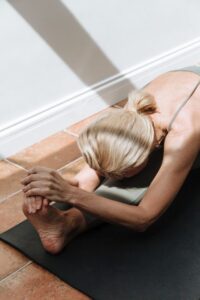
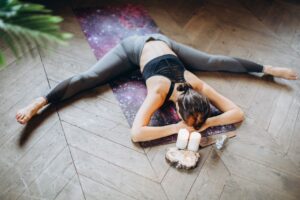
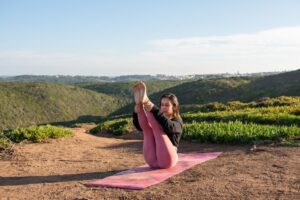
In short: tortoise pose is a deep seated forward bend with the legs wide. You slide the shoulders under the knees, stretch the arms out to the sides under the legs and lower the chest and chin toward the floor while the legs straighten forward. It needs open hamstrings and hips and a warm body, so treat it as an advanced pose and approach it patiently.
Tortoise pose belongs to the Ashtanga primary series and is described in the Iyengar tradition. Its name is also used for a very different seated posture in the Hatha Yoga Pradipika, which we explain below so you know which one a book or teacher means.
The name, and two different Kurmasanas
Kūrmāsana comes from kūrma, tortoise or turtle, and āsana, posture. The image is the tortoise drawing its limbs into its shell, and many teachers link the pose with pratyāhāra, the withdrawal of the senses in Patanjali’s eight limbs of yoga; a 1977 Yoga Journal article makes exactly that connection. In Hindu mythology Kūrma is also the tortoise form of Vishnu.
The Hatha Yoga Pradipika, the 15th-century hatha manual, also has a posture called Kurmasana, but it is a seated position in which the ankles are pressed against the perineum in a particular crossed way, not a forward bend. In Pancham Sinh’s 1914 translation, the right ankle is placed on the left side of the anus and the left ankle on the right side. The same text’s Uttana Kurmasana is a lotus-based shape lying on the back. The wide-legged forward bend on this page is the modern Kurmasana of the 20th-century Mysore lineages (Pattabhi Jois and B.K.S. Iyengar). Both are legitimately called Kurmasana; they are simply different postures.
Making the pose work
Bend the knees first. Yoga Journal’s step-by-step version starts with the legs wide, knees bent and feet flexed, reaching the chest and arms forward between the legs, then working the shoulders under the knees one at a time. The thighs must rest behind the shoulders, not on the upper arms: AshtangaYoga.info warns that otherwise the legs lever the shoulder joints, and if you lack the flexibility it is better to keep the arms above the legs. Only then stretch the arms out to the sides, palms down, and slowly press the heels forward to straighten the legs. Do not force the legs straight; exhale and release as far as is comfortable. Ashtanga stays for five breaths; Yoga Journal suggests a few breaths and repeating.
Precautions in plain words
This is a deep flexion of the whole spine with weight from the legs on the shoulders. Avoid it with a disc problem, sciatica, a recent back, shoulder or hamstring injury, and during pregnancy. If you feel pain behind the knees, Yoga Journal advises moving the arms slightly forward. Never bounce or push the legs down with force. Learn it with a teacher if you are new to it. This page is general information, not individual advice.
Preparation and what comes next
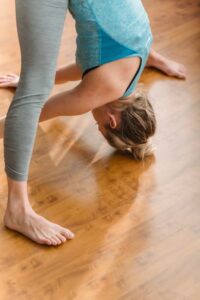
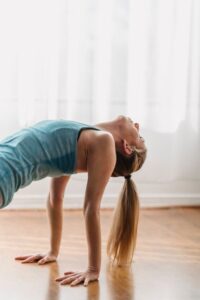
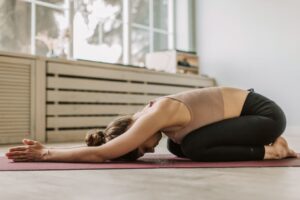
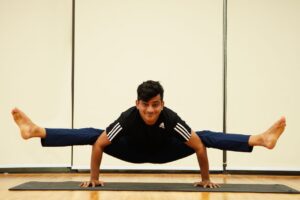
Prepare with plenty of forward bends: seated forward bend, seated wide-angle forward bend, wide-legged standing forward bend and garland pose. In the Ashtanga primary series it follows shoulder-pressing pose and leads into reclining tortoise, where the hands bind behind the back and the feet cross behind the head. Afterwards, open the front body with upward plank or rest in child’s pose.
A simple way to practise it. Treat tortoise pose as a long-term project. Yoga Journal’s step-by-step version ends with the reminder that it is fine never to reach the full expression; what matters is working within the day’s limits. A practical plan is to keep the knees well bent, slide the shoulders under the knees only as far as the thighs can rest behind them, stretch the arms out and breathe, then come out and fold again a little later in the practice when the body is warmer.
You will meet tortoise pose in Ashtanga and Iyengar classes and in advanced vinyasa classes.