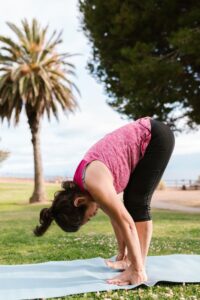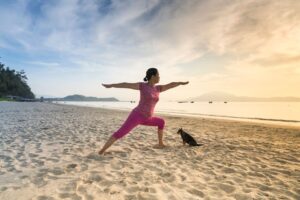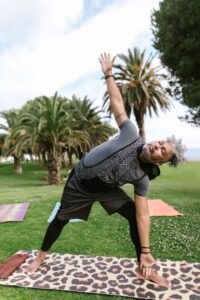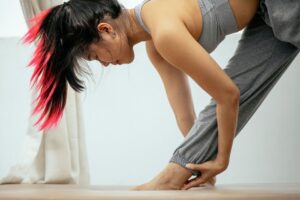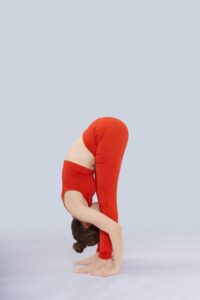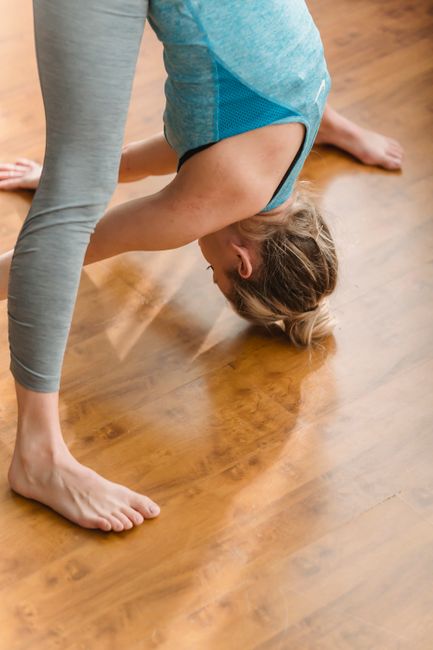
In short: wide-legged forward fold is a standing forward bend with the feet set wide apart and parallel: you hinge from the hips, place the hands on the floor (or blocks) and let the head move toward the floor between the hands. It stretches the hamstrings and inner thighs. The head goes below the heart, so come up slowly; bend the knees and use blocks so the fold comes from the hips.
The wide base makes this fold more stable than a feet-together forward bend, and that is why many people find it more accessible. The Ashtanga standing sequence teaches it in four versions, A to D, that differ only in what the hands do. We cover all four on this page, after the basic pose.
The name
The Sanskrit name is Prasārita Pādottānāsana. Light on Yoga glosses prasārita as expanded, spread or extended and pāda as foot: a pose in which the spread legs are stretched intensely (uttāna, intense stretch). B.K.S. Iyengar teaches it in two forms, I (hands on the floor) and II (hands on the waist or joined behind the back), both rated Four*. AshtangaYoga.info and Yoga Journal use the same name.
Making the fold work
Face the long side of the mat and step the feet wide: Yoga Journal suggests 3 to 4 feet, Iyengar 4½ to 5. Keep the outer edges of the feet parallel. With the hands on the hips, lift tall, then hinge forward from the hip joints; Yoga Journal’s rule is that if the back starts to round, stop folding. Place the hands on the floor shoulder-width apart in line with the feet, inhale and lengthen the spine into a concave back, then exhale, bend the elbows and let the crown of the head move toward the floor. Iyengar is careful to add that the weight stays on the legs, not the head.
Press into the outer edges of the feet and lift the inner arches so the knees do not roll in. If the knees hyperextend, keep a slight bend. To come out, straighten the arms, lengthen the back, bring the hands to the hips and inhale up slowly with a long spine. Iyengar holds half a minute; Ashtanga five breaths for each version.
Precautions in plain words
The head is below the heart. Yoga Journal advises exiting slowly, especially if you get dizzy or have low blood pressure; with high blood pressure, glaucoma or detached retina, keep the head above the hips with the hands on blocks or a chair, or skip it. Avoid or soften the pose with a hamstring or groin tear, and with lower back problems keep the knees bent and the fold shallow. Never put weight on the head.
Version A: hands on the floor
The basic version described above, and Iyengar’s Prasarita Padottanasana I. In Ashtanga: inhale into the wide stance with the hands on the hips, exhale and place the hands on the floor between the feet, inhale with a concave back, exhale and fold the head toward the floor for five breaths, then come up. Blocks under the hands make it accessible to most people. Beginner level.
Version B: hands on the hips
Spread the arms on an inhalation, then place the hands on the hips (AshtangaYoga.info: on the top of the pelvis, fingers forward) and fold forward without using the arms for support. The hands pressing on the pelvis help lengthen the spine. Because there is no support from the floor, this one asks more of the legs and back; keep the knees soft if needed. This corresponds to the hands-on-waist form of Iyengar’s Prasarita Padottanasana II. Beginner level.
Version C: hands clasped behind the back
Interlace the fingers behind the pelvis, lengthen the arms, then fold forward and let the clasped hands move overhead toward the floor. AshtangaYoga.info suggests keeping a slight bend in the elbows to give the shoulder blades room. This is a strong shoulder stretch: with shoulder injuries, hold a strap between the hands or skip the bind. Intermediate level.
Version D: holding the big toes
Hands on the hips, exhale and fold forward, and hook the big toes with the index and middle fingers, thumbs countering. Inhale with straight arms and a lifted gaze; exhale, bend the elbows out to the sides and let the spine lengthen down toward the floor. It needs the most hamstring length of the four; bend the knees or hold the shins instead. Intermediate level.
Preparation, next poses and where it is taught
Prepare with standing forward fold, warrior II and triangle. Afterwards, stand in mountain pose. Wide-legged folds prepare for seated wide angle and, as a head-down shape, give a gentle taste of inversion. The pose is in Iyengar yoga, the Ashtanga standing sequence (A to D) and most hatha and vinyasa classes.